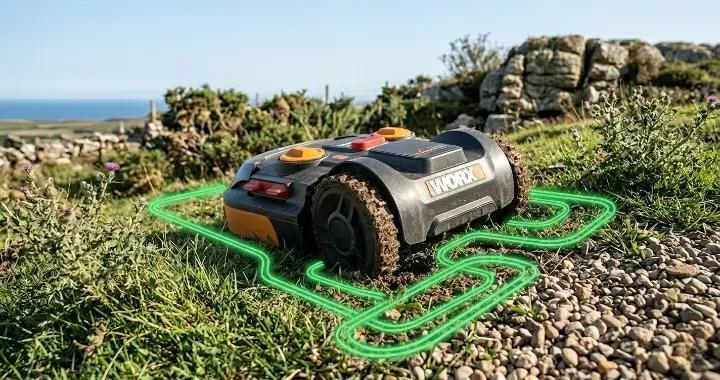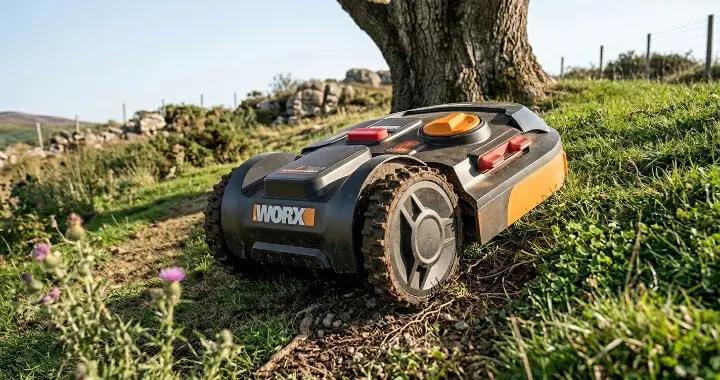

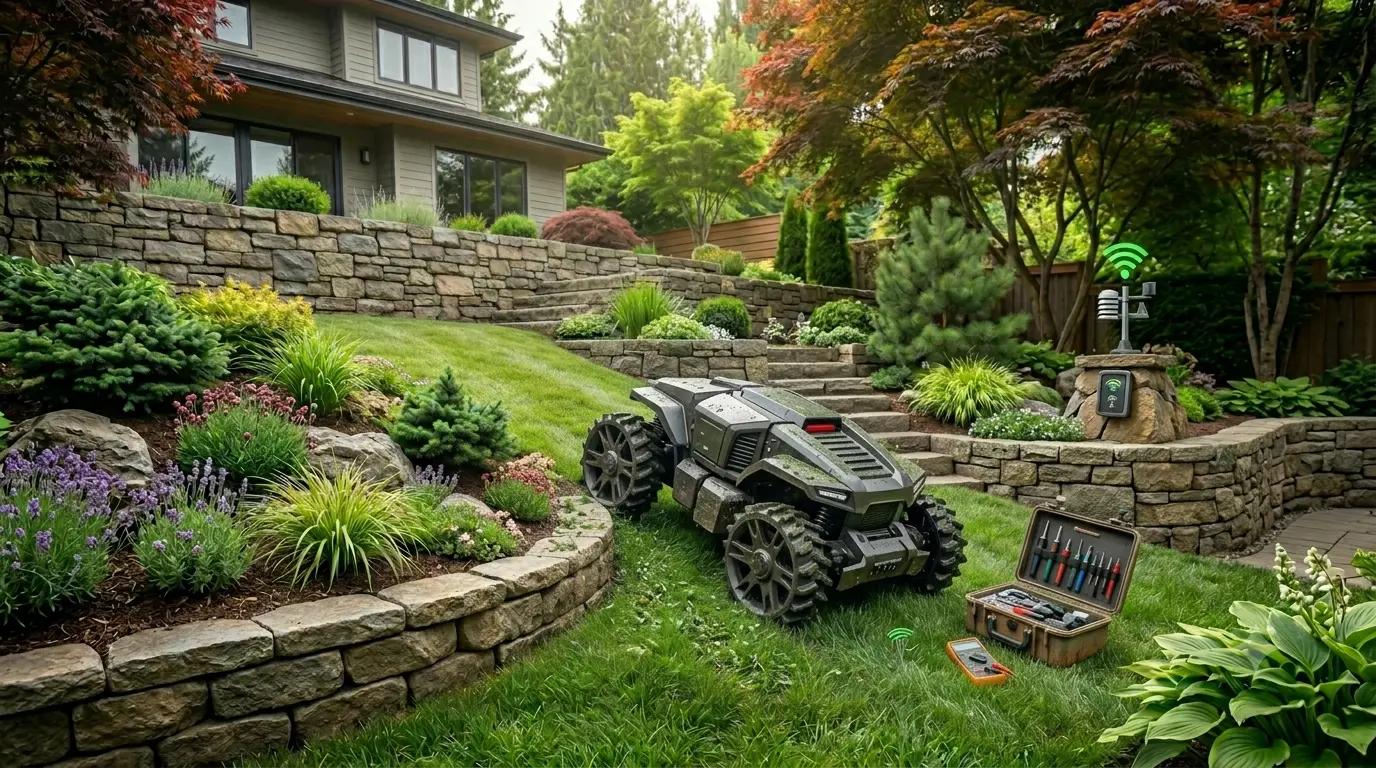
Robot mowers have become popular for keeping lawns neat without constant manual work. But if your yard has steep hills, you may wonder whether a robotic mower can handle the incline.
Slopes add a unique challenge for these machines. Even high-end models struggle with traction, navigation, and stability when the grass is steep. Many people assume that all robot mowers can handle hills, but the reality is more nuanced.
In this guide, we’ll explain what makes slopes difficult, which features matter, and which mowers are best suited for steep terrain. Real-world user experiences and manufacturer specifications are included to help you make an informed decision.
Can Robot Mowers Really Handle Steep Slopes?
Robot mowers can work on slopes, but not all models perform well on steep hills. Most standard machines are safe only on gentle inclines, typically up to about 25–35% slope.
Problems start when the incline increases. Wheels can slip, causing the mower to lose traction. The blades may cut unevenly, and navigation systems can get confused, especially if the yard has complex contours.
Real users often share their experiences online. One Reddit user noted:
“Even a 20 degree slope can cause mapping issues. On steeper hills, AWD models still struggle depending on layout.”
The takeaway is simple: slope rating is not just a number. It reflects ideal conditions, not the realities of a messy, uneven lawn. Choosing the right mower for hills means understanding the limitations of traction, navigation, and terrain design.
Why Steep Slopes Are Difficult for Robot Mowers
Steep slopes create problems for robot mowers that are not obvious at first glance. On flat lawns, most models perform smoothly. But once the ground tilts, gravity, traction, and navigation all start to interact in ways that push the machine to its limits.
The difficulty is not just about power. Even strong motors can fail on hills if the wheels cannot maintain grip or if the mower’s balance shifts during movement. This is why two mowers with similar specifications can perform very differently on real slopes.
Traction Is the Real Limiting Factor
The most important challenge on slopes is traction. Robot mowers rely on wheel grip to move forward, especially when climbing uphill. If the wheels lose contact with stable ground, the mower starts to spin or slide instead of advancing.
Wet grass makes this even worse. A slope that is manageable in dry conditions can become unstable after rain or morning dew. Some users report that even AWD models begin to struggle when the surface is slick, especially in shaded parts of the yard.
Gravity and Wheel Slip on Inclines
Gravity is constantly working against the mower on steep terrain. When going uphill, the motor must fight both the weight of the machine and the pull of the slope. This increases strain and reduces efficiency.
Going downhill creates a different issue. The mower can gain momentum too quickly, making it harder to control speed and direction. This is where wheel slip becomes more noticeable, especially during turns or when the mower tries to adjust its path.
In practice, steep lawns often require slower movement patterns and more frequent corrections from the navigation system, which can reduce overall cutting efficiency.
Terrain Transitions Cause Most Failures
One of the most overlooked problems is not the slope itself, but the transition between flat and steep areas. These transition zones create sudden changes in elevation that can confuse the mower’s balance and navigation logic.
When a mower moves from flat ground into a slope, the shift in weight distribution happens instantly. This can cause slight wheel lift, momentary slipping, or path deviation. Over time, these small errors can accumulate and lead to missed areas or uneven cutting patterns.
Yards with mixed terrain are usually more challenging than lawns that are consistently steep, because the mower must constantly adapt to changing conditions instead of maintaining a stable movement pattern.
What “Slope Rating” Actually Means (and Why It Misleads Buyers)
When you look at a robot mower’s specifications, you often see a slope rating. This number tells you the maximum incline the manufacturer claims the mower can handle. For example, a mower may list 35%, 45%, or even 70% slope capability.
But these numbers can be misleading. The rating is based on ideal conditions: dry grass, smooth terrain, minimal obstacles, and a level transition between slopes. Most real lawns don’t match these ideal conditions.
A few key factors influence how well a mower actually performs on hills:
- Grass condition: Wet or long grass reduces traction and increases slipping.
- Wheel design: Shallow treads or small wheels struggle more on steep inclines.
- Yard layout: Complex curves, steps, and uneven surfaces make climbing harder.
- Battery load: Climbing hills consumes more power, shortening runtime.
Even high-end AWD models may struggle when multiple factors combine. For example, a slope that is technically within the rated limit can still challenge the mower if the ground is wet or the incline includes abrupt transitions.
Understanding slope rating is essential. Buyers often assume a high percentage guarantees performance, but it only indicates the maximum under ideal conditions. Real-world performance depends on a combination of traction, balance, and terrain complexity.
Key Features That Matter for Hills (Buying Criteria)
Choosing a robot mower for steep slopes is not just about looking at slope ratings. Real performance depends on how the machine is built and how it handles uneven ground over time.
If your yard has hills, a few core features matter much more than brand or price alone. These are the factors that usually decide whether a mower works smoothly or struggles on inclines.
All-Wheel Drive (AWD) vs Rear-Wheel Drive
Drive system is one of the biggest differences between robot mowers designed for flat lawns and those built for hills. AWD models power all wheels, which helps distribute force more evenly when climbing or turning on slopes.
Rear-wheel drive models rely more on a single driving force at the back. On gentle lawns, this is usually fine. But on steeper terrain, rear-wheel drive can lose traction more easily, especially during uphill movement or when the grass is slightly wet.
In practice, AWD is often the difference between a mower that “tries” to climb and one that actually completes the job consistently.
Traction Wheels and Tire Design
Wheel design plays a bigger role than many buyers expect. Robot mowers don’t have large off-road tires, so grip comes from tread patterns and surface contact.
Deeper tread wheels can bite into grass and soil more effectively, helping the mower stay stable during climbs. Smoother or narrow wheels tend to slip more easily, especially on loose or damp ground.
This becomes even more important on uneven slopes where traction changes constantly as the mower moves across different patches of grass.
Weight Distribution and Low Center of Gravity
On steep lawns, stability is just as important as traction. A mower with a high center of gravity is more likely to tilt or lose balance when crossing uneven sections of a slope.
Lower, wider designs tend to stay more stable because the weight is closer to the ground. This reduces the chance of tipping and helps the mower maintain consistent contact with the surface while turning or adjusting direction.
Even small design differences can have a noticeable impact when the mower operates on continuous inclines.
Sensor Stability on Inclines
Robot mowers rely on sensors to understand their position and adjust movement. On flat ground, this is relatively simple. On slopes, the system has to constantly adjust for angle changes and traction loss.
Better models use more advanced slope detection to reduce sudden corrections or path errors. This helps prevent drifting or overcompensation when the mower encounters uneven ground.
When sensor stability is weak, the mower may appear uncertain on hills, leading to repeated adjustments or inefficient cutting paths.
Real-World Problems Reported by Users
Even the best robot mowers face challenges on steep slopes. While manufacturer specifications look impressive on paper, real users often notice issues that only appear during regular lawn maintenance.
By looking at forums and Reddit discussions, a few common problems stand out. Understanding these experiences can help you choose the right mower and set realistic expectations.
Slipping on Wet Grass
One of the most frequent complaints is wheel slip on damp or dewy grass. Even advanced AWD models can lose traction, especially on angles steeper than their ideal rating.
A Reddit user shared their experience with the Husqvarna 435X AWD:
“We have steep inclines and I have the 435X AWD. It handled them fine most of the time, but after heavy rain, it slipped a few times on the upper slope.”
This shows that wet conditions are still a limiting factor, regardless of slope rating or drive system.
Steep Slopes
View DiscussionNavigation and Mapping Errors on Slopes
Navigation is another area where steep lawns challenge robot mowers. Mowers that rely on mapping or GPS can miscalculate their position when moving across inclines. This sometimes leads to missed areas or inefficient paths.
For example, a Reddit user trying the LUBA 2 AWD reported:
“When using the mapped schedule on a slope, even a 15-degree hill caused the mower to drift off course. Manual adjustment with the remote was needed.”
Steep Slopes
View DiscussionThis highlights that even models rated for high slopes may need supervision in complex terrain.
Getting Stuck in Transition Zones
Slopes are not the only problem. Users often encounter difficulties at transition points where flat areas meet steep sections. Small dips or sudden changes in elevation can cause the mower to stall or get temporarily stuck.
These issues are less about the mower’s raw power and more about weight distribution and wheel contact. Consistent mowing patterns can help, but they don’t eliminate the problem entirely.
Battery Drain on Hills
Climbing hills uses more energy than mowing flat sections. Users note that on steep lawns, battery life can be noticeably shorter.
This means the mower may need more frequent recharging, which can extend total mowing time. Planning your mowing schedule with slope-related energy consumption in mind can prevent unexpected interruptions.
Best Robot Mowers for Steep Slopes (2026)
Not all robot mowers are built for hills, but a few models consistently perform well on steep lawns. Based on slope capability, traction, and real-world user experiences, the following mowers are the top choices for 2026.
Husqvarna Automower 435X AWD – Best Overall
The Husqvarna 435X AWD is widely recognized for its stability on slopes. Its all-wheel drive system distributes power evenly, allowing it to handle inclines up to 35 degrees without losing traction.
Real users report that the mower climbs hills reliably while maintaining a clean, even cut. One Reddit user mentioned that it handled steep sections of their yard with minimal slipping, even on damp grass. Its navigation system adjusts smoothly to changing terrain, which makes it a strong choice for hilly properties.
Steep Slopes
View DiscussionHusqvarna Automower 535 AWD – Best for Large Properties
For larger lawns, the 535 AWD provides a wider cutting range and longer battery life. Like the 435X, it features all-wheel drive and a low center of gravity, which helps with both uphill climbs and stability on transitions between flat and steep areas.
This model excels when the yard has complex contours or multiple slopes. Users appreciate its ability to mow continuously with fewer interruptions, reducing the need for manual intervention.
Mammotion LUBA 2 AWD – High Slope Alternative
The Mammotion LUBA 2 AWD is designed specifically for steep terrain. Rated for slopes up to 38 degrees, it uses powerful traction and AWD to tackle challenging hills.
Some users report that while it can handle very steep inclines, it may require remote adjustments on unusually uneven ground. Still, it offers a strong alternative for lawns where high slope performance is the priority over brand familiarity.
Sunseeker Elite X7 – Mid-Range AWD Option
The Sunseeker Elite X7 offers a balance between affordability and slope capability. It handles moderately steep inclines with consistent traction and comes with standard sensors that help it navigate transitions.
It’s a good choice for users who want AWD performance without investing in premium Husqvarna models. While it may not match the 435X on very steep hills, it covers most residential inclines reliably.
LUBA Mini AWD – Small Yard Hills
For compact lawns with hills, the LUBA Mini AWD provides sufficient slope handling without taking up much space. Its small footprint and AWD system allow it to climb short but steep sections efficiently.
This model is ideal for backyards or side yards where full-sized machines might be overkill. Users note that it completes the job well, though it is best suited for smaller plots rather than extensive, hilly properties.
Husqvarna vs Other Brands for Steep Slopes
Husqvarna has long been the go-to brand for robot mowers that handle hills. Their AWD models, like the 435X and 535, combine traction, weight distribution, and stable navigation to tackle slopes reliably. Users often cite Husqvarna for consistent performance on inclines up to 35 degrees, which is suitable for most residential hills.
Other brands offer alternatives, but performance varies. Mammotion’s LUBA 2 AWD, for example, can handle even steeper inclines in theory, but some users report occasional navigation issues on uneven terrain. The mower’s hardware is capable, but software or mapping limitations can require manual adjustments.
Mid-range brands such as Sunseeker provide decent AWD options for moderate slopes. They cover most yards effectively, but they may not perform as consistently on very steep or complex terrain compared to Husqvarna models.
In practice, if your primary concern is stability and minimal intervention on hilly lawns, Husqvarna remains the most reliable choice. Other brands can be suitable depending on budget, slope severity, and willingness to supervise or manually correct the mower in tricky areas.
Should You Use a Robot Mower on a 45° Slope?
A 45-degree slope is extremely steep for most robot mowers. Even the highest-rated AWD models may struggle to maintain traction or navigate efficiently on such an incline.
Some users attempt it, but success depends heavily on yard layout. If the slope is continuous without transitions or obstacles, and the grass is short and dry, an AWD mower might manage a few passes. In most cases, however, the mower will need supervision or manual adjustments.
For very steep hills, traditional solutions such as ride-on mowers or hiring professional lawn care may be safer and more reliable. Robot mowers excel at moderate slopes, but extreme inclines push them beyond their intended design.
The key takeaway is to understand your yard and mower limitations. A slope that exceeds the mower’s rated capability is likely to cause slipping, uneven cutting, or repeated interruptions. Setting realistic expectations prevents frustration and potential damage to the mower.
Conclusion
Steep slopes present real challenges for robot mowers, from traction and stability to navigation and battery use. Understanding slope ratings, sensor performance, and AWD capabilities is crucial when choosing a mower for hilly lawns.
Husqvarna models like the 435X and 535 AWD consistently perform well on most residential hills, while alternatives like Mammotion LUBA 2 AWD or Sunseeker models can work under certain conditions but may require more supervision.
Ultimately, the right mower depends on your yard’s slope, terrain complexity, and willingness to monitor performance. By considering features, user experiences, and real-world limitations, you can select a mower that keeps your hilly lawn maintained safely and efficiently.