
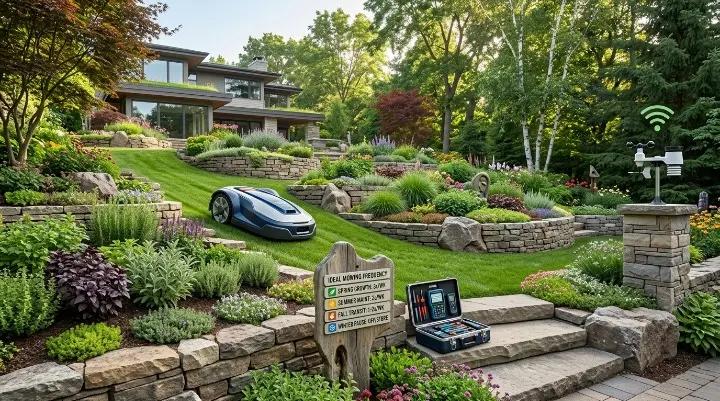
Robotic lawn mowers are designed to work differently from traditional lawn mowers. Instead of cutting a large amount of grass once a week, they trim a small amount more frequently to keep your lawn at a consistent height.
For most lawns, a robotic mower should run between 3 and 7 days per week during the growing season. Fast-growing grass in spring may require daily mowing, while slower growth in summer or fall may only need a few mowing sessions each week.
However, there is no single schedule that works for every yard.
Grass type, weather conditions, lawn size, and mower capacity all affect how often your robot mower should run. A schedule that works perfectly for a small Kentucky bluegrass lawn may not be enough for a large Bermuda grass lawn during peak growing season.
In this guide, we'll explain the ideal mowing frequency for different conditions, how many hours your mower should run, and how to adjust your schedule throughout the year for the best-looking lawn.
The Short Answer: How Often Should a Robotic Mower Mow?
If you want a quick answer, the table below is a good starting point.
| Grass Growth Rate | Recommended Mowing Frequency |
|---|---|
| Slow growth | 2–3 days per week |
| Moderate growth | 4–5 days per week |
| Fast growth | 6–7 days per week |
| Peak spring growth | Daily mowing may be needed |
For many homeowners, running a robotic mower every day sounds excessive. In reality, frequent mowing is exactly how these machines are designed to work.
Unlike traditional mowers that may remove several inches of grass at once, robotic mowers trim only a small amount during each pass. This helps maintain a cleaner appearance and reduces stress on the lawn.
The ideal schedule also changes throughout the year. During spring, grass often grows so quickly that daily mowing produces the best results. By late summer, growth usually slows down, allowing many homeowners to reduce mowing frequency without sacrificing lawn quality.
The goal is not to keep the robot moving as much as possible. The goal is to remove small amounts of grass before it becomes too tall.
If your lawn always looks freshly cut and the mower is not struggling to keep up with growth, your schedule is probably close to ideal.
Why Robot Mowers Need More Frequent Mowing Than Traditional Mowers
Many first-time owners make the mistake of treating a robotic mower like a conventional lawn mower.
With a traditional mower, the typical routine is simple: wait until the grass gets taller, then mow once a week. The machine removes a significant portion of the grass blade in a single session.
Robotic mowers follow a completely different approach.
They are designed around the concept of "little and often." Instead of cutting a lot of grass at once, they continuously trim tiny amounts throughout the week.
This approach offers several advantages.
First, the grass clippings are so small that they naturally fall back into the lawn. These fine clippings break down quickly and return nutrients to the soil, a process often called grasscycling.
Second, frequent trimming helps maintain a more consistent lawn height. Rather than seeing visible growth between weekly mowing sessions, the lawn stays neat almost every day.
Frequent mowing can also reduce stress on the grass. Lawn care experts often recommend following the one-third rule, which means removing no more than one-third of the grass blade during a single mowing session. Because robotic mowers cut so often, they naturally stay within this guideline most of the time.
Real-world owner experiences reflect this approach as well. In robot mower communities, many owners report running their machines daily during periods of rapid growth to keep the lawn looking consistently maintained. Others reduce mowing frequency later in the season when growth slows down.
That doesn't mean every robotic mower should operate 24 hours a day or seven days a week. Modern RTK and systematic mowing models are often more efficient than older random-navigation machines and may need fewer operating hours to achieve the same result.
The key principle remains the same: robotic mowers work best when they prevent grass from getting too tall, rather than trying to catch up after excessive growth.
The Best Robot Mower Schedule by Season
One of the biggest scheduling mistakes homeowners make is using the same mowing schedule all year.
Grass growth changes dramatically throughout the seasons. A schedule that works perfectly in July may not be enough in April, while a spring schedule may be excessive during a summer drought.
Adjusting your robot mower schedule a few times each year can improve lawn quality while reducing unnecessary wear on the mower and battery.
Spring
Spring is usually when grass grows the fastest.
Warmer temperatures, longer daylight hours, and frequent rainfall create ideal growing conditions for many cool-season and warm-season grasses. During this period, most robotic mowers need to run more often to keep up.
For many lawns, running the mower 6–7 days per week during spring produces the best results.
If you notice visible growth between mowing sessions or the mower starts leaving taller patches behind, increase the schedule before the grass gets out of control.
A robot mower performs best when it trims a little every day rather than trying to recover from several days of rapid growth.
Summer
Summer schedules depend heavily on weather conditions.
In areas that receive regular rainfall or irrigation, grass may continue growing quickly and require frequent mowing. In hotter and drier regions, growth often slows significantly.
For most lawns, 3–6 mowing days per week is sufficient during summer.
This is also a good time to monitor lawn stress. If the grass appears dry or dormant, reducing mowing frequency slightly may be beneficial.
Many robotic mower owners also prefer daytime mowing during summer because morning dew has evaporated and visibility systems on camera-equipped models perform better in brighter conditions.
Fall
As temperatures begin to cool, lawn growth gradually slows.
Most homeowners can reduce mowing frequency while still maintaining a clean appearance. The lawn is no longer growing aggressively, so the mower spends less time trimming new growth and more time maintaining an already healthy lawn.
For many yards, 2–4 mowing days per week is enough during fall.
However, don't stop mowing too early. Grass often continues growing longer than many people expect, especially in regions with mild autumn weather.
Winter
In many parts of the United States, robotic mowers can take a well-deserved break during winter.
Cool temperatures and reduced daylight hours slow growth dramatically, and many warm-season grasses enter dormancy altogether.
For most homeowners, regular mowing is unnecessary during winter.
In warmer climates, occasional mowing may still be needed if grass continues growing, but schedules are usually much lighter than during the rest of the year.
If your lawn has stopped growing, storing the mower according to the manufacturer's recommendations is often the best option until spring returns.
How Many Hours Per Day Should a Robot Mower Run?
Mowing frequency is only part of the equation.
A robotic mower may run every day, but if it doesn't spend enough time on the lawn, it can still fall behind. Likewise, running excessively long schedules may waste battery cycles without improving results.
The ideal runtime depends on lawn size, grass growth rate, terrain complexity, and the efficiency of your mower.
As a general guideline, most homeowners can start with the following ranges:
| Lawn Size | Typical Daily Runtime |
|---|---|
| Up to 0.1 acre | 2–4 hours |
| 0.1–0.25 acre | 4–8 hours |
| 0.25–0.5 acre | 8–12 hours |
| 0.5–1 acre | 12–24 hours |
| Over 1 acre | Depends on mower capacity and zone setup |
These numbers are only starting points.
A modern RTK mower that follows systematic mowing patterns can often finish a lawn much faster than an older random-navigation model. Two mowers covering the same yard may require very different runtimes depending on how efficiently they navigate.
Instead of focusing on a specific number of hours, pay attention to the condition of the lawn.
If the grass consistently stays at the desired height and the mower is not leaving uncut areas, the schedule is likely sufficient.
On the other hand, if you notice taller patches appearing between mowing sessions, the mower probably needs either more runtime or more mowing days each week.
Many newer robotic mowers also include smart scheduling features that automatically adjust operating time based on grass growth. Systems such as weather-based scheduling can reduce runtime during dry periods and increase mowing activity when growth accelerates after rainfall.
In practice, the best schedule is usually the shortest one that keeps the lawn looking consistently maintained. A robot mower should spend enough time cutting grass, but not so much time that it is unnecessarily driving around the yard.
What Actually Determines Mowing Frequency?
While seasonal guidelines are helpful, no two lawns grow at exactly the same rate.
That's why the ideal mowing schedule depends on several factors working together. If your neighbor's robot mower runs every day, that doesn't necessarily mean yours should too.
Grass Type
Some grass types grow much faster than others.
For example, Bermuda grass can grow aggressively during warm weather and may require daily mowing in peak season. Kentucky bluegrass and perennial ryegrass also grow quickly during spring when temperatures and moisture levels are ideal.
Other grass types grow more slowly and can often maintain a neat appearance with fewer mowing sessions each week.
If you're unsure what type of grass you have, observe how quickly it recovers after mowing. Fast-growing lawns generally benefit from more frequent robotic mowing.
Weather Conditions
Weather may have a bigger impact on mowing frequency than any other factor.
A week of warm temperatures and regular rainfall can dramatically increase grass growth. During these periods, many homeowners need to increase mowing frequency to keep up.
On the other hand, growth often slows during droughts, extreme heat, or extended dry periods.
This is why a schedule that worked perfectly in April may feel excessive by August.
Many modern robotic mowers can automatically adjust schedules based on weather conditions, reducing unnecessary mowing when growth slows down.
Lawn Size and Layout
Larger lawns naturally require more mowing time.
However, lawn complexity is just as important as total size. Narrow passages, multiple mowing zones, slopes, trees, and landscaped areas can all increase the amount of time needed to maintain the lawn.
A simple 5,000-square-foot lawn may be easier to maintain than a smaller yard divided into several separate sections.
If your mower regularly struggles to complete coverage, increasing runtime is often more effective than simply adding extra mowing days.
Mower Capacity and Navigation Technology
Not all robotic mowers work at the same speed.
Older boundary-wire models that use random navigation patterns often require longer operating times to cover the same area. Newer RTK and systematic mowing models follow planned routes and can finish much faster.
For example, a modern RTK mower may complete a lawn in a fraction of the time required by an older random-pattern mower.
This is one reason why two homeowners with similar-sized lawns may use completely different schedules and still achieve excellent results.
Real-World Robot Mower Schedules From Owners
Manufacturer recommendations provide a useful starting point, but real-world schedules often show how robotic mowers are used in everyday conditions.
One Husqvarna owner reported running their mower every night during spring when grass growth was at its fastest, then reducing mowing to about four days per week later in the summer as growth slowed.
Another owner with an 8,000-square-foot lawn divided into three mowing zones schedules mowing six days per week, allowing each zone to be cut twice weekly. This approach helps maintain a consistent appearance while avoiding unnecessary runtime.
Not every homeowner chooses daily mowing. Several users reported successful schedules of three mowing days per week, such as Monday, Wednesday, and Friday. These schedules often work well when grass growth is moderate and the mower can comfortably keep up with demand.
Interestingly, many experienced owners focus less on the exact schedule and more on the results. If the lawn always looks freshly cut and the mower is not falling behind, the schedule is usually doing its job.
Newbie question: How often do you run your mower?
View DiscussionThese examples highlight an important point: there is no universal robot mower schedule.
The best setup depends on your lawn, your grass, your climate, and how tidy you want the lawn to look throughout the week.
Can a Robot Mower Mow Every Day?
Yes. In fact, many robotic mowers are designed to mow every day.
This is one of the biggest differences between robotic mowing and traditional mowing.
A conventional mower removes a large amount of grass in a single session. A robotic mower removes only a small amount during each pass, so daily mowing is often completely normal.
For fast-growing lawns, daily mowing can actually produce healthier results because the mower is trimming tiny amounts of growth instead of removing large sections of the grass blade.
Daily mowing also helps maintain the consistent "freshly cut" appearance that many robot mower owners enjoy.
However, daily mowing isn't always necessary.
If grass growth is slow, the mower may spend much of its time driving around without cutting very much. In these situations, reducing mowing frequency can save battery cycles and reduce wear on moving parts without affecting lawn quality.
The key is to match the schedule to grass growth rather than following a fixed rule.
Some homeowners worry that daily mowing could damage the lawn. Under normal conditions, this is rarely a problem as long as the cutting height is appropriate and the mower is not creating excessive wheel traffic in the same areas.
Modern RTK and systematic mowing models can further reduce this concern by varying routes and mowing patterns throughout the week.
A good rule of thumb is simple: if the mower is only trimming a small amount of grass each time and the lawn remains healthy, daily mowing is perfectly acceptable.
For many lawns during peak spring growth, it may even be the ideal schedule.
Common Robot Mower Scheduling Mistakes
Even the best robotic mower can struggle if the schedule isn't set correctly.
The good news is that most scheduling problems are easy to fix once you know what to look for.
Using the Same Schedule All Year
Grass doesn't grow at the same rate every month.
Many homeowners create a schedule in spring and never adjust it. As growth speeds up or slows down throughout the year, the mower may end up working too little or too much.
Reviewing your schedule a few times each season can help keep mowing efficient and maintain a healthier lawn.
Running Too Few Hours During Peak Growth
Spring is when many robotic mowers fall behind.
Grass can grow surprisingly fast after periods of rain and warm weather. If the mower doesn't have enough runtime, taller patches may begin appearing across the lawn.
When this happens, increasing runtime is often more effective than lowering the cutting height.
Mowing Wet Grass Too Often
Most robotic mowers can operate in damp conditions, but that doesn't mean they always should.
Wet grass tends to clump together, stick to mower components, and create a less consistent cut. It can also increase wheel slip on slopes and soft ground.
If your mower includes weather-based scheduling, enabling this feature can help avoid unnecessary mowing during poor conditions.
Ignoring Lawn Growth Instead of Following Results
Some owners become overly focused on schedules.
A mower running five days per week is not automatically better than one running three days per week.
The lawn itself should determine the schedule.
If the grass stays healthy, evenly cut, and consistently maintained, the schedule is working. If the mower is struggling to keep up, adjustments are needed regardless of what the calendar says.
Recommended Robot Mowers With Smart Scheduling Features
Modern robotic mowers do much more than follow a simple timer.
Many models can adjust mowing activity based on lawn size, weather conditions, growth patterns, and zone requirements. These features help reduce guesswork and make scheduling easier for homeowners.
Lymow
Lymow is designed for homeowners who need strong coverage, efficient navigation, and flexible scheduling options.
Its systematic mowing approach allows the mower to cover large areas efficiently rather than relying on random movement patterns. This often means fewer operating hours are needed to achieve the same results.
For lawns with varying growth rates throughout the season, smart scheduling tools can help maintain consistent grass height without requiring constant manual adjustments.
Lymow may be particularly appealing for larger properties where runtime efficiency becomes increasingly important.
Husqvarna
Husqvarna has been one of the most established names in robotic mowing for many years.
Many Automower models include features such as Weather Timer, which automatically adjusts mowing activity based on grass growth conditions. During periods of slower growth, the mower can reduce operating time, helping minimize unnecessary wear.
The Automower Connect app also allows homeowners to modify schedules remotely, making seasonal adjustments quick and convenient.
For users who want a proven scheduling system backed by years of development, Husqvarna remains one of the strongest options available.
Final Verdict
So, how often should a robotic mower mow?
For most lawns, the ideal schedule falls somewhere between 3 and 7 days per week, depending on grass growth, weather conditions, lawn size, and mower capacity.
During peak spring growth, daily mowing is often the best way to maintain a clean, healthy lawn. As growth slows in summer and fall, many homeowners can reduce mowing frequency without sacrificing appearance.
Rather than focusing on a fixed schedule, pay attention to how your lawn responds.
If the grass stays evenly cut, the mower keeps up with growth, and the lawn consistently looks freshly maintained, you've likely found the right balance.
The best robot mower schedule isn't necessarily the one that runs the longest—it's the one that keeps your lawn looking great with the least amount of effort.