
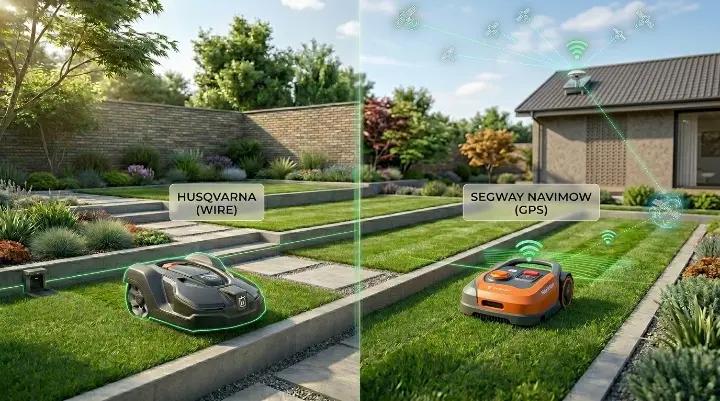
If you're shopping for a robot lawn mower in 2026, two names will likely appear at the top of your list: Husqvarna Automower and Segway Navimow.
Both brands offer wire-free robotic mowing, smartphone control, GPS navigation, and the ability to maintain large lawns with minimal effort. However, they take very different approaches to solving the same problem.
Husqvarna is the established industry leader with nearly three decades of robotic mowing experience. Its latest Automower NERA and EPOS models focus on reliability, dealer support, and proven long-term performance. Segway Navimow, on the other hand, is one of the fastest-growing newcomers in the category, attracting homeowners with advanced RTK navigation, AI-powered obstacle avoidance, and competitive pricing.
So which one is actually better?
The answer depends on your lawn, your budget, and how much technology you want involved in the mowing process. Some homeowners prioritize long-term reliability and dealer support. Others want the latest smart features, camera-based navigation, and a fully wireless setup.
In this guide, we'll compare Husqvarna and Segway Navimow across navigation technology, installation, mowing performance, reliability, owner feedback, and overall value to help you decide which robot mower is the better investment for your yard.
For most homeowners who prioritize reliability, dealer support, and long-term ownership, Husqvarna Automower remains the safer choice.
For homeowners who want a fully wireless setup, advanced obstacle avoidance, and more technology for the money, Segway Navimow offers outstanding value.
Choose Husqvarna if:
- You want a proven robot mower platform with years of real-world reliability.
- Your property is large, complex, or includes challenging terrain.
- Local dealer support and spare parts availability matter to you.
- You plan to keep the mower for many years.
Choose Segway Navimow if:
- You want to avoid perimeter wire installation entirely.
- Your lawn contains toys, pets, landscaping features, or other obstacles.
- You enjoy smart technology and app-based customization.
- You want premium wireless navigation at a lower price point.
Quick Summary
| Category | Winner |
|---|---|
| Reliability & Longevity | Husqvarna |
| Dealer Network & Support | Husqvarna |
| Wireless Navigation | Segway Navimow |
| Obstacle Avoidance | Segway Navimow |
| Ease of Installation | Segway Navimow |
| Value for Money | Segway Navimow |
| Large Property Management | Husqvarna |
| Overall Premium Ownership Experience | Husqvarna |
The biggest difference is philosophy.
Husqvarna focuses on dependable mowing performance backed by decades of robotic lawn care experience. Segway focuses on modern technology, automation, and user-friendly wireless operation.
Neither is objectively better for every homeowner. Husqvarna is often the better long-term investment, while Segway is often the more exciting and feature-rich choice today.
Husqvarna vs Segway Navimow at a Glance
Before diving into the details, here's a high-level comparison of what each brand does best.
While both companies now offer wire-free robot lawn mowers using RTK satellite positioning, they target slightly different types of homeowners.
Husqvarna focuses on reliability, dealer support, and proven mowing performance. Segway Navimow focuses on technology, convenience, and advanced automation features.
| Feature | Husqvarna Automower | Segway Navimow |
|---|---|---|
| Brand Experience | Nearly 30 years in robotic mowing | Newer entrant backed by Segway |
| Navigation System | Boundary wire, EPOS RTK, or hybrid options depending on model | RTK GPS + VisionFence camera system |
| Installation | More setup options, including dealer installation | DIY-friendly wireless setup |
| Obstacle Avoidance | Basic to moderate depending on model | Excellent camera-assisted obstacle detection |
| Lawn Complexity | Excellent for large and complex properties | Best for open and moderately complex lawns |
| Slope Performance | Excellent, especially AWD models | Very good on most residential slopes |
| App Experience | Functional but sometimes less polished | Modern and feature-rich |
| Dealer Network | Extensive worldwide support network | Growing but still limited in some regions |
| Spare Parts Availability | Excellent | Improving but more limited |
| Long-Term Reliability | Proven track record | Promising but less established |
| Value for Money | Premium pricing | Strong value proposition |
| Best For | Owners prioritizing reliability and support | Owners prioritizing technology and convenience |
The Core Difference
If you had to summarize the comparison in one sentence, it would be this:
Husqvarna is the safer long-term investment, while Segway Navimow is the more technology-focused choice.
Husqvarna has spent decades refining robotic mowing systems and has one of the largest dealer and service networks in the industry. Many owners report using Automowers for five to ten years with relatively minor maintenance.
Segway Navimow takes a different approach. Instead of relying on years of mower heritage, it focuses on modern navigation technology, AI-assisted obstacle avoidance, wireless installation, and a highly user-friendly app experience.
For homeowners upgrading from traditional perimeter-wire systems, Navimow often feels like the future. For homeowners who simply want a mower that quietly works year after year, Husqvarna still sets the benchmark.
The rest of this comparison will help determine which approach makes the most sense for your lawn and your budget.
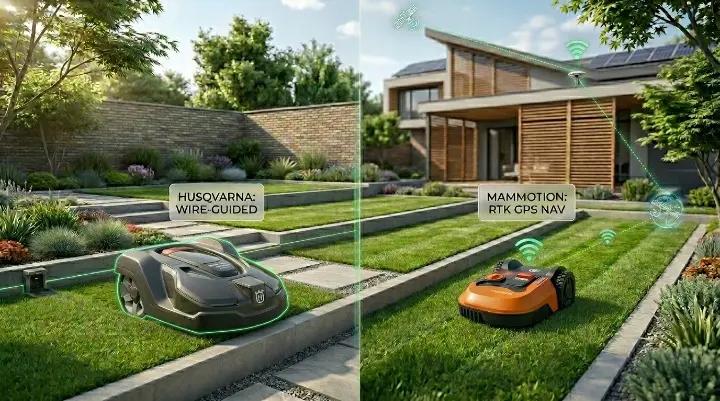
The Biggest Difference: Boundary Wire Heritage vs Wire-Free Design
If there is one factor that separates Husqvarna and Segway Navimow more than anything else, it's their approach to navigation.
For years, Husqvarna built its reputation around perimeter-wire technology. Millions of Automowers worldwide have relied on boundary wires buried around the lawn to define mowing areas and keep the robot on course.
Segway Navimow arrived much later and skipped that entire phase of robot mower evolution. From the beginning, Navimow focused on wire-free navigation using RTK GPS and vision-based positioning.
Today, both brands offer wireless mowing solutions, but their philosophies remain very different.
Husqvarna: Evolution from Wire to Wireless
Husqvarna's biggest advantage is flexibility.
Depending on the model, homeowners can choose:
- Traditional boundary wire installation
- Wireless EPOS (Exact Positioning Operating System)
- Hybrid solutions in certain situations
This matters because no navigation system is perfect in every yard.
If your property has dense tree cover, narrow passages, tall hedges, or areas with weak satellite visibility, a boundary-wire installation can sometimes provide more predictable performance than a fully GPS-dependent setup.
Newer Automower NERA and EPOS models have embraced wireless technology, but Husqvarna still approaches navigation from the perspective of reliability first.
The company's philosophy is simple:
The mower should finish the job even when conditions are difficult.
Segway Navimow: Designed for a Wireless World
Segway took the opposite approach.
Instead of evolving from boundary wires, Navimow was built around wire-free mowing from the start.
The system combines:
- RTK satellite positioning
- GPS correction signals
- VisionFence camera technology
- AI-assisted obstacle recognition
For homeowners, this creates a much simpler setup experience.
Instead of burying hundreds of feet of wire, you create virtual boundaries through the app. If you redesign a flower bed, add a play area, or create a temporary no-go zone, adjustments can be made in minutes.
This flexibility is one of the biggest reasons many first-time robot mower buyers are drawn to Navimow.
Which System Is Better?
The answer depends on your lawn.
For open yards with good satellite visibility, both systems perform extremely well. Most homeowners would struggle to notice a significant difference in daily mowing quality.
However, challenging environments often reveal the strengths of each approach.
Husqvarna's long experience with navigation systems gives it an advantage in difficult conditions. Large properties, complex layouts, and areas with intermittent GPS reception are situations where many experienced robot mower owners continue to trust Husqvarna.
Segway's strength is simplicity. Homeowners who want a modern, cable-free experience often find Navimow easier to install, easier to modify, and easier to live with day-to-day.
Interestingly, many discussions on Reddit and robot mower forums follow the same pattern:
- Owners frustrated with boundary wire breaks often move toward Navimow.
- Owners frustrated by GPS or software issues often move toward Husqvarna.
Both groups are solving different problems.
Bottom Line
Husqvarna's navigation system is built on decades of real-world robotic mowing experience and prioritizes reliability above everything else.
Segway Navimow is built around the idea that robotic mowing should be completely wireless, easy to configure, and adaptable as your yard changes.
If you want maximum flexibility and a modern setup experience, Segway has the advantage.
If you want the reassurance of a navigation system backed by nearly 30 years of robotic mowing development, Husqvarna still holds a strong edge.
Installation and Setup
For many homeowners, installation is the point where the difference between Husqvarna and Segway Navimow becomes most obvious.
A robot mower can save hundreds of hours of lawn care over its lifetime, but first you have to get it running properly. The amount of effort required varies significantly between these two brands.
Segway Navimow: The Easier DIY Experience
Segway Navimow was designed with first-time robot mower owners in mind.
The typical setup process looks like this:
- Place the charging station.
- Install the RTK antenna.
- Connect the mower through the app.
- Drive the mower around the lawn to create virtual boundaries.
- Start mowing.
For many homeowners, the entire process can be completed in a few hours.
The biggest advantage is flexibility. If you add a flower bed, build a patio, install a swing set, or reseed part of the lawn, you can simply update the map in the app instead of modifying physical wires.
Many owners report that creating virtual zones and no-go areas is one of the most satisfying parts of owning a wireless mower.
For technology-oriented users, Navimow's setup process feels modern and intuitive.
Husqvarna: More Options, More Complexity
Installation depends heavily on which Husqvarna model you choose.
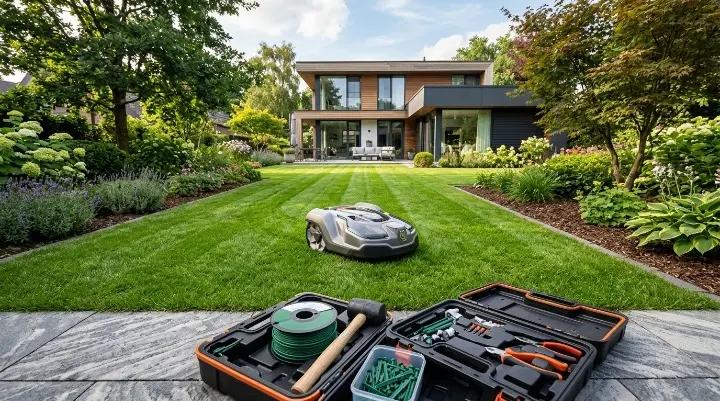
Traditional Automower models using perimeter wire require significantly more work.
You may need to:
- Lay or bury boundary wire around the lawn
- Install guide wires
- Configure charging station locations
- Adjust wire placement around obstacles
For larger properties, installation can take a full weekend or longer.
However, newer Husqvarna NERA and EPOS models are much closer to the Navimow experience.
Instead of boundary wires, EPOS models use virtual boundaries and RTK positioning. Mapping is performed through the app, and changes can be made digitally without digging up wire.
The result is a setup experience that is far easier than older Automower systems.
The Hidden Factor: Long-Term Adjustments
Many comparison articles focus only on the initial installation.
In reality, the more important question is:
How easy is it to make changes later?
This is where wireless systems shine.
Suppose you:
- Add a new garden bed
- Install a trampoline
- Create a dog area
- Overseed part of the lawn
- Build a new walkway
With a wireless mower, these changes can usually be handled in minutes through the app.
With a wired system, modifications often require physically relocating boundary wire.
This is one reason many long-time robot mower owners have become enthusiastic supporters of RTK-based systems.
Potential Setup Challenges
Neither system is completely foolproof.
Segway Navimow relies heavily on satellite visibility. Properties with dense tree cover, narrow side yards, or areas between large buildings can sometimes require additional tuning to achieve optimal positioning.
Husqvarna EPOS models can encounter similar RTK-related challenges, although the company has years of experience refining navigation in difficult environments.
Traditional wired Automowers avoid many GPS-related issues entirely, but they introduce their own challenge: boundary wire installation and occasional wire repairs.
Several robot mower owners who switched from wired systems specifically cite boundary wire breaks as one of the main reasons they moved to wireless technology.
Installation Winner
For most homeowners in 2026, Segway Navimow wins the installation category.
The wireless setup process is straightforward, beginner-friendly, and highly flexible when lawn layouts change.
However, Husqvarna deserves credit for giving buyers more choices. If your property presents challenges for RTK navigation, the ability to choose between wire-based and wireless solutions can be a significant advantage.
Winner: Segway Navimow
If your goal is the fastest path from unboxing to autonomous mowing, Navimow currently offers one of the easiest setup experiences in the robot mower market.
Navigation and Obstacle Avoidance
Navigation is where Husqvarna and Segway Navimow feel like they belong to two different generations of robot lawn mower design, even though both now operate in a wire-free world on newer models.
At a high level, both systems can map a lawn, follow efficient mowing patterns, and return to charge automatically. The real difference is how they understand space and how they react to unexpected objects in the yard.
Husqvarna: Precision Through Proven Positioning Systems
Husqvarna’s navigation philosophy is built around reliability and controlled movement.
Depending on the model, navigation may rely on:
- Boundary wire guidance (in traditional models)
- EPOS RTK satellite positioning (in newer models)
- Systematic mowing patterns optimized over time
With EPOS-enabled Automowers, the mower follows virtual boundaries with high positional accuracy. It tends to move in structured patterns, covering the lawn methodically rather than randomly.
This approach has a major advantage: consistency.
Husqvarna mowers are designed to finish the job even in less-than-ideal conditions, such as uneven terrain, complex yard shapes, or partially obstructed satellite signals.
However, obstacle avoidance is generally more conservative. The mower may bump into objects lightly or avoid them with a safety buffer, depending on the model and sensor configuration. While reliable, it is not always as reactive or “intelligent” in real time as newer camera-based systems.
Segway Navimow: Camera + AI + RTK Fusion
Segway Navimow takes a more modern, perception-driven approach to navigation.
Instead of relying solely on positioning data, Navimow combines:
- RTK GPS for precise location tracking
- VisionFence camera system for object recognition
- AI-based path planning for dynamic adjustment
This allows the mower to “see” its environment to some extent, rather than simply follow coordinates.
In practice, this changes how it behaves around obstacles:
- It can detect toys, pets, and garden objects more proactively
- It adjusts its path dynamically instead of relying only on bump-and-turn logic
- It can avoid smaller objects that GPS-only systems might miss
For families with children, pets, or frequently changing garden setups, this can be a meaningful advantage.
However, the trade-off is complexity. Vision-based systems are improving quickly, but they still depend on lighting conditions, object size, and software tuning. Some edge cases—like small items or low-contrast objects—can still challenge detection.
Real-World Behavior Difference
In everyday use, the contrast becomes clearer:
Husqvarna behaves like a highly disciplined mower. It follows structured logic, stays within defined boundaries, and prioritizes completing the mowing cycle reliably.
Segway Navimow behaves more like a “smart assistant.” It adapts to what is happening in the yard, adjusts around obstacles more actively, and feels more interactive in how it navigates.
Neither approach is strictly better—they are optimized for different priorities.
Which One Is Safer Around Obstacles?
Safety depends on what you mean by “safe.”
- If you want predictable behavior and proven long-term reliability, Husqvarna’s system is extremely stable.
- If you want proactive object avoidance and smarter real-time responses, Segway Navimow has the advantage.
In practical terms:
- Husqvarna is less likely to misinterpret unusual environments.
- Segway is less likely to physically contact unexpected objects.
Navigation Winner
- Husqvarna wins on navigation reliability and consistency
- Segway Navimow wins on obstacle avoidance and real-time adaptability
For most modern homeowners, obstacle avoidance is becoming increasingly important, especially in active family yards. This is one area where Segway has clearly pushed the category forward, while Husqvarna continues to rely on its long-established precision navigation foundation.
Reliability and Long-Term Ownership
When comparing robot lawn mowers, reliability is often more important than features. A mower that works perfectly on day one is not very useful if it struggles after a few seasons of real-world use.
This is where Husqvarna and Segway Navimow show one of their clearest differences.
Husqvarna: Built for Long-Term Durability
Husqvarna’s reputation in robotic mowing is largely built on longevity.
Many Automower owners report using their machines for 5–10 years with only routine maintenance such as blade changes, wheel cleaning, and occasional battery replacement.
Key strengths include:
- Mature hardware design refined over decades
- Strong dealer and service network in many regions
- Easy access to spare parts and accessories
- Stable firmware with gradual, conservative updates
In real-world use, Husqvarna mowers are often described as “boring in the best way.” Once properly installed, they tend to just keep running with minimal attention.
This is especially important for homeowners who do not want to troubleshoot software issues or constantly adjust settings.
The trade-off is that Husqvarna evolves more slowly. New features arrive, but typically in incremental steps rather than rapid software-driven changes.
Segway Navimow: Fast Innovation, Evolving Maturity
Segway Navimow is built on a newer technology stack, which brings both advantages and risks.
On the positive side:
- Frequent software updates with new features
- Rapid improvement in navigation and obstacle detection
- Modern app experience with continuous refinement
- Strong performance improvements over short time periods
However, because the platform is still relatively new compared to Husqvarna, long-term reliability data is more limited.
Some owners report issues such as:
- Occasional app connectivity instability
- Software bugs after updates
- Sensitivity to environmental conditions (especially GPS or RTK signal quality)
- More frequent need for user tuning during early ownership
It is important to note that many of these issues are improving quickly as the platform matures. Segway is actively iterating, and performance today is generally more stable than early-generation units.
Still, in terms of proven multi-year durability, it does not yet match Husqvarna’s long historical track record.
Maintenance Requirements
Both systems are relatively low maintenance compared to traditional lawn mowing, but there are differences in consistency.
Husqvarna maintenance tends to be predictable:
- Blade replacement every few weeks or months
- Occasional cleaning of chassis and wheels
- Rare but straightforward part replacement when needed
Segway maintenance is similar physically, but may involve more software-related attention:
- Firmware updates more frequently
- Occasional recalibration of mapping or zones
- App-based adjustments when behavior changes after updates
Long-Term Ownership Experience
Over time, Husqvarna tends to “fade into the background.” Once installed, it becomes part of the yard’s infrastructure.
Segway Navimow feels more like a connected smart device that continues evolving. For some users, this is a benefit; for others, it introduces ongoing interaction that they may not want.
Reliability Winner
- Husqvarna wins for proven long-term durability and stability
- Segway Navimow wins for innovation speed and feature evolution
If your priority is a mower that will quietly work for many years with minimal attention, Husqvarna remains the safer choice.
If you are comfortable with a more modern, software-driven system that improves rapidly over time, Segway Navimow offers a compelling alternative—but with less historical proof behind it.
Which Handles Difficult Lawns Better?
Not all lawns are equal. Some are flat, open, and simple. Others include slopes, narrow passages, uneven ground, shaded areas, and unpredictable obstacles. This is where the differences between Husqvarna and Segway Navimow become much more noticeable.
“Difficult lawns” usually mean a combination of the following:
- Steep or uneven slopes
- Narrow corridors between zones
- Trees or buildings blocking satellite signal
- Complex garden layouts with multiple sections
- Frequent obstacles like toys, pets, or garden furniture
Both systems can handle challenging environments, but they do so in different ways.
Husqvarna: Strong Performance in Complex Environments
Husqvarna has one of the longest histories in robotic mowing, and that experience shows most clearly in difficult lawns.
Its advantages include:
- Strong slope performance, especially in AWD models
- Ability to switch between wire, EPOS, or hybrid setups depending on terrain
- Highly predictable movement patterns in complex spaces
- Better tolerance for partial signal loss or environmental interference
In particular, Husqvarna EPOS systems tend to perform well in structured but complex gardens where precision boundaries matter more than visual interpretation.
For large properties or lawns with multiple disconnected sections, Husqvarna is often more forgiving during edge cases such as weak GPS conditions or irregular terrain.
Segway Navimow: Better at Visual Complexity and Everyday Obstacles
Segway Navimow performs especially well in what could be called “lived-in” lawns—yards that change frequently and contain unpredictable objects.
Its strengths include:
- VisionFence camera system for object recognition
- Better avoidance of small obstacles on the lawn surface
- Smooth navigation in open or moderately complex layouts
- Easy adjustment of zones when the lawn changes
For households with children, pets, garden tools, or constantly changing outdoor setups, Navimow often feels more adaptable in day-to-day use.
However, in very complex environments with poor satellite visibility or tight structural constraints, it may require more careful setup and occasional adjustments to maintain optimal performance.
Where Husqvarna Still Has the Edge
Husqvarna generally performs better in:
- Large or multi-zone properties
- Lawns with heavy tree coverage or signal interference
- Sloped terrain requiring consistent traction
- Environments where reliability is more important than flexibility
Its ability to rely on multiple navigation approaches (wire or EPOS) gives it more resilience in edge cases.
Where Segway Navimow Has the Edge
Segway Navimow performs better in:
- Open suburban lawns with clear sky visibility
- Homes with frequent obstacles (toys, pets, furniture)
- Users who want quick layout changes without hardware adjustments
- Smaller to mid-sized properties with moderate complexity
Its camera-assisted navigation makes it especially strong in environments where unpredictable objects are a daily occurrence.
Difficult Lawn Winner
This category does not have a single universal winner.
- Husqvarna wins for structural complexity, slopes, and large-scale reliability
- Segway Navimow wins for real-world obstacle-rich everyday lawns
In practice, the “better” choice depends on what makes your lawn difficult.
If your challenge is terrain and scale, Husqvarna is more dependable.
If your challenge is constant change and obstacles, Segway Navimow often feels more intelligent and responsive.
What Real Owners Say (Reddit & Forums)
Across Reddit threads and mower forums, the debate between Husqvarna and Segway Navimow is less about specs—and more about what kind of problems you’re willing to tolerate long term.
A clear pattern shows up repeatedly:
Husqvarna owners tend to describe a “boring but reliable” experience. The machines are often praised for durability and parts availability, but complaints usually focus on installation complexity (especially wire-based setups) and occasional getting stuck in difficult terrain.
Segway Navimow owners, on the other hand, often highlight the appeal of wire-free setup and modern app control. However, feedback is more mixed when it comes to software stability and consistency in edge cases like weak signal areas, complex gardens, or irregular terrain.
Mammotion Luba users (often part of the same comparison discussions) frequently mention powerful hardware but inconsistent software updates and support responsiveness—making it feel more experimental compared to the other two.
A few real-world user experiences capture this split clearly:
What stands out is not that one brand “wins” universally, but that users self-select based on priorities:
- People who want predictable long-term ownership often lean Husqvarna
- People who want wire-free convenience and newer tech tend to prefer Segway
- People chasing maximum capability per dollar sometimes try Mammotion, but accept higher variability
In short, real owners don’t describe a perfect product—they describe trade-offs. And the strongest opinions usually come from users whose lawn conditions sit right at the edge of what these systems are designed to handle.
Price vs Value
Price is usually the first reason people hesitate between Husqvarna and Segway Navimow—but it only tells part of the story.
On paper, Segway Navimow is clearly the cheaper entry point. You typically get wire-free installation, modern app control, and AI-based navigation at a significantly lower upfront cost than most comparable Husqvarna EPOS or high-end Automower models. For many homeowners, that price gap alone is hard to ignore.
But Husqvarna’s pricing reflects something different: a long-established ecosystem built around durability, service networks, and long-term parts availability. You are not just paying for the mower—you are paying for a system that has been refined over decades of real-world lawn conditions.
The real question is not “which is cheaper,” but “what are you paying for per year of reliable operation?”
- Segway Navimow often wins on initial cost and features per dollar
- Husqvarna often wins on long-term stability and resale confidence
This is where ownership perspective matters. If you plan to keep the mower for many years with minimal troubleshooting, Husqvarna’s higher upfront cost can feel justified over time. If you want to reduce entry cost and are comfortable with faster-evolving software ecosystems, Segway offers stronger short-term value.
In simple terms:
- Segway = lower barrier to entry + faster tech evolution
- Husqvarna = higher upfront cost + more predictable long-term ownership
For many buyers, the decision eventually comes down to whether they value saving money today—or reducing uncertainty over the next 5–10 years.
Who Should Buy Husqvarna?
Husqvarna makes the most sense for buyers who care less about “latest features” and more about whether the mower will still be doing its job years from now without constant attention.
If you have a medium to large lawn, mixed terrain, or you simply don’t want to troubleshoot your mower every few weeks, Husqvarna is usually the safer choice. It’s built around a more mature ecosystem—especially the wire-based Automower lineup and the newer EPOS models—which prioritizes stability over experimentation.
You’re likely a better fit for Husqvarna if:
- You want a set-it-and-forget-it system with minimal ongoing tinkering
- You value long-term durability and spare parts availability
- Your lawn is complex, sloped, or split into multiple zones
- You prefer a brand with a long track record in robotic mowing (20+ years)
- You are okay paying more upfront in exchange for lower long-term uncertainty
Husqvarna also tends to appeal to homeowners who see the mower as infrastructure rather than a gadget. Once installed properly—especially EPOS systems—it becomes part of the yard maintenance system rather than something you constantly manage.
There is also a practical side: service networks and parts availability are generally stronger compared to newer brands. That matters more than most people realize when something breaks in year 4 or 6.
In short, Husqvarna is for people who want reliability to be the default behavior, not something they have to hope for.
Who Should Buy Segway Navimow?
Segway Navimow is built for homeowners who want to skip the traditional “robot mower learning curve” and go straight to a cleaner, more modern experience—especially if they prefer wire-free setups and app-driven control from day one.
It’s a strong fit if you care more about convenience and features than decades of mechanical heritage.
You’re likely a better match for Segway Navimow if:
- You want a wire-free installation without digging or perimeter cable setup
- You’re comfortable with a software-first product that evolves over time
- Your lawn is relatively open, with good GPS visibility
- You value smart mapping, app control, and quick setup
- You want strong performance at a lower entry price than premium Husqvarna systems
Segway tends to appeal to more tech-oriented users who enjoy adjusting settings, exploring features, and optimizing performance through the app. Instead of being “install once and ignore,” it feels more like a connected device that can improve through updates.
It also makes sense for homeowners who have a fairly typical suburban lawn and don’t want to deal with boundary wire installation or repair in the future. For many people, that alone is the deciding factor.
The trade-off is that Segway is still a newer ecosystem compared to Husqvarna. That means fewer long-term case studies, a shorter track record, and a more software-dependent experience.
In simple terms, Segway Navimow is for people who prefer modern convenience and flexibility today, even if it means accepting a bit more uncertainty about how the system evolves in the long run.
Final Verdict
Choosing between Husqvarna and Segway Navimow ultimately comes down to what you value more: long-term predictability or modern convenience.
Husqvarna represents the mature approach to robotic mowing. It’s built on decades of field experience, a strong service network, and systems designed to keep working even when conditions aren’t ideal. Whether you choose a traditional wire setup or EPOS, the focus is on stability, consistency, and long-term ownership with minimal surprises.
Segway Navimow represents the newer direction: wire-free installation, fast setup, and a more app-centric experience. It lowers the entry barrier and feels more aligned with how modern smart devices work—flexible, connected, and frequently updated. The trade-off is that it still doesn’t have the same long-term track record as Husqvarna in real-world, multi-year ownership.
If you strip everything down, the decision looks like this:
- Choose Husqvarna if you want maximum reliability, proven durability, and fewer unknowns over time
- Choose Segway Navimow if you want easier setup, lower upfront complexity, and a more modern software-driven experience
There is no universal winner. Instead, there are two different philosophies of automation—one built for stability, the other built for speed of innovation.