
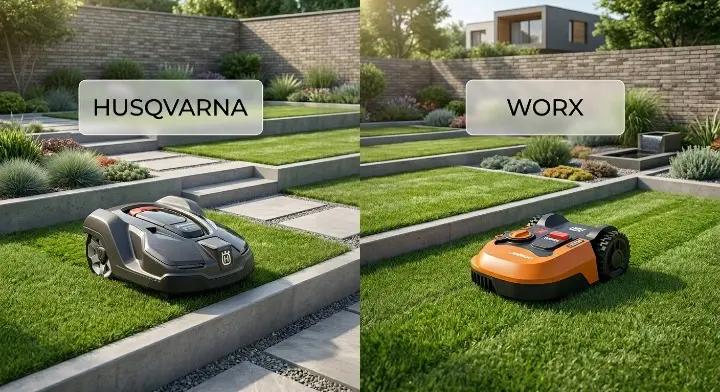
Choosing between Husqvarna and Worx is one of the most common decisions robot mower buyers face today. Both brands offer a wide range of robotic lawn mowers, and both have built strong reputations among homeowners looking to spend less time mowing and more time enjoying their yards.
At first glance, the two brands seem similar. Both offer app control, automatic charging, weather resistance, and models designed for different lawn sizes. However, once you look beyond the marketing materials, important differences begin to appear. Factors such as reliability, performance on slopes, installation complexity, maintenance requirements, and long-term ownership costs can have a significant impact on your experience.
In general, Husqvarna is often positioned as the premium option, with a strong reputation for handling larger and more challenging lawns. Worx, on the other hand, is known for offering more affordable models that appeal to budget-conscious homeowners and DIY enthusiasts.
This guide compares Husqvarna and Worx from a practical homeowner's perspective. Rather than focusing only on specifications, we'll examine pricing, real-world lawn performance, common owner complaints, installation considerations, maintenance needs, and feedback from current users. By the end, you should have a much clearer idea of which robot mower brand is the better fit for your lawn and budget.
Quick Verdict
If you want the short answer, Husqvarna is generally the better choice for homeowners with large, complex, or challenging lawns. It tends to offer stronger navigation, better traction on slopes, and a reputation for long-term reliability.
Worx, on the other hand, is often the better value option. It costs less, is widely available, and can be an excellent choice for smaller, flatter lawns where budget is a major consideration.
| Category | Winner |
|---|---|
| Best Overall | Husqvarna |
| Best Value for Money | Worx |
| Large Lawns | Husqvarna |
| Small to Medium Lawns | Worx |
| Steep Slopes | Husqvarna |
| Uneven Terrain | Husqvarna |
| DIY-Friendly Setup | Worx |
| Budget Buyers | Worx |
| Long-Term Reliability | Husqvarna |
| Advanced Features | Husqvarna |
Choose Husqvarna if:
- You have a large or complicated lawn layout.
- Your yard includes slopes, narrow passages, or uneven terrain.
- Reliability is more important than upfront cost.
- You're willing to pay more for premium features and performance.
Choose Worx if:
- You have a relatively simple lawn.
- Keeping costs down is a priority.
- You enjoy DIY setup and adjustments.
- You want a capable robot mower without spending premium-brand money.
For many homeowners, the decision ultimately comes down to lawn complexity. If your lawn is challenging, Husqvarna's higher price is often easier to justify. If your lawn is straightforward and your budget is tighter, Worx may provide better overall value.
Husqvarna vs Worx at a Glance
While both Husqvarna and Worx manufacture robotic lawn mowers, they target different types of homeowners.
Husqvarna is widely regarded as a premium robot mower brand. The company has decades of experience in outdoor power equipment and is often associated with advanced navigation, strong performance on difficult terrain, and long-term durability. Many of its models are designed to handle larger properties, complex lawn layouts, and steeper slopes.
Worx takes a different approach. Its Landroid series focuses on affordability, ease of use, and DIY-friendly ownership. Worx robot mowers are often popular among first-time buyers because they typically cost less than comparable Husqvarna models while still offering smart features such as app control and automatic scheduling.
The table below summarizes the biggest differences between the two brands.
| Feature | Husqvarna | Worx |
|---|---|---|
| Brand Positioning | Premium | Budget-Friendly |
| Typical Price Range | Higher | Lower |
| Best For | Large and complex lawns | Small to medium lawns |
| Slope Performance | Excellent | Good |
| Navigation Quality | Advanced | Good |
| Reliability Reputation | Strong | Mixed |
| Setup Difficulty | Moderate | Easy to Moderate |
| DIY Friendliness | Good | Excellent |
| App Control | Advanced | Good |
| Long-Term Ownership | Lower intervention | May require more adjustments |
| First-Time Buyers | Good | Excellent |
| Overall Value | Premium Performance | Budget Value |
The biggest difference can be summarized in a single sentence:
Husqvarna focuses on minimizing problems, while Worx focuses on minimizing costs.
That doesn't mean Husqvarna is always the better choice. Many homeowners with relatively simple lawns are perfectly satisfied with a Worx Landroid and appreciate the lower purchase price. However, when lawns become more challenging—with slopes, tree roots, narrow passages, uneven ground, or multiple mowing zones—Husqvarna tends to justify its premium positioning more clearly.
This difference becomes even more apparent when we look at pricing, real-world lawn performance, and owner experiences.
Price: Is Husqvarna Worth the Extra Money?
For many buyers, the biggest difference between Husqvarna and Worx isn't performance—it's price.
In most cases, a comparable Husqvarna robot mower costs several hundred dollars more than a similar Worx Landroid model. Depending on the lawn size and feature set, the gap can easily range from $300 to well over $1,000.
At first glance, that makes Worx look like the obvious value choice. If both mowers can cut grass automatically, why pay more?
The answer comes down to what you're actually buying.
| Factor | Husqvarna | Worx |
|---|---|---|
| Upfront Cost | Higher | Lower |
| Build Quality | Premium | Mid-Range |
| Lawn Complexity Handling | Excellent | Good |
| Slope Performance | Excellent | Fair to Good |
| Setup and Fine-Tuning | Less frequent | Often requires more adjustments |
| Long-Term Reliability | Generally stronger | More dependent on lawn conditions |
For homeowners with a simple lawn, the extra money may not provide a dramatic improvement. If your yard is relatively flat, free of obstacles, and under half an acre, a Worx Landroid may deliver excellent results at a significantly lower cost.
However, the value equation changes as lawn complexity increases.
Many robot mower owners report that Husqvarna machines require less intervention over time. On lawns with slopes, tree roots, uneven ground, tight passages, or multiple mowing zones, Husqvarna models often handle challenging conditions more consistently. In contrast, some Worx owners report spending additional time adjusting boundary wires, modifying trouble spots, or rescuing the mower when it becomes stuck.
In other words, part of Husqvarna's premium price is paying for convenience.
A useful way to think about it is this:
- Worx helps you save money upfront.
- Husqvarna may save you time and frustration later.
Of course, not every Worx owner experiences problems. Many users are extremely satisfied with their Landroid mowers after optimizing their installation and addressing a few trouble areas. For the right lawn, a Worx can represent outstanding value.
So, is Husqvarna worth the extra money?
- For small, simple lawns, probably not.
- For larger, more complex lawns where reliability matters, many homeowners find that the higher price becomes easier to justify over the long run.
Which Brand Handles Difficult Lawns Better?
A robot mower that performs well on a perfectly flat lawn may struggle once real-world challenges are introduced. Slopes, tree roots, uneven terrain, narrow passages, and wet ground can quickly expose the limitations of a mower's design.
Based on manufacturer specifications, product design, and feedback from long-term owners, Husqvarna generally has the stronger reputation when lawns become more challenging.
Slopes
Slopes are often one of the biggest tests for a robot mower.
Many Husqvarna Automower models are designed to handle steeper inclines and maintain traction on uneven terrain. Their wheel design and overall chassis layout are often better suited for hilly properties.
Worx Landroid models can manage moderate slopes, but some owners report traction issues on wet grass or steeper sections of their lawn. Several users also mention that the mower may occasionally dig into soft ground while turning.
Winner: Husqvarna
Tree Roots and Uneven Ground
Tree roots, small holes, exposed soil, and bumpy terrain can cause robot mowers to become stuck.
This is one area where owner feedback frequently favors Husqvarna. Many users describe Automowers as more capable of navigating rougher ground with fewer interruptions.
Worx owners often report excellent performance on smooth lawns, but some users with roots, dips, or uneven surfaces mention spending time modifying trouble spots or making adjustments to prevent the mower from getting stuck.
Winner: Husqvarna
Narrow Passages and Complex Layouts
Modern robot mowers are designed to navigate tight spaces, but some handle them better than others.
Husqvarna has invested heavily in navigation technology over the years, and many models are specifically designed to manage multiple mowing zones, narrow corridors, and more complicated yard layouts.
Worx can also handle narrow passages, especially when the boundary wire is installed correctly. However, on complex properties with multiple sections or obstacles, Husqvarna generally has a stronger track record.
Winner: Husqvarna
Wet Conditions
Neither brand performs at its best on extremely muddy ground, but wet conditions are common in many regions.
Several Worx owners report that traction problems become more noticeable when the soil is soft after heavy rain. This can increase the likelihood of wheel spinning or the mower becoming trapped.
Husqvarna mowers are not immune to wet conditions, but they tend to receive fewer complaints related to traction and mobility.
Winner: Husqvarna
Large and Complex Lawns
For larger properties, consistency becomes more important than raw mowing speed.
Many homeowners choose Husqvarna specifically because they want a mower that can operate with minimal supervision across a complicated lawn. Multiple mowing zones, detached areas, and challenging terrain are situations where Husqvarna's premium positioning becomes easier to understand.
Worx remains a strong option for small and medium-sized lawns, but the performance gap often becomes more noticeable as lawn complexity increases.
Winner: Husqvarna
Bottom Line
If your lawn is relatively flat, open, and straightforward, both brands can do an excellent job.
However, if your property includes slopes, tree roots, uneven terrain, tight passages, or multiple lawn sections, Husqvarna generally has the advantage. The higher purchase price may be difficult to justify on a simple lawn, but it often makes more sense when the mower is expected to handle challenging conditions with minimal intervention.
Reliability and Common Owner Complaints
Specifications can tell you how a robot mower is supposed to perform. Reliability tells you what ownership is actually like after months or years of use.
When reviewing discussions from robot mower communities, forums, and owner groups, a clear pattern emerges: both Husqvarna and Worx have satisfied customers, but the types of complaints are noticeably different.
In general, Husqvarna owners tend to complain about cost, while Worx owners are more likely to discuss performance issues and the need for ongoing adjustments.
Common Husqvarna Complaints
Despite its premium reputation, Husqvarna is not perfect.
The most common criticism is simply the price. Many homeowners struggle to justify paying hundreds—or even thousands—of dollars more compared to competing brands.
Other frequently mentioned complaints include:
- Expensive replacement parts
- Higher initial installation costs
- Boundary wire repairs on older installations
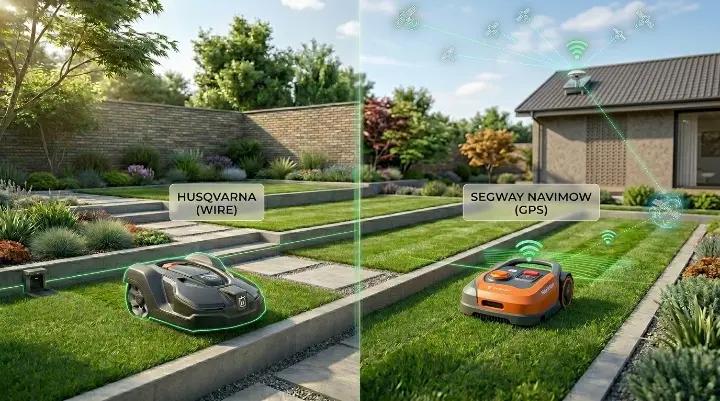
- Some models still relying on perimeter wire technology while newer competitors offer wire-free navigation
A few owners also report occasional hardware failures or wire-related issues, but these complaints appear less common than concerns about cost.
That said, many long-term Husqvarna owners describe the machines as highly dependable once properly installed. Some users report using the same mower for multiple seasons with only routine maintenance such as blade replacements and cleaning.
Common Worx Complaints
Worx Landroid owners often praise the value for money, but discussions frequently mention a different set of challenges.
The most common complaints include:
- Getting stuck on roots, holes, or uneven terrain
- Traction problems on slopes or wet grass
- Wheel spinning and lawn wear near docking areas
- Requiring adjustments to boundary wire placement
- Needing more setup tweaks before reaching reliable operation
One theme appears repeatedly in owner discussions: many Worx users are happy with their mower after spending time optimizing their lawn and installation.
In other words, a Worx mower may require more patience during the first few months of ownership, especially if the lawn has challenging terrain.
Reliability Depends on Lawn Conditions
One reason opinions vary so much is that robot mowers are heavily influenced by the environment they operate in.
A Worx mower on a smooth suburban lawn may run flawlessly for years. The same mower on a property with roots, slopes, soft soil, and narrow passages may experience far more interruptions.
Likewise, a Husqvarna mower is not immune to problems, but its design and navigation systems are generally considered more forgiving when lawn conditions become difficult.
Which Brand Has the Better Reliability Reputation?
Based on long-term owner feedback, Husqvarna generally holds the stronger reputation for reliability and consistency.
That doesn't necessarily mean a Worx mower will fail more often. Rather, Husqvarna owners tend to report fewer situations where they need to rescue the mower, modify the lawn, or continuously fine-tune the installation.
For homeowners who value a "set it and forget it" experience, this may be one of the strongest arguments for paying the premium price.
Reliability Winner: Husqvarna
Installation and Setup
For many first-time buyers, installation is one of the biggest concerns when choosing a robot mower.
No matter which brand you choose, setup typically involves placing a charging station, installing a boundary wire (unless you're purchasing a newer wire-free model), configuring the app, and adjusting mowing schedules. However, the overall setup experience can vary significantly between Husqvarna and Worx.
Boundary Wire Installation
Most Husqvarna and Worx models still rely on a perimeter wire to define the mowing area.
Installing the wire is often the most time-consuming part of the process. Depending on lawn size and complexity, installation can take anywhere from a few hours to an entire weekend.
Both brands provide installation instructions, but Husqvarna also has a larger network of dealers and professional installers in many regions. Homeowners who prefer a hands-off experience may find this appealing, although it adds to the overall cost.
Worx is generally more focused on DIY installation, making it popular among homeowners who want to set everything up themselves.
App Setup and Configuration
Both brands offer smartphone apps that allow users to schedule mowing sessions, monitor mower status, and adjust settings remotely.
Worx's setup process is generally straightforward and beginner-friendly. Many owners can get their mower running quickly without extensive configuration.
Husqvarna's app ecosystem tends to offer more advanced controls and customization options. While this provides greater flexibility, it can also mean a slightly steeper learning curve for new users.
Fine-Tuning the Installation
This is where the biggest difference often appears.
Many robot mower owners discover that installation doesn't end when the boundary wire is in place. Small adjustments are often needed to prevent the mower from getting stuck, improve navigation, or optimize coverage.
Based on owner feedback, Worx users are more likely to spend time refining wire placement, adjusting problem areas, and experimenting with settings during the first few weeks of ownership.
Husqvarna owners are not immune to setup challenges, but they generally report fewer ongoing adjustments once the installation is complete.
Time to Reach "Set It and Forget It"
The ultimate goal of a robot mower is automation.
For some lawns, both brands can reach that point relatively quickly. On more complex properties, however, Husqvarna often appears to require less long-term intervention.
Many Worx owners report that the mower performs very well after they identify and fix trouble spots. The key difference is that reaching this stage may require more patience and experimentation.
Which Brand Is Easier to Install?
The answer depends on what you mean by "easy."
- If you're looking for a budget-friendly DIY project, Worx is often the easier choice.
- If you're willing to invest more upfront for a smoother long-term experience, Husqvarna may be easier overall.
For simple lawns, the installation experience is often similar. As lawn complexity increases, Husqvarna's stronger navigation and broader professional support network can help reduce setup headaches.
Installation Winner: Worx (for DIY users)
Long-Term Setup Winner: Husqvarna
Maintenance and Long-Term Ownership
The purchase price is only part of the cost of owning a robot mower. To understand the true value of Husqvarna and Worx, it's important to consider maintenance requirements, replacement parts, and the amount of attention each mower may need over the years.
The good news is that both brands require far less ongoing effort than a traditional gas-powered lawn mower. There are no oil changes, spark plugs, fuel stabilizers, or engine maintenance to worry about.
However, robot mowers are not completely maintenance-free.
Blade Replacement
Both Husqvarna and Worx use small razor-style blades that should be inspected regularly and replaced when they become dull.
The exact replacement schedule depends on lawn size, grass type, and mowing frequency, but most homeowners should expect to replace blades several times during the mowing season.
Fortunately, blade replacement is simple and inexpensive on both brands, typically taking only a few minutes.
Cleaning and Seasonal Care
Grass clippings, dirt, and debris can gradually build up underneath the mower deck.
Most manufacturers recommend cleaning the mower regularly to maintain cutting performance and prevent excessive wear. A quick inspection every few weeks is usually enough for most homeowners.
At the end of the season, both Husqvarna and Worx recommend storing the mower indoors and fully charging the battery before winter storage.
Boundary Wire Maintenance
For models that rely on perimeter wires, the wire itself can become a long-term maintenance item.
Accidental cuts from landscaping projects, aeration, digging, or animal activity can create wire breaks that require troubleshooting and repair.
This issue is not unique to either brand, but it is one of the most common maintenance tasks robot mower owners eventually face.
Battery Life and Replacement Costs
Robot mower batteries typically last several years before capacity begins to decline.
Actual lifespan depends on climate, mowing frequency, charging habits, and overall usage. Many owners report getting several seasons of reliable service before considering a battery replacement.
One advantage often mentioned by Worx owners is the removable battery design found on many Landroid models, which can make replacement more straightforward.
Time Investment Over the Years
This is where the ownership experience often differs between the two brands.
Many Husqvarna owners describe the mower as requiring relatively little attention once installation is complete. Routine blade changes, cleaning, and occasional maintenance are often enough to keep the machine operating smoothly.
Worx owners frequently report a similar experience on simple lawns. However, on more challenging properties, some users mention spending additional time addressing traction issues, adjusting problem areas, or fine-tuning the installation to maintain optimal performance.
This doesn't necessarily mean Worx is less durable. Instead, it reflects the fact that the mower may be more sensitive to difficult lawn conditions.
Which Brand Is Better for Long-Term Ownership?
If your goal is to minimize ongoing intervention, Husqvarna generally has the stronger reputation among long-term owners. Many users view the higher purchase price as an investment in convenience and consistency over several seasons.
Worx remains an attractive option for homeowners who prioritize affordability and are comfortable making occasional adjustments when needed.
Ultimately, the best value depends on your lawn. For straightforward yards, both brands can provide years of reliable service. For larger or more challenging properties, Husqvarna's premium positioning often becomes easier to justify over time.
Long-Term Ownership Winner: Husqvarna
What Real Owners Say About Husqvarna and Worx
Manufacturer specifications only tell part of the story. To understand what ownership is really like, it's helpful to look at feedback from homeowners who have lived with these machines for months or even years.
While individual experiences vary depending on lawn size, terrain, installation quality, and maintenance habits, several recurring themes appear in robot mower communities and owner discussions.
What Owners Like About Husqvarna
Many Husqvarna owners describe their mower as a long-term investment rather than a simple lawn care tool.
Positive comments frequently mention:
- Reliable day-to-day operation
- Strong performance on slopes and uneven ground
- Fewer instances of getting stuck
- Good navigation in complex lawn layouts
- Long service life with routine maintenance
Some owners report using their Automower for five or more seasons with only basic maintenance such as blade changes, cleaning, and occasional replacement of wear items.
Another commonly praised area is customer support. While not every experience is positive, many users report receiving helpful assistance when dealing with warranty claims or replacement parts.
What Owners Dislike About Husqvarna
The biggest complaint is easy to predict: price.
Many homeowners feel that Husqvarna's premium positioning comes with a significant cost penalty. Depending on the model, buyers may spend hundreds or even thousands of dollars more compared to a comparable Worx mower.
Other criticisms include:
- Expensive replacement parts
- Professional installation costs
- Boundary wire troubleshooting when wire damage occurs
- Some older models lacking newer wire-free navigation technology
Several owners also mention that while Husqvarna mowers are highly capable, they are not completely maintenance-free as marketing materials sometimes suggest.
What Owners Like About Worx
The most common reason people choose Worx is value.
Many owners appreciate that a Landroid can provide automatic mowing at a much lower entry price than premium competitors.
Positive feedback often highlights:
- Affordable purchase price
- Easy DIY installation
- User-friendly app controls
- Removable battery design on many models
- Good performance on simple lawns
Some long-term users report excellent results after making a few adjustments to their installation. Once the mower's trouble spots are identified and corrected, they describe the machine as reliable and capable of maintaining a healthy lawn with minimal effort.
What Owners Dislike About Worx
The most common criticism is that performance can be highly dependent on lawn conditions.
In owner discussions, recurring complaints include:
- Getting stuck on roots, holes, or uneven terrain
- Reduced traction on wet grass
- Wheel spinning in soft soil
- Requiring more setup adjustments than expected
- Repeated travel paths creating visible tracks in some lawns
One interesting pattern is that many dissatisfied owners describe their lawns as having slopes, roots, rough terrain, or other obstacles. In contrast, owners with relatively flat and simple lawns often report far fewer problems.
The Most Important Takeaway
Perhaps the most important lesson from owner feedback is that neither brand is universally better for everyone.
Homeowners with smooth, uncomplicated lawns often praise Worx for delivering excellent value at a lower price point.
Meanwhile, homeowners dealing with larger properties, slopes, narrow passages, or uneven terrain are more likely to view Husqvarna's higher price as worthwhile because of its stronger reputation for consistency and reliability.
That is why two people can own different robot mowers and both feel they made the right choice. The best brand often depends less on the mower itself and more on the type of lawn it is expected to manage.
Who Should Buy Husqvarna?
Husqvarna is not the cheapest robot mower brand on the market, and it isn't the right choice for every homeowner. However, there are certain situations where the premium price becomes much easier to justify.
You should seriously consider a Husqvarna robot mower if any of the following describe your lawn or priorities.
You Have a Large or Complex Lawn
Husqvarna has built its reputation on handling lawns that are more challenging than the average suburban yard.
If your property includes:
- Multiple lawn sections
- Narrow passages
- Landscaping features
- Trees and flower beds
- Irregular lawn shapes
Husqvarna's navigation and coverage capabilities are often worth the extra investment.
Your Lawn Includes Slopes or Uneven Terrain
Many owner discussions highlight Husqvarna's strong traction and stability on difficult terrain.
If your yard contains:
- Hills
- Slopes
- Tree roots
- Uneven ground
- Soft areas after rain
A Husqvarna mower will generally require fewer interventions and less troubleshooting than many budget-oriented alternatives.
You Want a "Set It and Forget It" Experience
Some homeowners enjoy tweaking settings and optimizing their installation. Others simply want the mower to work.
If your goal is maximum automation with minimal supervision, Husqvarna's reputation for reliability may be worth paying for.
Many long-term owners report that after installation is complete, routine maintenance often consists of little more than cleaning the mower and replacing blades.
Reliability Is More Important Than Saving Money
Worx often wins on upfront affordability.
Husqvarna often wins on consistency.
If you'd rather spend more initially to reduce the chances of dealing with traction problems, repeated adjustments, or mower rescues later, Husqvarna may offer better overall value over several years of ownership.
You Plan to Keep the Mower for Many Years
Robot mowers are not inexpensive purchases.
Many Husqvarna owners view the mower as a long-term investment and expect to use it for multiple seasons. While every machine eventually requires maintenance and replacement parts, Husqvarna generally has a strong reputation for durability and long-term support.
Husqvarna Is Probably the Right Choice If...
Choose Husqvarna if you:
- Have a large lawn or a complicated layout
- Deal with slopes, roots, or uneven ground
- Prioritize reliability over upfront cost
- Want the most hands-off ownership experience possible
- Plan to keep your robot mower for many years
- Are willing to pay more for premium performance
For homeowners with challenging lawns, Husqvarna is often easier to justify because the extra cost buys more than additional features—it can also buy peace of mind.
Who Should Buy Worx?
Worx robot lawn mowers are designed for homeowners who want automated lawn care at a more accessible price point. While they may not be as rugged or advanced as premium alternatives, they can be an excellent choice in the right conditions.
You should consider a Worx Landroid if your situation matches the following.
You Have a Small to Medium-Sized Lawn
Worx mowers are generally best suited for simpler lawn layouts.
They tend to perform well on:
- Flat or gently sloped lawns
- Standard suburban yards
- Open areas with fewer obstacles
- Regularly maintained grass with no extreme terrain challenges
If your lawn is relatively straightforward, Worx can often handle the job efficiently without requiring a premium investment.
Budget Is a Priority
One of the strongest advantages of Worx is affordability.
Compared to Husqvarna, Worx models typically offer:
- Lower upfront purchase cost
- Lower entry barrier for first-time buyers
- Good feature set for the price
If you want to experience the convenience of a robot mower without spending a premium amount, Worx is often the most practical starting point.
You Prefer a DIY-Friendly Setup
Many homeowners choose Worx because of how accessible the installation process is.
Worx is often a good fit if you:
- Prefer setting up the mower yourself
- Want a straightforward app experience
- Are comfortable making minor adjustments over time
- Don’t want to rely on professional installation services
For many users, the initial setup experience is simpler and more approachable compared to higher-end systems.
Your Lawn Has Minimal Complexity
Worx tends to perform best when the environment is predictable.
It is often a strong option if your lawn:
- Has few narrow passages
- Contains minimal tree roots or obstacles
- Stays relatively dry and firm
- Does not include steep or uneven terrain
In these conditions, Worx can deliver consistent mowing with relatively low maintenance needs.
You Are Willing to Do Some Light Optimization
While Worx can work very well, it sometimes benefits from small adjustments after installation.
Some owners find that optimizing boundary wire placement or adjusting certain zones helps improve long-term performance, especially on more challenging lawns.
If you're comfortable making occasional tweaks early on, Worx can become a very capable and cost-effective solution.
Worx Is Probably the Right Choice If...
Choose Worx if you:
- Have a small to medium-sized, relatively simple lawn
- Want the lowest reasonable cost for automation
- Prefer DIY installation and setup
- Are a first-time robot mower buyer
- Don’t have steep slopes or complex terrain
- Are willing to do some minor tuning if needed
For many homeowners, Worx offers a strong balance between price and functionality, especially when the lawn conditions are not demanding. It is often the most practical entry point into robot mowing without committing to a premium system.
Final Verdict
Choosing between Husqvarna and Worx ultimately comes down to what kind of lawn you have—and how much effort you want to put into maintaining your robot mower experience over time.
Husqvarna is the stronger choice for homeowners who prioritize performance, reliability, and long-term consistency. It tends to handle more difficult lawns better, especially when slopes, uneven terrain, narrow passages, or multiple mowing zones are involved. While the upfront cost is significantly higher, many users view that cost as an investment in fewer problems and a more hands-off experience.
Worx, on the other hand, is best suited for homeowners who want a more affordable entry into robot mowing. It performs well on simple, flat lawns and offers solid smart features for the price. However, it may require more attention during setup and occasional adjustments depending on lawn conditions.
A simple way to think about it is:
- If your lawn is challenging, Husqvarna is usually worth the extra money.
- If your lawn is simple, Worx often delivers better value.
There is no universal winner. The right choice depends on your yard, your expectations, and how much you are willing to spend upfront versus how much time you want to spend managing the mower later.