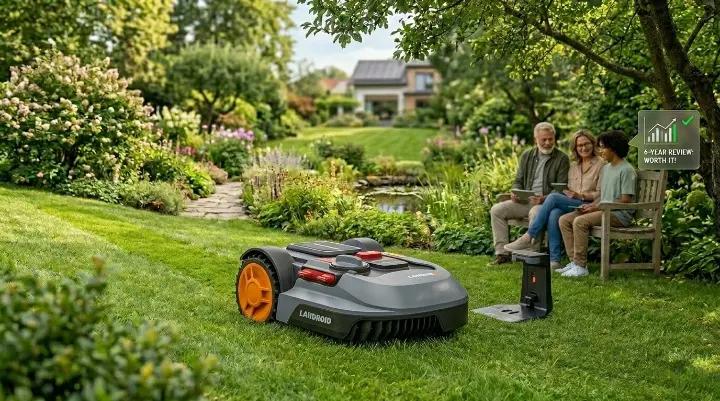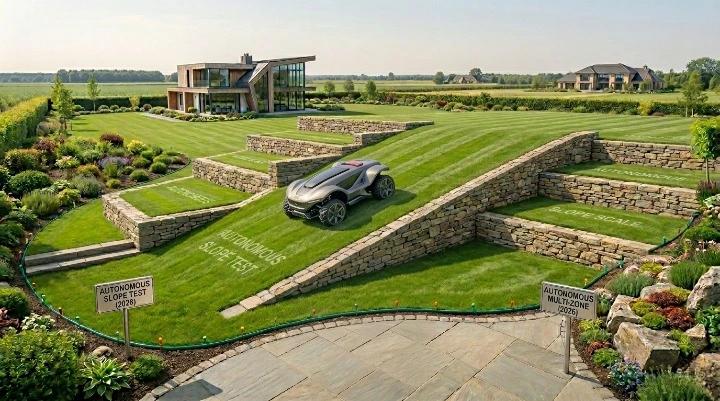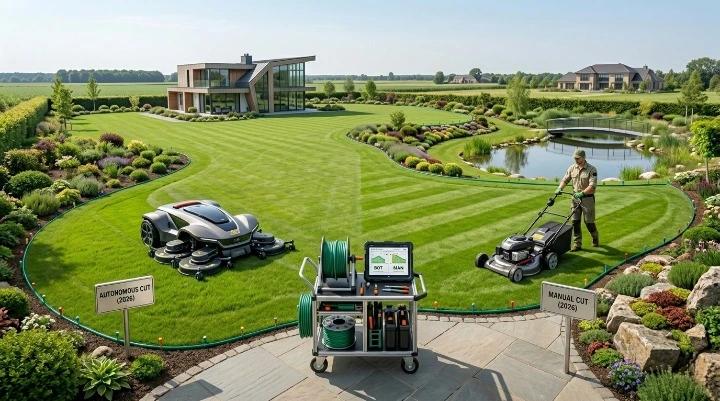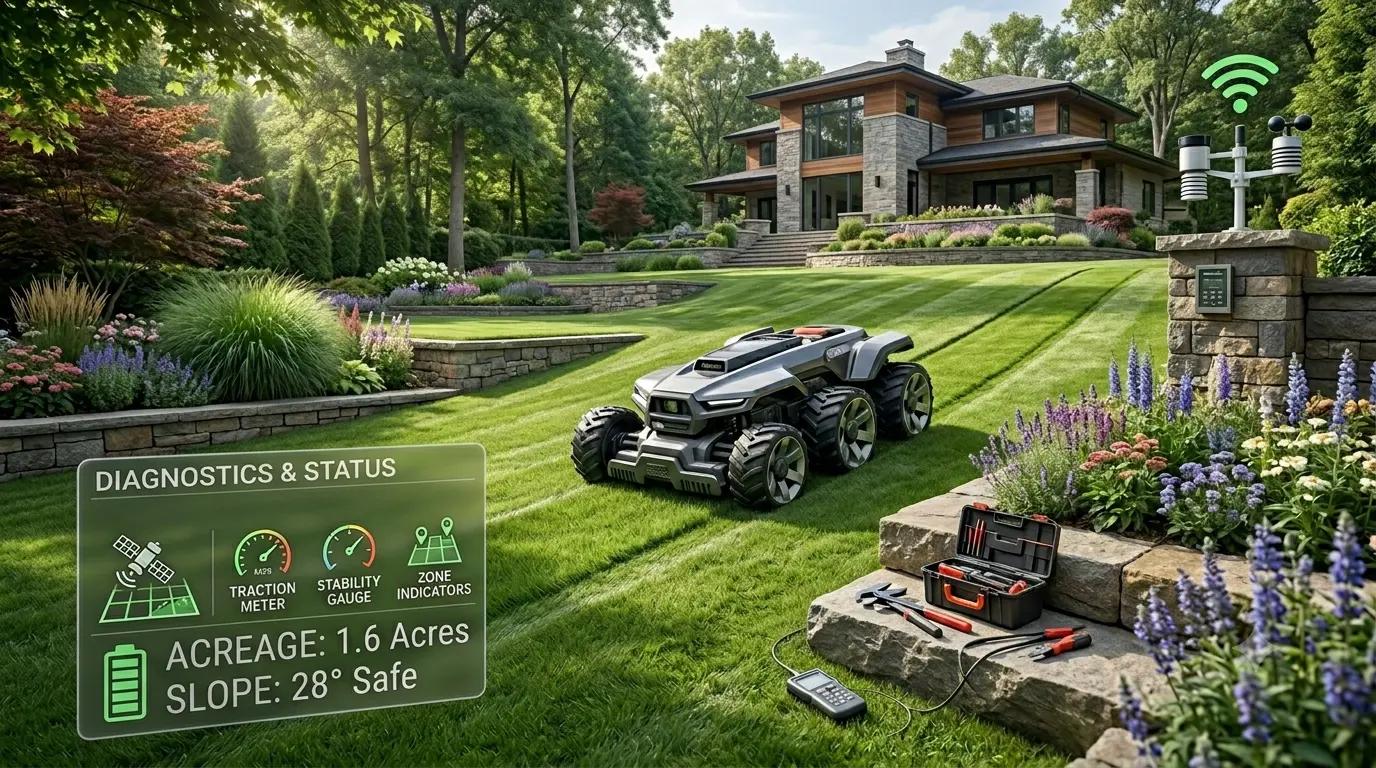

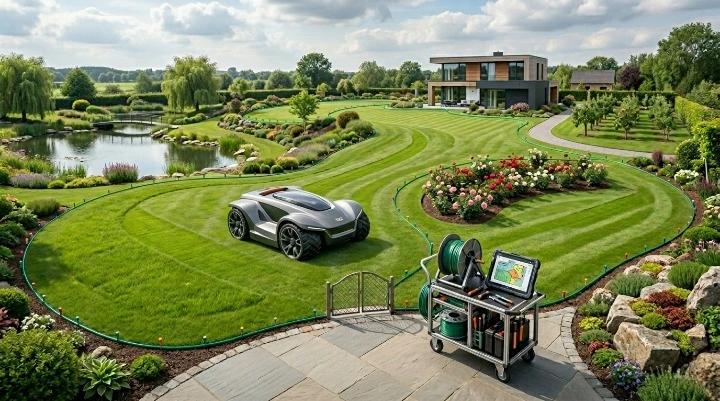
Mowing a large garden can take hours every week, especially during the growing season. For many homeowners, a robot mower seems like an attractive way to save time and keep the lawn looking neat without regular manual work.
But one question comes up again and again: can a robot mower actually handle a large garden?
The short answer is yes. Modern robot mowers are far more capable than they were a few years ago. Many models can maintain lawns well over half an acre, while some premium models are designed for properties of one acre or more.
However, lawn size is only part of the story. A mower that works perfectly on a flat, open acre may struggle on a smaller lawn filled with slopes, trees, narrow passages, and multiple mowing zones.
Before choosing a robot mower, it's important to understand what really determines whether a machine can handle your garden. In this guide, we'll look at the key factors, common mistakes, and the types of robot mowers that work best on large properties.
Can a Robot Mower Handle a Large Garden?
Yes, a robot mower can handle a large garden, provided it is designed for the size and complexity of the area.
Many people assume robot mowers are only suitable for small suburban lawns. While that may have been true years ago, today's models can manage much larger spaces. Some residential robot mowers are rated for more than 1 acre, and certain premium models can maintain several acres with the right setup.
As a general guide:
| Lawn Size | Can a Robot Mower Handle It? |
|---|---|
| Up to 0.25 acre | Easily |
| 0.25–0.5 acre | Most modern models can handle it |
| 0.5–1 acre | Requires a mid-range or premium model |
| 1 acre+ | Usually requires a high-capacity robot mower |
However, the advertised coverage area should not be treated as a guarantee.
Manufacturers often calculate coverage under ideal conditions. Real gardens are rarely ideal. Slopes, obstacles, multiple zones, and narrow passages can all reduce efficiency and increase mowing time.
For example, a mower rated for 1 acre may still struggle if the lawn includes several separate areas that require frequent navigation between zones. On the other hand, the same mower might easily maintain a simple, open lawn of a similar size.
This is why experienced robot mower owners often focus on more than just the area rating. Battery capacity, charging frequency, navigation technology, and lawn layout usually have a bigger impact on real-world performance.
The good news is that if you choose the right machine, a robot mower can keep a large garden consistently maintained with very little effort from the owner. The key is understanding which features matter most before making a purchase.
What Counts as a Large Garden?
The term "large garden" can mean different things depending on where you live.
In the United States, homeowners often describe lawn size in acres. In other countries, garden size is usually measured in square meters. Because of this, what one person considers a large garden may only be considered medium-sized by someone else.
For robot mower buyers, a practical definition is based on the amount of lawn that needs regular mowing rather than the total property size.
| Lawn Area | Category |
|---|---|
| Up to 2,500 sq ft (230 m²) | Small |
| 2,500–10,000 sq ft (230–930 m²) | Medium |
| 10,000–20,000 sq ft (930–1,860 m²) | Large |
| 20,000 sq ft+ (1,860 m²+) | Very Large |
Many homeowners start looking at robot mowers once their lawn reaches around 10,000 square feet. At that size, mowing can easily take an hour or more each week during peak growing seasons.
However, lawn area alone does not tell the whole story.
A simple 15,000-square-foot lawn with few obstacles may be easier for a robot mower to maintain than a smaller lawn divided into several separate sections. Features such as slopes, trees, flower beds, pathways, and narrow passages can all affect how efficiently a mower works.
This is why two gardens of the same size may require very different robot mowers.
Instead of asking whether your garden is "large," a better question is whether your lawn requires more mowing time, battery capacity, or navigation ability than an entry-level robot mower can provide.
Once lawns move beyond roughly half an acre, these factors often become more important than cutting width or top speed. Choosing a mower based only on advertised coverage can lead to disappointing results, especially on complex properties.
The next step is understanding which features actually make the biggest difference when maintaining a large garden.
The 5 Factors That Actually Matter
When shopping for a robot mower for a large garden, it's easy to get distracted by marketing claims.
Manufacturers often highlight features such as cutting width, top speed, or the maximum area rating. While these specifications matter, they don't always determine how well a mower performs in everyday use.
In reality, large gardens place different demands on a robot mower than smaller lawns. The most successful setups usually come down to five key factors.
Area Coverage
Area coverage is the first specification most buyers look at, and for good reason.
Every robot mower is designed to maintain a certain amount of lawn over time. If your garden is significantly larger than the mower's recommended coverage area, the machine may spend most of its time mowing and charging without ever achieving a consistently clean result.
That said, coverage ratings should be viewed as guidelines rather than guarantees.
Manufacturers often calculate these numbers under ideal conditions with simple lawn layouts. Real gardens typically include obstacles, narrow passages, multiple mowing zones, and areas that slow the mower down.
For this reason, it is usually wise to leave some margin between your lawn size and the mower's maximum rated capacity. A mower rated for exactly the size of your lawn may not always perform as expected once real-world conditions are involved.
Battery Life and Charging Time
For large gardens, battery performance is often more important than cutting speed.
A robot mower with a powerful battery can spend more time mowing and less time sitting on the charging station. Over weeks and months, this can make a significant difference in lawn quality and overall efficiency.
Charging time matters as well.
Two mowers may have similar coverage ratings, but if one requires frequent and lengthy charging sessions, it may take much longer to maintain the same lawn.
This becomes especially noticeable during periods of rapid grass growth when the mower needs to work more often to keep up.
Many experienced owners find that real-world mowing performance depends just as much on the balance between mowing time and charging time as it does on the advertised coverage area.
Using a mower for a larger area than designed?
View DiscussionNavigation Technology
A large garden gives a robot mower more opportunities to get lost, waste time, or follow inefficient routes.
This is where navigation technology becomes important.
Traditional boundary wire systems remain effective and are often very reliable once installed. However, they can become more complicated on large properties with multiple zones and long boundary runs.
Newer RTK and GPS-assisted systems allow some robot mowers to navigate with greater precision. They can create virtual boundaries, optimize mowing routes, and often require less physical installation work.
Neither approach is automatically better for every property.
A simple, open lawn may work perfectly with a boundary wire system, while a large and complex garden may benefit from advanced RTK navigation.
The right choice depends more on your lawn layout than the technology itself.
Multi-Zone Management
Many large gardens are not one continuous area of grass.
Instead, they may include a front yard, backyard, side lawn, or separate sections connected by narrow pathways. Some properties also have detached areas that require the mower to travel between zones.
Without proper multi-zone support, a robot mower may spend too much time in one area while neglecting another.
Modern robot mowers often allow users to assign mowing schedules or priorities to different zones. This helps ensure that all sections of the lawn receive consistent coverage.
If your property contains multiple mowing areas, multi-zone management should be considered a necessity rather than a bonus feature.
Slopes and Obstacles
Large gardens often include features that smaller lawns do not.
Steep hills, tree roots, flower beds, ponds, garden furniture, and children's play equipment can all create challenges for a robot mower.
A mower that performs well on flat ground may struggle when faced with frequent elevation changes or difficult terrain.
Slope ratings can provide a useful starting point, but they do not tell the entire story. The shape of the hill, the condition of the grass, and weather conditions can all affect traction and performance.
Obstacle handling is equally important. The more objects a mower encounters, the more efficiently it needs to navigate around them without wasting time or leaving uncut patches.
For many large gardens, terrain complexity becomes a bigger deciding factor than lawn size itself.
Choosing a mower that can comfortably handle your slopes and obstacles will usually have a greater impact on long-term satisfaction than choosing one with a slightly larger area rating.
The Biggest Mistakes Homeowners Make
Large gardens can be maintained successfully with a robot mower, but many buyers end up disappointed because they focus on the wrong specifications.
In most cases, the problem is not the mower itself. It's choosing a machine that doesn't match the realities of the property.
Here are some of the most common mistakes homeowners make when buying a robot mower for a large garden.
Choosing Based Only on Advertised Coverage
The biggest mistake is assuming that a mower rated for a certain area will automatically perform well on a lawn of the same size.
Coverage ratings are useful, but they only tell part of the story.
For example, a mower rated for one acre may perform very differently on two properties of the same size. A flat, open lawn is relatively easy to maintain, while a lawn with multiple zones, narrow passages, and frequent obstacles requires far more navigation and travel time.
Some robot mower owners have reported successfully maintaining areas larger than the manufacturer's recommendation. However, this usually means the mower spends more hours mowing each day and has less flexibility during periods of rapid grass growth.
Using a mower for a larger area than designed?
View DiscussionA safer approach is to choose a mower with some capacity to spare rather than trying to stretch a smaller model to its limits.
Ignoring Charging Frequency
Many buyers compare battery size but overlook how often the mower needs to return to charge.
On a large lawn, charging behavior can have a major impact on overall performance.
A mower that spends a large portion of the day traveling back and forth to its charging station may struggle to keep up during the peak growing season. This is especially true when the lawn is near the upper limit of the mower's rated capacity.
Over time, the difference between a highly efficient mowing-and-charging cycle and a less efficient one can be more noticeable than differences in cutting width or maximum speed.
Before buying, it's worth paying attention to both mowing runtime and charging time rather than focusing on battery capacity alone.
Underestimating Lawn Complexity
Homeowners often measure the size of their lawn but forget to consider its layout.
A property with several separate mowing areas can be much more demanding than a larger lawn that is mostly open.
Trees, flower beds, fences, pathways, steep slopes, and narrow corridors all affect how efficiently a robot mower can work. These features force the mower to spend more time navigating and less time actively cutting grass.
This is one reason why two homeowners with similarly sized gardens can have completely different experiences with the same mower.
Recommendations for robot lawn mower for large area?
View PostBefore choosing a model, think about how your lawn is structured, not just how large it is. A mower that is perfectly capable on paper may struggle if the garden is unusually complex.
For many large properties, navigation quality and multi-zone support end up being just as important as the mower's rated coverage area.
RTK vs Boundary Wire for Large Gardens
One of the biggest decisions when buying a robot mower for a large garden is choosing between an RTK model and a traditional boundary wire system.
Both technologies can work well on large properties, but they solve the navigation problem in different ways.
Boundary wire mowers use a physical wire installed around the lawn to define where the mower can and cannot travel. RTK mowers use satellite positioning and reference stations to create virtual boundaries without the need for perimeter wires.
For many homeowners, the choice comes down to lawn layout, installation preferences, and budget.
| Feature | RTK Mowers | Boundary Wire Mowers |
|---|---|---|
| Installation | No perimeter wire required | Requires wire installation |
| Lawn Mapping | Virtual boundaries and app-based editing | Physical boundaries fixed by wire |
| Large Property Management | Often better for multiple zones and complex layouts | Works well but may require more setup |
| Flexibility | Easy to adjust mowing areas | Changes require wire modifications |
| Signal Dependence | Requires reliable satellite reception | Not affected by GPS signal quality |
| Initial Cost | Usually higher | Often lower |
RTK technology has become increasingly popular because it makes managing large properties easier. If you frequently change garden layouts, add new landscaping features, or need to manage multiple mowing zones, virtual boundaries can save a significant amount of time.
RTK systems can also mow in more organized patterns rather than relying entirely on random movement. On large lawns, this often improves efficiency and can reduce the time needed to maintain the grass.
However, RTK is not automatically the best choice for every garden.
Satellite-based navigation works best when the mower has a clear view of the sky. Properties with dense tree cover, tall buildings, or areas that block satellite signals may experience positioning issues. In these situations, a boundary wire system can sometimes provide more consistent results.
Boundary wire mowers also remain a popular option because the technology is mature and proven. Once properly installed, they can operate reliably for years with very little adjustment.
For homeowners with a relatively simple lawn layout, a quality boundary wire mower may deliver results that are just as good as an RTK model.
In general, RTK tends to offer the greatest benefits on larger and more complex properties where flexibility, mapping, and multi-zone management are important. Boundary wire systems remain a practical choice for homeowners who prioritize reliability and do not mind the initial installation work.
The good news is that both technologies are capable of maintaining large gardens. The best option is usually the one that matches the specific challenges of your property rather than the newest technology on the market.
Recommended Robot Mowers for Large Gardens
Once you've identified the size and complexity of your lawn, the next step is choosing a mower that matches those needs.
For large gardens, it is usually worth focusing on models with strong area coverage, reliable navigation, and effective multi-zone management. While there are many options available, a few models consistently stand out for larger properties.
Best Overall: Lymow
Lymow is one of the more interesting options for homeowners with large and demanding lawns.
Unlike many traditional robot mowers that are designed primarily for flat suburban yards, Lymow focuses heavily on coverage capacity, terrain handling, and high productivity. This makes it particularly appealing for properties with large open areas or challenging slopes.
Another advantage is its wire-free setup. Homeowners can create and adjust mowing zones without installing perimeter wire, making future changes much easier. For larger gardens where landscaping often evolves over time, this flexibility can be a major benefit.
Lymow is best suited for homeowners who want a modern wire-free system and need a mower capable of handling larger, more complex properties.
Best Premium Option: Husqvarna
Husqvarna remains one of the most established names in robotic lawn care.
The company's premium models are known for dependable performance, mature software, and excellent long-term reliability. Many homeowners choose Husqvarna because the brand has years of experience managing large lawns and difficult garden layouts.
Advanced models offer features such as GPS-assisted navigation, systematic mowing patterns, and strong multi-zone support. These capabilities help maintain consistent results even on larger properties.
While Husqvarna products are often more expensive than competing options, they remain a strong choice for buyers who value proven performance and a long track record.
Best for Complex Lawns: Navimow
Navimow has become a popular choice for homeowners who want RTK navigation without the complexity of installing boundary wires.
Its mapping system allows users to create virtual boundaries, manage multiple mowing zones, and adjust layouts directly from an app. This can be particularly useful for gardens with separate lawn sections, narrow passages, or changing landscaping features.
For large gardens with complicated layouts, efficient navigation is often just as important as raw mowing capacity. Navimow's strength lies in helping the mower spend less time searching and more time cutting.
Homeowners with heavily divided or irregularly shaped lawns may find these navigation advantages especially valuable.
Best Value: Worx
Worx offers an affordable entry point for homeowners who need a robot mower but are not ready to invest in a premium model.
While its coverage capabilities may not match the largest RTK-based systems, several Worx models can comfortably maintain medium-to-large residential lawns. The platform is widely available, easy to use, and generally less expensive than many competitors.
For homeowners with a straightforward lawn layout and moderate coverage requirements, Worx can provide good value without sacrificing the convenience of automated mowing.
The key is choosing a model with enough capacity for your lawn rather than selecting the least expensive option available.
Choosing the right robot mower ultimately depends on more than just lawn size. Factors such as terrain, navigation needs, mowing zones, and future landscaping plans should all be considered before making a decision. A mower that matches the way your property is actually used will usually deliver better results than one chosen solely because it advertises the largest coverage area.
Are Robot Mowers Worth It for Large Gardens?
For many homeowners, the main question is not whether robot mowers can handle a large garden, but whether they are actually worth the investment.
The answer depends on how much time, effort, and consistency you expect from lawn maintenance.
For large gardens, mowing is often one of the most time-consuming outdoor tasks. In peak growing seasons, it can easily take several hours each week, especially if the lawn is uneven, divided into multiple areas, or affected by fast-growing grass.
Robot mowers solve this problem by turning mowing into an automated routine. Instead of blocking out time on weekends, the mower works regularly in the background, keeping grass height consistent throughout the week.
One of the biggest benefits is consistency. Because robot mowers cut small amounts of grass frequently, the lawn often looks more even compared to traditional weekly mowing. Over time, this can also improve lawn health by reducing stress on the grass.
However, the value of a robot mower becomes clearer when looking at larger properties specifically.
On a small lawn, the time savings may feel minor. On a large garden, the difference is much more noticeable. A property that once required hours of manual mowing can be maintained with very little direct involvement.
That said, robot mowers are not completely “set and forget” machines. Large gardens still require occasional maintenance, such as blade changes, cleaning, and monitoring of navigation performance. Gardens with complex layouts or frequent obstacles may also require some initial setup adjustments before everything runs smoothly.
Cost is another important consideration. High-capacity robot mowers designed for large gardens are more expensive than basic models. However, many homeowners find that the long-term trade-off in time savings and reduced manual labor justifies the investment.
In general, robot mowers are most worth it for large gardens when:
- ✔The lawn requires regular, time-consuming mowing
- ✔The layout is complex or difficult to maintain manually
- ✔The homeowner values convenience and consistency over manual control
For simple, small lawns, the benefit may be modest. But for medium to very large gardens, especially those with multiple zones or uneven terrain, a robot mower can significantly reduce ongoing maintenance effort while keeping the lawn consistently neat.
Final Verdict
Robot mowers can handle large gardens, but success depends less on the mower itself and more on how well it matches your lawn.
For simple, open lawns, almost any mid-range robot mower with sufficient area coverage can do the job. As garden size increases, however, factors like navigation technology, battery efficiency, and multi-zone management become more important than basic specifications like cutting width or top speed.
If your garden is close to or above half an acre, it is usually worth choosing a model with some extra capacity rather than one that only just meets your lawn size. This gives the mower more flexibility during periods of fast grass growth and reduces the risk of uneven coverage.
For complex properties with slopes, multiple sections, or narrow passages, navigation quality and zone handling often matter more than raw power. In these cases, RTK-based or advanced mapping systems can provide a smoother experience than traditional setups.
Overall, robot mowers are a strong option for large gardens if you choose based on layout and usage rather than marketing specifications alone. The right mower can significantly reduce maintenance time while keeping the lawn consistently well-trimmed.