
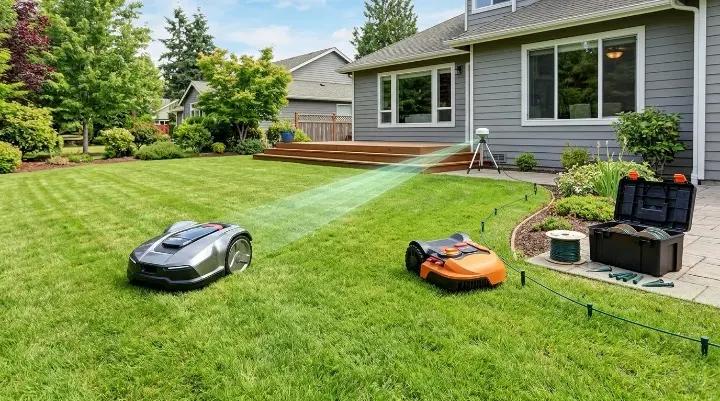
Wire-free robot mowers are quickly becoming one of the most talked-about upgrades in lawn care, promising easier setup and smarter navigation without boundary wires. At the same time, traditional wired systems—especially proven models like Husqvarna Automower—still dominate many real-world lawns because of their reliability and predictable performance. This creates a clear question for most buyers in 2026: should you stick with a wired system or switch to wire-free?
This guide breaks down the real differences between the two technologies, focusing on how they perform in everyday conditions—not just marketing claims—so you can choose the right system for your lawn.
The Short Answer: Which Type Should You Choose?
If you just want a quick decision without diving into technical details, here’s the simplest way to choose between wired and wire-free robot mowers.
Choose Wired If:
- ✔reliability matters most
- ✔lots of trees or signal-blocking areas
- ✔smaller or more complex lawn layout
Choose Wire-Free If:
- ✔large open property
- ✔you may change your lawn layout in the future
- ✔you want to avoid boundary wire installation
In short, wired systems prioritize stability and predictability, while wire-free systems prioritize flexibility and convenience. Neither is universally better—the right choice depends entirely on how your lawn behaves in the real world.
How Wired and Wire-Free Robot Mowers Actually Work
To understand the difference between wired and wire-free robot mowers, it helps to look at how each system actually “knows” where to go. Both are autonomous, but they rely on completely different navigation methods.
How Boundary Wire Mowers Navigate
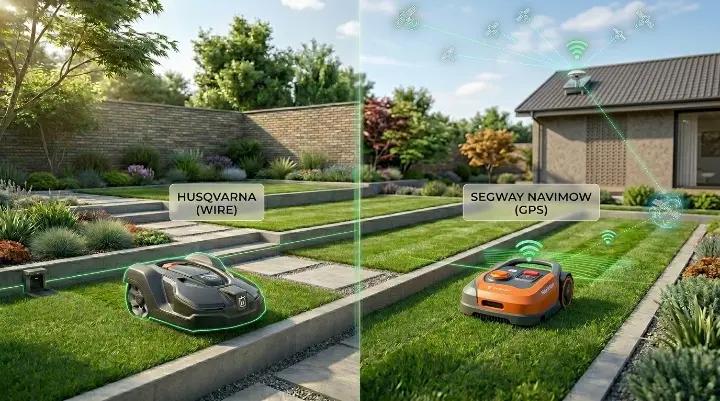
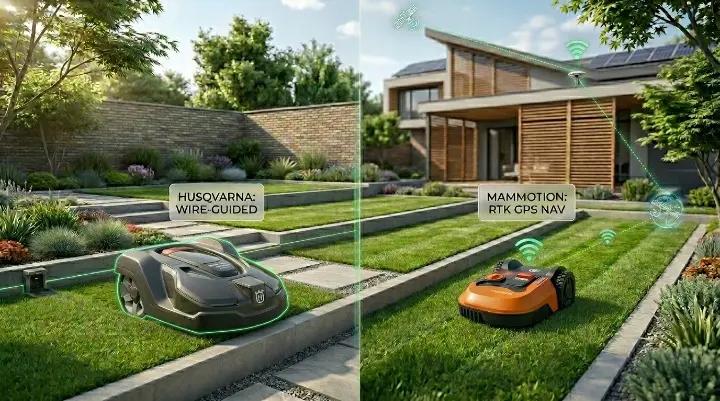
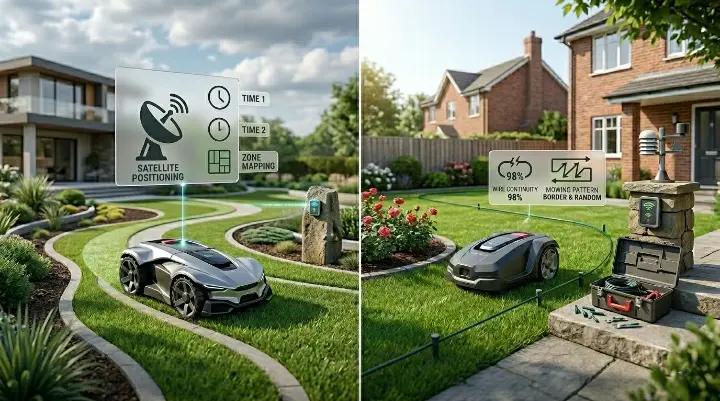
Wired robot mowers use a physical boundary wire installed around the perimeter of the lawn and sometimes around restricted areas like flower beds or ponds. This wire emits a low-frequency signal that the mower continuously detects, allowing it to understand where it is allowed to operate.
In practice, the mower moves in a semi-random pattern within the boundary, correcting direction whenever it approaches the wire. Many established systems—such as Husqvarna Automower models—also use a guide wire to help them return to the charging station more efficiently.
The key advantage of this system is that it is self-contained and stable, meaning it does not depend on external positioning signals or environmental conditions.
How RTK and Wire-Free Systems Navigate
Wire-free robot mowers typically rely on a combination of RTK (Real-Time Kinematic) GPS, onboard sensors, and mapping software. Instead of following a physical wire, the mower builds a digital map of your lawn and navigates using satellite positioning with centimeter-level correction.
This allows users to define virtual boundaries through an app, adjust mowing zones, and modify layouts without physically changing anything on the ground. Some systems also use vision or sensor-based obstacle detection to improve accuracy near edges and complex areas.
However, because these systems rely on satellite signals and data processing, their performance can be influenced by trees, buildings, or weak signal zones, especially in dense or shaded environments.
Why Navigation Technology Matters Less Than Most Buyers Think
On paper, navigation systems look like the biggest difference between wired and wire-free mowers. In reality, most homeowners care more about whether the mower consistently covers the lawn without intervention.
For example, many long-term Husqvarna users report that once a boundary wire system is properly installed, it becomes “invisible infrastructure”—the mower simply works every day without needing adjustments. Meanwhile, wire-free systems offer flexibility, but may require occasional remapping or signal optimization depending on the environment.
In other words, the navigation method matters less than how reliably the system performs in your specific yard conditions over time.
The Biggest Difference Isn't Installation
At first glance, most buyers assume the main trade-off between wired and wire-free robot mowers is installation. One system requires laying a boundary wire, while the other promises a quick, wire-free setup through an app. But in real-world use, installation is actually a one-time inconvenience—the real differences show up after months or years of ownership.
What matters far more is how each system behaves when something goes wrong, how consistently it performs over time, and how much intervention you need once the mower becomes part of your weekly routine.
Reliability Over Time
Wired systems like Husqvarna Automower are often preferred because they are predictable once installed. The boundary wire defines a fixed environment, and the mower operates within it without relying on external positioning accuracy.
In contrast, wire-free systems depend on satellite positioning and mapping data, which can introduce small variations depending on tree coverage, weather conditions, or signal quality. In open lawns this is rarely noticeable, but in more complex gardens, it can lead to occasional inconsistencies in edge precision or path stability.
Over time, many users value not setup simplicity, but behavioral consistency—the mower doing the same reliable job every day without surprises.
What Happens When Something Goes Wrong
When issues occur, the experience is very different between the two systems.
With wired mowers, the most common problem is a broken or damaged boundary wire, often caused by garden tools or ground movement. While this sounds serious, it is usually localized and fixable once the break is found.
Wire-free systems don’t have physical wires to break, but they introduce different types of issues such as signal loss, mapping drift, or positioning instability. These problems are less visible but can sometimes take longer to diagnose because they depend on software, environment, and connectivity rather than a single physical fault.
Recovery and Troubleshooting
Recovery behavior is another overlooked difference.
Wired mowers generally follow a clear logic: if the wire signal is intact, the system continues operating normally. If there is a fault, it usually stops or shows a clear error that points to the issue.
Wire-free mowers, on the other hand, rely on digital maps and positioning systems to recover their location. In most cases they self-correct automatically, but in complex environments they may require remapping, repositioning of the base station, or app-level adjustments.
This is why many experienced users describe wired systems as easier to “live with” long term, even if they required more effort on day one.
Installation: One-Time Effort vs Long-Term Flexibility
Installation is where most comparisons between wired and wire-free robot mowers begin—but in real ownership terms, it’s also the part that gets overstated. The real question isn’t “which is easier to install,” but whether you prefer a one-time setup investment or ongoing layout flexibility after the system is running.
Installing a Boundary Wire System
Wired robot mowers require physically placing a boundary wire around the lawn and any restricted zones. This process can take several hours for a small yard and longer for complex layouts with islands, narrow passages, or multiple zones.
In practice, most users only do this once. After the wire is properly installed and tested, it rarely needs adjustment unless the garden layout changes or the wire is accidentally damaged.
Typical setup steps include:
- Planning the mowing zones and edge distances
- Laying and securing the boundary wire
- Connecting the wire to the charging station
- Running a calibration or test cycle
While this sounds labor-intensive, many Husqvarna users treat it as a one-time infrastructure task, similar to installing irrigation lines or outdoor lighting.
Setting Up a Wire-Free Mower
Wire-free systems replace physical installation with digital setup. Instead of digging or pegging wires, users define boundaries through an app while the mower maps the lawn.
The process usually involves driving or guiding the mower around the perimeter once or twice, after which the system builds a virtual map of the property.
This approach feels significantly faster at the beginning. However, the “installation” is not entirely finished after setup. In real-world use, changes in landscaping, signal conditions, or mowing zones can require remapping or fine-tuning through software updates.
Which Process Is Easier in Real Life?
On paper, wire-free systems are clearly easier to install. But in real use, the difference depends on how you value time.
If you prefer doing a single, concentrated setup and then forgetting about it, wired systems are often more satisfying long-term. If you prefer avoiding physical work and want the ability to change your lawn layout digitally, wire-free systems offer more flexibility.
Many experienced users describe it this way: wired systems require more effort on day one, while wire-free systems distribute small adjustments over time.
Wire-Free vs Wired in Real-World Conditions
On paper, both wired and wire-free robot mowers can handle most residential lawns. The real difference shows up when you move beyond ideal conditions—trees, narrow passages, uneven terrain, and multi-zone layouts all expose how each system behaves under pressure.
Lawns With Trees
Tree coverage is one of the most common stress tests for wire-free systems. Dense canopies can weaken satellite signals and reduce positioning accuracy, which may lead to less precise navigation or occasional path corrections.
Wired systems are largely unaffected by this because navigation is not dependent on overhead signals. Once the boundary wire is set, the mower follows it consistently regardless of tree density or seasonal changes in foliage.
In heavily wooded yards, this is often where users notice the difference between signal-dependent mapping vs fixed physical boundaries.
Narrow Passages and Tight Spaces
Narrow corridors between houses, fences, or garden structures can challenge both systems, but in different ways.
Wire-free mowers rely on mapping accuracy and positioning stability. If the corridor is tight or surrounded by signal-reflective surfaces, navigation can become less predictable.
Wired systems, by contrast, physically define these passages with boundary wire. Once correctly installed, the mower follows the corridor in a consistent pattern without needing to “interpret” the space.
Large Open Lawns
In wide, open spaces with minimal obstacles, wire-free systems perform at their best. Clear sky visibility allows RTK positioning to work efficiently, and the mower can cover large areas with minimal interruption.
Wired systems also perform well here, but their advantage is less about performance and more about consistency. They tend to behave the same way regardless of environmental changes.
In simple terms, open lawns reduce the gap between the two technologies.
Multiple Zones
Multi-zone lawns—front yard, backyard, side areas—highlight another key difference.
Wire-free systems can switch between zones digitally, often without physical intervention. This makes it easier to adjust mowing schedules or redefine zones through the app.
Wired systems require guide wires or manual transport between zones, depending on the setup. Once configured, however, they remain stable and predictable, even if less flexible.
Slopes and Uneven Terrain
Slopes and uneven ground are where navigation and traction both matter. While both systems can handle moderate inclines, real-world performance depends heavily on the mower’s physical design.
Wire-free systems may struggle slightly more in areas where positioning accuracy affects edge behavior on slopes. Wired systems, especially established models like Husqvarna Automower, often rely on proven terrain handling combined with stable boundary reference.
For a deeper comparison of slope performance, see: Best Robot Mowers for Steep Slopes.
In real-world conditions, the choice between wired and wire-free is less about features and more about environment. The more complex your lawn becomes, the more value you get from the system that prioritizes stability over flexibility—or vice versa.
Why Many Homeowners Still Prefer Wired Mowers
Even as wire-free robot mowers become more advanced, wired systems—especially established platforms like Husqvarna Automower—still dominate in many long-term installations. The reason is not that newer technology doesn’t work, but that many homeowners value predictability over flexibility once the mower becomes part of their daily routine.
For most users, the goal is simple: the mower should run every day without attention. Wired systems tend to deliver exactly that once the initial setup is done.
Mature Technology and Predictable Behavior
Wired robot mowers are built on a technology that has been refined for years. The navigation logic is simple: stay within the boundary wire and follow internal movement patterns until the job is done.
This simplicity translates into consistency. The mower behaves the same way in spring, summer, or fall, regardless of minor environmental changes. There is no dependence on satellite accuracy, software mapping drift, or signal optimization.
For many homeowners, this “set it and forget it” reliability is the most valuable feature of all.
Fewer Surprises in Daily Operation
Another reason wired systems remain popular is that they produce fewer unexpected behaviors.
Once the boundary wire is installed correctly, the mowing area is fixed. The mower does not reinterpret boundaries or adjust its map dynamically. This reduces edge-case issues like drifting paths or occasional misalignment near borders.
Many users describe this as a lack of “surprises”—the mower simply shows up, cuts the grass, and returns to the dock without requiring supervision.
Real-World User Experience Feedback
In long-term user discussions, a common theme appears: while wire-free systems are exciting and convenient, wired systems are often described as more dependable over multiple seasons.
One recurring sentiment from experienced users is that, once properly installed, a wired system becomes almost invisible in daily life. It doesn’t require recalibration or signal troubleshooting, even as weather or yard conditions change.
This is why, despite rapid innovation in wire-free technology, many homeowners still choose wired systems when reliability is the top priority rather than installation convenience.
When Wire-Free Mowers Are Worth the Extra Money
Wire-free robot mowers are not objectively “better” or “worse”—they are simply designed for a different type of user and lawn. The extra cost only makes sense when the flexibility they offer solves a real problem in your specific situation.
For many homeowners, that means the value is not in the technology itself, but in how often their lawn changes or how much they want to avoid physical installation work.
Large Properties With Complex Layouts
Wire-free systems start to make more sense as lawn size and complexity increase. Large properties with multiple sections, long perimeters, or irregular shapes can be time-consuming to wire and rewire if changes are needed.
With a wire-free system, the entire layout is handled digitally. This allows you to adjust mowing zones, expand coverage, or refine boundaries without digging or re-installing physical infrastructure.
In these cases, the higher upfront cost can be offset by reduced labor over time.
Lawns That Change Over Time
If your outdoor space is still evolving—new garden beds, temporary fencing, seasonal landscaping, or frequent redesigns—wire-free systems offer a clear advantage.
Instead of redoing boundary wire every time the layout changes, you simply update the map in the app. This makes wire-free mowers more suitable for homeowners who treat their yard as a dynamic space rather than a fixed layout.
Users Who Prioritize Convenience Over Stability
Some users simply prefer avoiding physical installation altogether. For them, the appeal of wire-free systems is the ability to get started quickly and make adjustments without touching the ground.
However, this convenience comes with a trade-off: reliance on signal quality, mapping accuracy, and occasional software tuning. In stable environments where conditions are predictable, this trade-off is often acceptable.
In short, wire-free mowers are worth the extra money when flexibility and ease of adjustment matter more than absolute long-term stability.q
Cost Comparison: What Ownership Really Costs
When comparing wired and wire-free robot mowers, the sticker price is only part of the story. The real cost of ownership comes from installation effort, potential maintenance, and how often you need to intervene over time. These hidden differences often matter more than the initial purchase decision.
Ownership Cost Breakdown (Wired vs Wire-Free)
| Factor | Wired | Wire-Free |
|---|---|---|
| Initial Cost | Lower | Higher |
| Installation | Higher upfront effort (wire setup) | Lower upfront effort (app setup) |
| Maintenance | Occasional wire repair possible | Occasional mapping / signal tuning |
| Long-Term Cost | Generally stable | Can vary depending on system updates and environmentq |
Wired systems typically require more effort at the beginning, mainly due to boundary wire installation. However, once installed correctly, ongoing costs are usually minimal and predictable.
Wire-free systems reduce initial physical labor but shift complexity into software, mapping accuracy, and environmental dependency. While this eliminates the risk of wire breaks, it introduces potential time costs related to recalibration or system optimization in challenging conditions.
In real-world ownership, the most important distinction is not what you pay once, but what kind of effort you will need to repeat over the next 3–5 years. Wired systems tend to front-load effort, while wire-free systems distribute smaller adjustments over time.
Recommended Robot Mowers for Each Type
Once you understand the trade-offs between wired and wire-free systems, the next step is matching the technology to proven products. The goal here isn’t to list every model on the market, but to highlight reliable categories that consistently perform well in real-world use.
Best Wired Choice: Husqvarna Automower Series
Husqvarna Automower series remains one of the most established wired robot mower ecosystems on the market. It is widely used in residential and commercial settings, largely because of its long-term reliability and mature boundary-wire navigation system.
The key strength of Husqvarna’s wired approach is consistency. Once the boundary wire is correctly installed, the mower follows a highly predictable mowing pattern with minimal need for user intervention. This makes it especially suitable for homeowners who prioritize stability over frequent system adjustments.
Another advantage is ecosystem depth. Over time, Husqvarna has developed strong support infrastructure, replacement parts availability, and a wide range of models for different lawn sizes and terrains. This reduces uncertainty when it comes to long-term ownership.
In short, if your priority is a “set it and forget it” mowing system that works the same way year after year, Husqvarna’s wired Automower lineup remains one of the safest choices.
Best Wire-Free Choice: Lymow
Wire-free systems are still a newer category, and the landscape is evolving quickly. Among emerging options, Lymow is often discussed for its focus on RTK-based navigation and app-driven boundary management.
The appeal of wire-free systems like Lymow is flexibility. Instead of installing physical wires, users define and adjust mowing zones digitally, which can be especially useful for properties that change frequently or require seasonal layout adjustments.
However, as with most wire-free solutions, real-world performance can vary depending on environmental conditions such as tree coverage, signal quality, and yard complexity. This makes them better suited for users who value convenience and adaptability over absolute long-term stability.
Other Alternatives Worth Considering
Beyond the two main categories, there are several other brands worth keeping an eye on as the market develops.
Sunseeker offers competitive mid-range models that balance cost and smart features, often targeting users who want partial automation without premium pricing.
Yarbo takes a different approach by positioning itself as a modular outdoor robotics platform, expanding beyond just mowing into multi-purpose yard automation.
While these alternatives are not as established as Husqvarna in the wired segment, or as specialized as newer wire-free RTK systems, they represent interesting directions in the broader robotic lawn care market.
Final Verdict: Which Technology Makes More Sense in 2026?
There is no single winner between wired and wire-free robot mowers. The better choice depends less on technology trends and more on how your lawn behaves in real life.
Wired systems still make the most sense for homeowners who want predictable performance. Once installed correctly, they tend to run with very few surprises. Many long-time users prefer them simply because they “just work,” even after years of operation.
Wire-free systems are becoming more attractive as technology improves. They remove the need for physical boundary wires and offer more flexible setup. However, they can still be affected by signal conditions, trees, and complex yard layouts.
In 2026, the decision is not about which technology is newer. It is about which type of system matches your yard, your patience for setup, and how much reliability matters in daily use.