
Robot lawn mowers are evolving quickly, and the biggest shift in recent years is happening between two very different approaches to navigation: traditional boundary wire systems and newer wire-free GPS-based technologies.
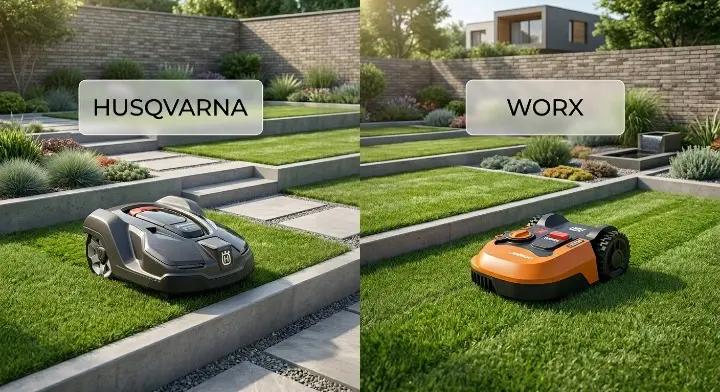
On one side, Husqvarna represents a long-established ecosystem built around boundary wire or EPOS satellite navigation. It has years of field testing, a strong dealer network, and a reputation for stable long-term operation. On the other side, Mammotion—especially the Luba 2 series—represents a newer generation of robot mowers that rely on RTK GPS positioning, AI vision, and virtual mapping instead of physical wires.
At first glance, both systems aim to solve the same problem: automated lawn mowing with minimal human effort. But in practice, they differ in a more fundamental way. Husqvarna focuses on proven reliability and predictable behavior over time, while Mammotion focuses on flexibility, wire-free setup, and modern smart navigation.
This comparison is especially relevant for homeowners with complex lawns, larger properties, or those considering upgrading from older wired systems. The decision is no longer just about cutting performance—it’s about how the mower understands and navigates your lawn.
Quick Verdict
Husqvarna and Mammotion are built for different priorities rather than direct performance superiority.
Husqvarna is generally the better choice if you want a mature, highly reliable system with strong long-term support, predictable behavior, and proven performance across a wide range of real-world lawns. It is especially suitable for users who value stability and are willing to use a boundary wire or trusted EPOS setup.
Mammotion Luba 2 is often the better option if you want a modern, wire-free setup with flexible mapping and are comfortable with a newer ecosystem that is still evolving. It reduces or eliminates the need for physical boundary wire, but may require more patience with software updates and system refinement.
In simple terms:
- Choose Husqvarna if you prioritize reliability, stability, and long-term proven performance.
- Choose Mammotion if you prioritize wire-free convenience and modern navigation flexibility.
There is no universal winner. The better system depends on whether you value mature reliability or next-generation flexibility more in your robot mower setup.
The Real Difference: Wire vs RTK Navigation
The most important difference between Husqvarna and Mammotion is not cutting power, build quality, or even price—it is how each system understands and navigates your lawn.
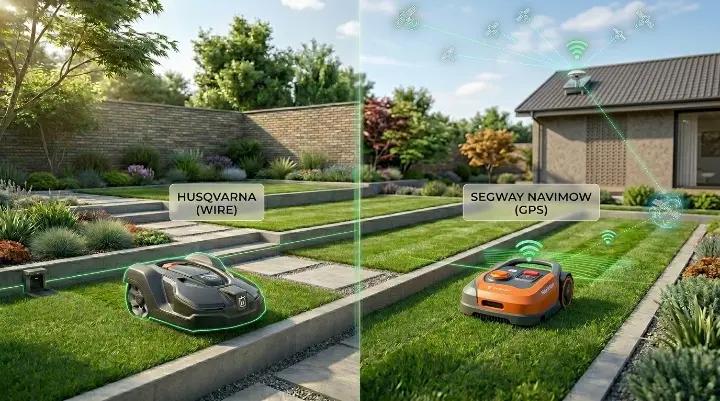
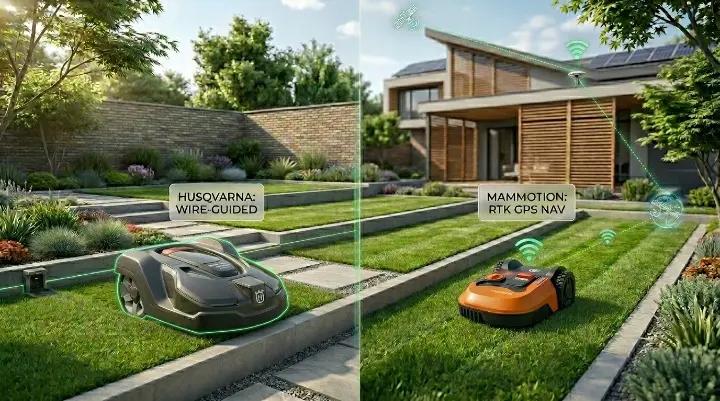
Husqvarna traditionally relies on a boundary wire system (or EPOS in higher-end models), while Mammotion uses RTK GPS combined with AI-assisted positioning. This difference fundamentally changes how the mower is installed, how it moves, and how it behaves over time.
Boundary Wire (Husqvarna): Physical Definition of the Lawn
In a wired Husqvarna setup, a physical cable is installed around the perimeter of your lawn and any no-go zones. The mower detects this signal and uses it as a strict physical limit.
This approach has several characteristics:
- The boundary is fixed and physically defined
- Signal is stable regardless of trees or overhead coverage
- Behavior is highly predictable once installed correctly
- Changes require physically adjusting or relaying wire
In newer Husqvarna EPOS models, the boundary wire is replaced by satellite-based virtual mapping, but the core philosophy remains the same: the mower follows a clearly defined, pre-set boundary with high consistency.
RTK GPS (Mammotion): Virtual Mapping of the Lawn
Mammotion Luba 2 uses RTK GPS positioning combined with onboard sensors and AI vision to create a virtual map of your lawn. Instead of following a physical wire, the mower navigates based on satellite positioning and digital boundaries.
This system allows:
- Fully wire-free installation
- Easy modification of mowing zones in software
- Dynamic no-go zones that can be updated anytime
- Flexible multi-zone management without physical changes
However, RTK systems also depend on signal quality and environmental conditions, which can vary depending on tree coverage, open sky visibility, and local interference.
The Core Tradeoff: Physical Certainty vs Digital Flexibility
The difference between these two systems is best understood as a tradeoff:
- Husqvarna prioritizes physical certainty. The boundary is real, stable, and independent of GPS accuracy. Once installed correctly, it rarely changes.
- Mammotion prioritizes digital flexibility. The lawn is defined virtually, making setup and adjustments easier, but it relies more on positioning accuracy and software stability.
This leads to different ownership experiences. Husqvarna tends to feel more “set and forget” after installation, while Mammotion feels more adaptable but potentially more dependent on firmware and signal conditions.
Why This Difference Matters More Than Specs
In most real-world lawns, cutting width, battery size, or blade design matter less than navigation reliability. A mower that knows exactly where it is—and stays consistent over time—will deliver better results than one with slightly higher specs but inconsistent positioning.
That is why this comparison is less about performance on paper and more about how each system interprets your lawn in practice: one through physical boundaries, the other through satellite-based mapping.
Installation: Setup Effort vs Long-Term Flexibility
Installation is one of the most practical differences between Husqvarna and Mammotion, and it often becomes a deciding factor for homeowners even before performance is considered.
At a high level, Husqvarna requires either a boundary wire installation or an EPOS satellite setup, while Mammotion Luba 2 relies entirely on RTK GPS-based mapping with no physical perimeter wire. This creates two very different ownership experiences from day one.
Husqvarna Installation: More Work Upfront, Stable Structure Long-Term
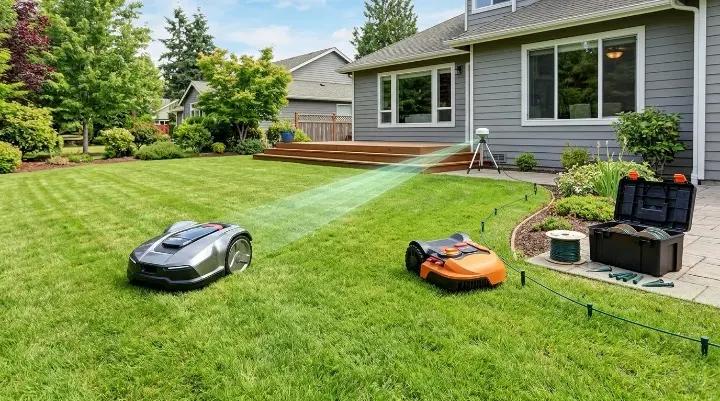
With traditional Husqvarna wired systems, installation involves physically laying a boundary wire around the lawn and any restricted zones. This process can take time, especially for larger or more complex gardens.
Typical steps include:
- Planning mowing zones and no-go areas
- Laying boundary wire around edges and obstacles
- Securing wire with stakes or burying it slightly underground
- Setting up the charging station and connecting the system
- Running initial calibration and testing
This setup requires effort upfront, and in some cases professional installation is recommended.
However, once installed correctly, the system is extremely stable. The mower always knows its exact limits because the boundary is physically defined. Adjustments are rare and usually only needed if you redesign your garden.
With Husqvarna EPOS models, installation becomes more digital and flexible, but still requires careful setup of reference points and signal calibration to ensure accuracy.
Mammotion Installation: Fast Setup, Software-Driven Boundaries
Mammotion Luba 2 removes the need for boundary wire entirely. Instead, you define the lawn using RTK GPS positioning and map creation within the app.
The installation process is typically:
- Position the charging station
- Set up RTK reference signal (if required)
- Drive or map the lawn boundary using the app
- Define mowing zones and no-go areas digitally
- Start mowing after calibration
This can often be completed much faster than a wired setup, especially for simple or open lawns.
The biggest advantage is flexibility. If you want to change mowing zones, adjust edges, or create new restricted areas, it can usually be done in the app without any physical work.
Tradeoff: Effort vs Flexibility
The key difference is not just installation difficulty, but what happens after installation.
- Husqvarna requires more physical effort upfront, but changes are rare and the system is structurally stable.
- Mammotion is faster to install and easier to modify, but relies more heavily on software accuracy and signal conditions.
Which One Feels Easier in Practice?
For first-time users, Mammotion often feels easier because there is no wire to plan or bury. The setup is more intuitive and reversible.
For long-term owners, Husqvarna can feel more “finished” once installed, because the system becomes less dependent on ongoing adjustments.
In simple terms:
- Husqvarna trades convenience at the start for long-term stability
- Mammotion trades physical installation work for long-term digital flexibility
Reliability: Mature System vs Fast-Evolving Technology
Reliability is often the deciding factor in long-term robot mower ownership, and this is where Husqvarna and Mammotion show one of their clearest differences.
Husqvarna represents a mature ecosystem that has been refined over many years of real-world use. Mammotion, by contrast, is a newer platform built on fast-moving GPS and AI-based technology that is still actively evolving through frequent software updates.
Husqvarna: Long-Term Stability and Predictable Behavior
Husqvarna’s strength lies in its maturity. The system has been tested across a wide range of climates, lawn types, and edge cases over many years, which has helped refine both hardware reliability and software behavior.
In real-world use, this typically translates to:
- Consistent mowing patterns over time
- Fewer unexpected navigation failures
- Strong availability of spare parts and accessories
- Established service and dealer support networks
- Predictable performance once properly installed
Many long-term owners describe the experience as “boring in a good way”—the mower simply runs on schedule and requires only basic maintenance such as blade changes and occasional cleaning.
However, Husqvarna is not completely free of issues. Boundary wire systems can require troubleshooting if the wire is damaged, and even newer EPOS models still depend on stable positioning signals in more complex environments.
Mammotion: Rapid Innovation with Ongoing Software Evolution
Mammotion Luba 2 is built on a newer technology stack, and as a result, it evolves more quickly through firmware and app updates. This allows the system to improve features at a faster pace, but it also introduces variability in user experience.
Commonly discussed points in owner feedback include:
- Frequent software updates with changing behavior
- Occasional inconsistencies after firmware updates
- Dependence on RTK signal stability
- Varying performance depending on environmental conditions
- Ongoing refinement of obstacle detection and navigation logic
At the same time, many users appreciate the rapid development cycle. Features that were limited or imperfect at launch may improve significantly over time as updates are released.
Support and Ecosystem Maturity
Another important aspect of reliability is the surrounding ecosystem.
Husqvarna benefits from:
- Established dealer and installer networks
- Widely available replacement parts
- Long-term service infrastructure
- Extensive field experience across multiple generations of products
Mammotion, being newer, is still building out its global support and service infrastructure. While many users report positive experiences, consistency of support can vary depending on region and timing.
Stability vs Evolution: The Core Tradeoff
The reliability difference can be summarized as a tradeoff between two philosophies:
- Husqvarna prioritizes stability, consistency, and predictable long-term behavior
- Mammotion prioritizes rapid innovation, feature expansion, and software-driven improvement
In practice, this means Husqvarna tends to feel more dependable once set up, while Mammotion may feel more dynamic but less uniform across all users and environments.
Why This Matters for Long-Term Ownership
Robot mowers are not short-term gadgets—they are expected to operate for many seasons. In that context, stability often becomes more important than feature speed.
Husqvarna leans toward “install once, maintain lightly, and trust the system.”
Mammotion leans toward “install and continue improving through updates.”
Neither approach is inherently better, but they create very different ownership expectations over time.
Terrain Performance: Where Each System Wins
When comparing Husqvarna and Mammotion on terrain performance, it is less about raw cutting ability and more about how reliably each system handles different real-world lawn conditions. Both brands can produce a clean cut, but they behave differently when the lawn becomes complex, uneven, or unpredictable.
Slopes and Uneven Ground
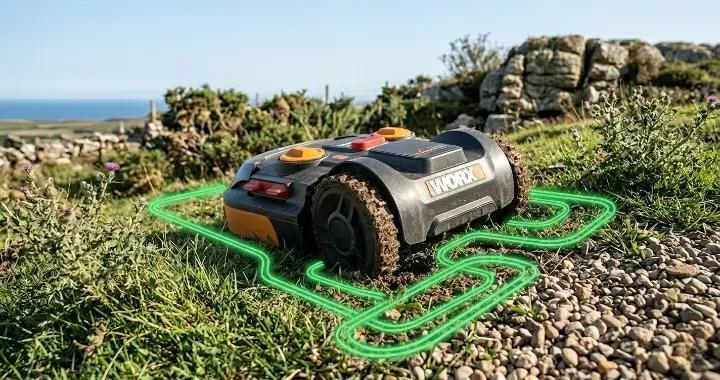
Husqvarna has a long history of building machines that handle slopes and uneven terrain well, especially in its higher-end Automower lineup. The combination of traction design, weight distribution, and mature navigation logic helps it maintain stability even when conditions are not ideal.
Mammotion Luba 2, particularly in AWD configurations, is also designed to handle slopes effectively. Its all-wheel-drive system gives it strong physical traction, which can be a clear advantage on steeper inclines or rougher patches of grass.
In practice:
- Husqvarna tends to feel more controlled and consistent on moderate slopes
- Mammotion can feel more physically capable on steeper or more rugged terrain
The difference often comes down to system behavior versus raw mechanical grip.
Complex Lawns and Multi-Zone Layouts
For lawns with multiple zones, narrow passages, or irregular shapes, navigation strategy becomes more important than traction.
Husqvarna relies on either boundary wire guidance or EPOS mapping, which creates a structured and predictable mowing path. This often results in consistent coverage patterns and fewer navigation surprises once the system is properly configured.
Mammotion uses RTK GPS positioning and digital mapping, which allows more flexible route planning and zone customization. It can handle multiple zones without physical adjustments, but its performance is more dependent on signal quality and mapping accuracy.
In general:
- Husqvarna is more predictable in complex layouts
- Mammotion is more flexible in how zones are created and adjusted
Obstacles, Garden Objects, and Real-World Interference
Real lawns are rarely clean and empty. Objects like toys, garden furniture, uneven patches, and temporary obstacles can significantly affect performance.
Husqvarna typically avoids obstacles using established sensor logic and structured path planning, which reduces the chance of unpredictable interactions once the mowing pattern is learned.
Mammotion incorporates vision-based and sensor-assisted obstacle detection, which allows it to respond dynamically to objects in the lawn. This can be useful in households where the lawn environment changes frequently, such as families with children or pets.
However, obstacle detection performance can vary depending on object size, lighting conditions, and software updates.
Signal Environment and Outdoor Conditions
A key difference between the two systems is how they behave under challenging environmental conditions.
Husqvarna’s wired systems are largely unaffected by external signal interference because the boundary is physical. EPOS models, however, can be influenced by satellite visibility in areas with heavy tree cover or structural obstruction.
Mammotion relies heavily on RTK GPS signals, which require a stable connection between the mower, base station, and satellites. Performance may vary in areas with poor sky visibility, dense trees, or signal obstruction.
Overall Terrain Advantage
There is no single winner across all conditions. Instead, each system excels in different scenarios:
- Husqvarna performs best in structured, predictable environments where long-term stability and consistent navigation are important
- Mammotion performs best in flexible, open environments where physical setup needs to be minimized and terrain can benefit from strong AWD capability
In most real-world cases, the “better” system depends less on specifications and more on how complex and signal-friendly the lawn environment actually is.
Real-World Ownership Feedback (Reddit & Owners)
Beyond specifications and marketing claims, the most useful insights often come from long-term owners who have actually lived with these machines in real garden conditions. Across forums, Reddit discussions, and community feedback, several consistent themes appear for both Husqvarna and Mammotion.
Husqvarna: “Reliable but Conservative”
A common theme among Husqvarna owners is reliability over time. Many users describe the experience as stable and predictable once the system is properly installed and configured.
Positive feedback often highlights:
- Strong long-term durability across multiple seasons
- Consistent mowing performance with minimal intervention
- Good availability of spare parts and service support
- Fewer unexpected system failures once installed correctly
Some owners also note that even after years of use, the mower continues to perform reliably with only basic maintenance such as blade changes and occasional cleaning.
However, there are also recurring criticisms:
- Higher upfront cost compared to newer alternatives
- Boundary wire issues in traditional setups (damage or breaks)
- EPOS systems can be affected by satellite visibility in complex environments
- App experience can feel less modern compared to newer competitors
Overall sentiment tends to be that Husqvarna feels like a “safe long-term investment,” especially for users who prioritize reliability over experimentation.
Mammotion: “Impressive When It Works, Inconsistent at Times”
Mammotion Luba 2 generates more polarized feedback. Many users are impressed by its wire-free setup and advanced navigation, but long-term discussions often highlight variability in experience depending on environment and software version.
Positive owner impressions commonly include:
- No need for boundary wire installation
- Strong concept of zone-based mowing and digital mapping
- Good performance on open or well-suited lawns
- Strong traction in AWD models for challenging terrain
- Frequent feature improvements through software updates
- At the same time, recurring concerns appear in owner discussions:
- Software stability issues after updates in some cases
- Occasional connectivity or positioning inconsistencies
- Dependence on RTK signal quality and environment
- Customer support experiences vary by region
- Some users report ongoing tuning or troubleshooting after setup
A notable pattern in feedback is that satisfaction tends to be higher in open, less obstructed environments, while frustration increases in complex gardens or areas with weaker signal conditions.
A Key Pattern in Owner Experiences
One of the most important takeaways from real-world feedback is that satisfaction is heavily environment-dependent rather than brand-dependent.
- Husqvarna owners in general tend to describe a more predictable, low-maintenance experience after installation.
- Mammotion owners often highlight innovation and flexibility, but with more variation in stability depending on setup conditions and software maturity.
In other words, the difference is not simply “good vs bad,” but rather “stable system with proven behavior” versus “new system with evolving performance.”
This explains why opinions online can be so divided: both systems work well when used in the right context, but the definition of “right context” is very different for each brand.
Price vs Value: Is Mammotion Worth the Savings?
Price is one of the most obvious differences between Mammotion Luba 2 and Husqvarna Automower systems, and it often becomes the deciding factor for many buyers before they even compare features in detail.
At a high level, Mammotion is typically positioned as a more affordable, feature-rich alternative, while Husqvarna sits in the premium segment with a higher upfront cost but a more established ecosystem.
Upfront Cost: Clear Advantage for Mammotion
In most comparable setups, Mammotion Luba 2 is significantly cheaper than a Husqvarna EPOS or high-end Automower model. This price gap can be substantial, especially for larger lawns where Husqvarna systems quickly move into premium pricing tiers.
For many users, this creates an immediate perception of value:
- Lower entry cost for wire-free mowing
- Fewer installation expenses (no boundary wire labor)
- Attractive feature set at a mid-range price point
This is one of the main reasons Mammotion has gained attention so quickly in the robotic mower market.
Total Cost of Ownership: The Hidden Difference
However, price alone does not tell the full story. When considering long-term ownership, other factors start to matter more:
Husqvarna advantages:
- Established service and repair infrastructure
- Widely available spare parts and accessories
- Long product lifecycle with long-term support
- Predictable maintenance costs over time
Mammotion considerations:
- Newer ecosystem with evolving support structure
- Potentially more reliance on software updates for performance improvements
- Spare parts and service availability may vary by region
This does not mean Mammotion is expensive to maintain, but rather that its long-term cost profile is less proven compared to Husqvarna’s decades of field history.
Value Perspective: What Are You Really Paying For?
The key difference is not just price—it is what you are paying for.
With Husqvarna, a large portion of the cost goes toward:
- System maturity
- Dealer and service network
- Proven long-term reliability
- Stable behavior across seasons
With Mammotion, a larger portion of the value comes from:
- Wire-free convenience
- Modern app-based control
- Faster feature development cycle
- Lower barrier to entry for complex installations
In other words, Husqvarna invests in stability, while Mammotion invests in flexibility and accessibility.
Is Mammotion “Worth It” Because It’s Cheaper?
The answer depends on what problem you are trying to solve.
Mammotion offers strong value if:
- You want to avoid boundary wire installation
- You prefer a lower upfront investment
- Your lawn environment is relatively open and RTK-friendly
- You are comfortable with evolving software systems
Husqvarna offers better value if:
- You prioritize long-term reliability over upfront savings
- You want a “set it and forget it” system
- You prefer established service and parts availability
- You are managing a complex or signal-challenging lawn
The Real Tradeoff
At its core, this is not a simple price comparison—it is a tradeoff between certainty and flexibility.
- Mammotion lowers the financial barrier and simplifies installation
- Husqvarna increases upfront cost but reduces long-term uncertainty
For many buyers, the decision comes down to whether the savings are worth accepting a newer and more evolving system, or whether paying more upfront is justified by long-term stability and ecosystem maturity.
Who Should Buy Husqvarna?
Husqvarna is not trying to be the newest or the cheapest option in the robot mower market. Instead, it focuses on long-term stability, predictable performance, and a mature ecosystem. That makes it a better fit for certain types of users and lawn conditions.
You should choose Husqvarna if reliability is your top priority
If your main goal is a mower that simply works in the background with minimal attention, Husqvarna is designed for that kind of ownership experience. Many long-term users value the fact that once the system is properly installed, it tends to run consistently across seasons with very little intervention.
This is especially important if you:
- Want a “set it and forget it” system
- Prefer fewer software surprises or behavioral changes over time
- Value predictable mowing patterns over experimental features
You should choose Husqvarna if you have a complex or large lawn
Husqvarna systems, especially higher-end models, are well suited for lawns that require structured navigation and consistent coverage. This includes:
- Multiple connected lawn zones
- Narrow passages or structured garden layouts
- Larger properties where coverage consistency matters more than flexibility
- Gardens where long-term mapping stability is important
In these environments, the mature navigation logic and structured boundary definition (wire or EPOS) can provide a more consistent experience over time.
You should choose Husqvarna if you care about long-term support
One of Husqvarna’s strongest advantages is its established ecosystem. This includes:
- Widely available spare parts
- Long-standing dealer and installer networks
- Proven maintenance paths and repair options
- Years of field-tested product evolution
For many buyers, this reduces uncertainty about what happens after the first year of ownership.
You should choose Husqvarna if you prefer proven over new technology
Husqvarna is built on incremental improvement rather than rapid experimentation. That means fewer radical changes in software behavior, but also less frequent feature disruption.
This appeals to users who:
- Prefer mature, well-tested systems
- Do not want to rely heavily on frequent firmware updates
- Value consistency more than cutting-edge features
In short
Husqvarna is best suited for users who want a long-term, stable, low-maintenance mowing system and are willing to invest more upfront for that reliability.
It is not necessarily the most modern or flexible option, but it is one of the most established and predictable choices in the robotic mower market today.
Who Should Buy Mammotion?
Mammotion Luba 2 represents a newer generation of robot mowers built around wire-free navigation, fast setup, and software-driven flexibility. It is not designed to replace Husqvarna’s long-established ecosystem in every scenario, but it does offer a compelling alternative for the right type of user.
You should choose Mammotion if you want a wire-free setup
The most obvious advantage of Mammotion is the elimination of boundary wire installation. For many homeowners, this alone changes the entire experience of owning a robot mower.
It is a strong fit if you:
- Want to avoid digging, burying, or repairing boundary wires
- Prefer a faster initial setup process
- Expect to change lawn layouts over time
- Want a more digital, app-based way to manage your garden
This flexibility is especially useful for evolving gardens or properties where layouts change seasonally.
You should choose Mammotion if flexibility matters more than tradition
Mammotion is built around the idea that your lawn should be editable like a digital map. Zones, boundaries, and no-go areas can be adjusted in software rather than through physical installation changes.
This makes it suitable for users who:
- Frequently modify garden layouts
- Want easy zone-based mowing control
- Prefer experimenting with mowing patterns and schedules
- Manage multiple areas that may change over time
In this sense, Mammotion behaves more like a software platform than a traditional hardware tool.
You should choose Mammotion if you have an open, RTK-friendly lawn
Because Mammotion relies on RTK GPS positioning, it performs best in environments with good satellite visibility and minimal obstruction.
It is often a better match for:
- Open lawns with fewer trees or overhead coverage
- Large, clearly defined outdoor spaces
- Properties where RTK signal can remain stable
- Users who can position the base station optimally
In the right environment, the system can deliver very efficient and structured mowing without physical boundaries.
You should choose Mammotion if you accept a newer, evolving ecosystem
Unlike long-established systems, Mammotion is still actively evolving through frequent firmware and app updates. This means features can improve quickly, but behavior may also change over time.
It is best suited for users who:
- Are comfortable with ongoing software updates
- Do not expect a fully “finished” ecosystem
- Are willing to troubleshoot or fine-tune settings if needed
- Prefer innovation over long-term product stability
In short
Mammotion is best suited for users who value wire-free convenience, digital flexibility, and modern smart features over long-term ecosystem maturity.
It is a strong choice for those who want to avoid installation complexity and are comfortable with a newer platform that continues to evolve over time.
Final Verdict: Traditional vs Next-Gen Robot Mowing
The comparison between Husqvarna and Mammotion is not really about which robot mower is “better” in absolute terms, but about which philosophy of automation fits your lawn and expectations.
Husqvarna represents the traditional approach to robotic mowing: a mature system built around proven navigation methods, long-term reliability, and a stable ecosystem. Once installed correctly, it is designed to operate quietly in the background with minimal changes over time.
Mammotion represents the next-generation approach: a fully wire-free, software-driven system that prioritizes flexibility, fast setup, and continuous feature evolution. It feels more modern and adaptable, but also depends more on GPS accuracy and ongoing software refinement.
The Core Decision
If you strip everything down to its essentials, the choice comes down to two different ownership philosophies:
- Husqvarna = stability, predictability, and long-term proven performance
- Mammotion = flexibility, convenience, and fast-evolving smart technology
Neither approach is universally better. Instead, each one is optimized for a different type of user and lawn environment.
Final takeaway
Choose Husqvarna if you want a mower that becomes a long-term, low-maintenance part of your garden with highly predictable behavior.
Choose Mammotion if you want a more modern, wire-free system that prioritizes convenience and adaptability, even if it means accepting a newer and evolving platform.
In many cases, the “best” choice is simply the one that matches how much control you want over setup versus how much stability you expect over time.