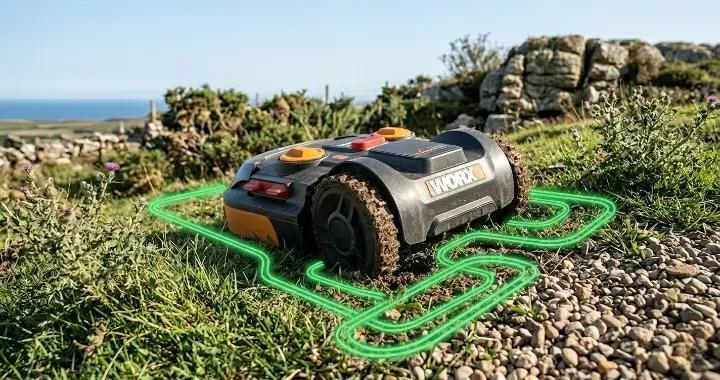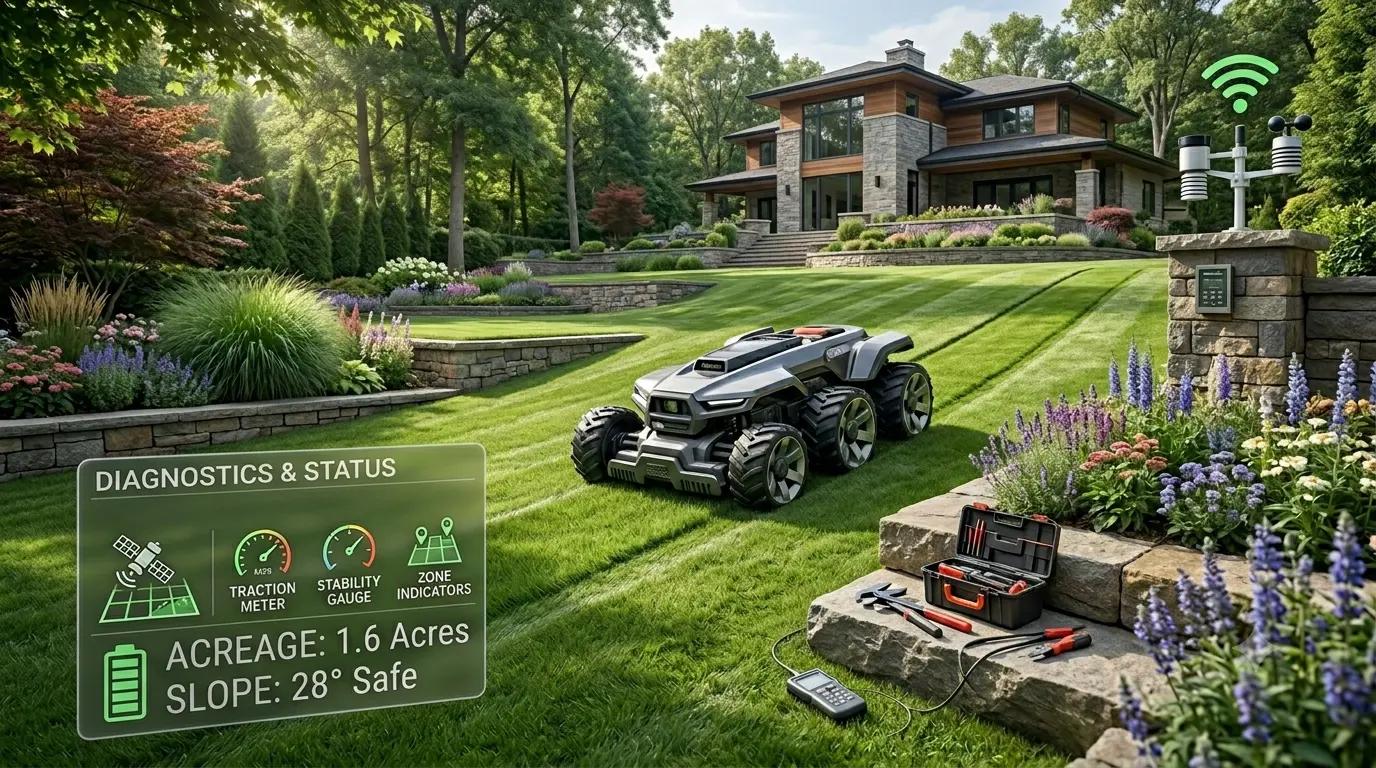

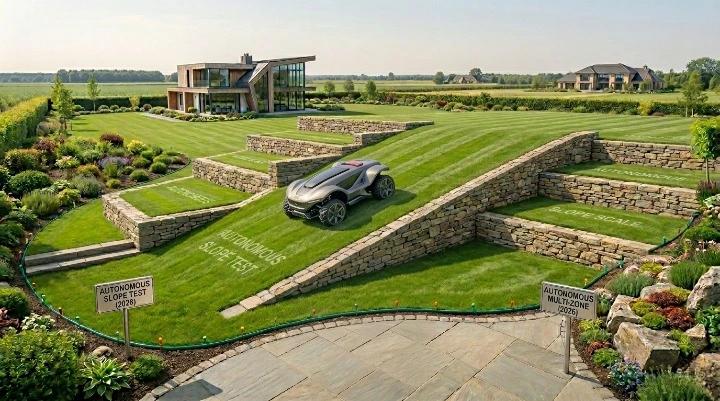
If your yard has hills, you may wonder whether a robot lawn mower can actually handle them.
The short answer is yes. Many modern robot mowers can work on slopes surprisingly well. Some models are designed for gentle inclines, while others can tackle steep terrain that would be difficult or tiring to mow with a traditional mower.
However, slope ratings alone do not tell the whole story.
A mower that performs perfectly on a smooth 35% slope may struggle on a rough hill with loose soil, wet grass, or sharp turns. In real-world conditions, traction, drive system, lawn layout, and installation quality often matter just as much as the advertised slope capability.
This is why some homeowners are thrilled with their robot mower on hilly property, while others find that their mower slips, gets stuck, or leaves worn patches of grass behind.
In this guide, we'll explain how robot lawn mowers handle hills, what slope limits actually mean, the factors that affect performance, and which types of mowers are best suited for sloped lawns.
Can Robot Lawn Mowers Really Handle Hills?
Yes, many robot lawn mowers can handle hills, but their performance depends on the steepness of the slope and the design of the mower.
Older robot mowers were mainly built for flat lawns. They could manage small inclines, but steep hills often caused wheel slip, navigation problems, or uneven mowing results.
Today's premium models are much more capable. Improved wheel designs, better traction control, all-wheel-drive systems, and advanced navigation technology have made robot mowers a realistic option for many hilly properties.
That said, there is a big difference between handling a hill and handling it well.
For example, a mower may be able to climb a steep slope in a straight line but struggle when turning on the same hill. Some models can safely travel up and down a slope but lose traction when the grass is wet. Others may repeatedly wear down the same area of turf while navigating difficult terrain.
This is one reason why real-world user experiences can vary so much. Homeowners with steep yards often report that their mower has no problem climbing a hill, but the biggest challenges tend to appear during turns, after heavy rain, or on uneven ground.
Another important factor is the drive system. Two-wheel-drive robot mowers are usually sufficient for mild slopes. For steeper terrain, all-wheel-drive models can provide significantly better grip and stability, especially when moving across challenging sections of the lawn.
The good news is that most residential hills are well within the capabilities of today's better robot mowers. If your lawn has moderate slopes and a reasonably stable surface, a properly installed robot mower can usually maintain the area with very little effort from you.
The key is choosing a mower that matches your yard's conditions rather than focusing on advertised slope numbers alone. In the next section, we'll look at how slope ratings work and why many homeowners misunderstand what those numbers actually mean.
Understanding Slope Ratings: Percent vs Degrees
One of the biggest sources of confusion when shopping for a robot mower is slope ratings.
You might see one manufacturer claim that a mower can handle a 70% slope, while another advertises 35 degrees. At first glance, those numbers can seem completely different, making it difficult to compare models.
The important thing to know is that slope percentage and slope degrees are not the same measurement.
A slope percentage describes how much the ground rises vertically over a horizontal distance. A slope angle, measured in degrees, describes how steep the hill appears relative to flat ground.
Because of this difference, a 100% slope is not a vertical wall. It is actually equal to a 45-degree angle.
The table below shows some common conversions:
| Slope Rating | Approximate Angle |
|---|---|
| 35% | 19° |
| 50% | 27° |
| 70% | 35° |
| 80% | 39° |
| 100% | 45° |
This misunderstanding often leads homeowners to overestimate what a mower can handle.
For example, someone might see a robot mower advertised for an 80% slope and assume it can easily climb a 45-degree hill. In reality, an 80% slope is closer to 39 degrees, which is still extremely steep but noticeably less challenging than a true 45-degree incline.
Just as important, manufacturers usually test slope performance under controlled conditions. A mower that is rated for a 70% slope may achieve that number on dry grass with good traction and a smooth surface.
Real lawns are rarely that simple.
Wet grass, loose soil, bumps, tree roots, and uneven terrain can all reduce real-world climbing performance. In some situations, a mower may struggle on a slope that is technically below its advertised limit.
This is why experienced robot mower owners often focus less on the maximum slope rating and more on the overall design of the machine. Factors such as wheel grip, weight distribution, drive system, and navigation technology often have a bigger impact on daily performance than a single number in the specifications.
As a general rule, if your lawn has gentle to moderate hills, most quality robot mowers can handle them without difficulty. As slopes become steeper, however, the mower's design becomes increasingly important.
In the next section, we'll look at the four factors that have the biggest impact on how well a robot mower performs on hills, regardless of its advertised slope rating.
The 4 Factors That Actually Determine Hill Performance
When people compare robot mowers for hills, they often focus on one specification: maximum slope rating.
While that number is useful, it doesn't tell the whole story.
Two robot mowers with similar slope ratings can perform very differently on the same lawn. That's because real-world hill performance depends on several factors working together.
Understanding these factors will help you choose a mower that actually performs well on your property instead of simply looking impressive on a spec sheet.
Traction Matters More Than Raw Power
Many homeowners assume that climbing a hill is all about motor power.
In reality, traction is often the limiting factor.
A mower can have plenty of power, but if the wheels lose grip, it won't be able to transfer that power to the ground effectively. The result is wheel spinning, reduced climbing ability, and in some cases, damage to the lawn surface.
Traction becomes even more important on steep sections where the mower must repeatedly start, stop, and change direction.
Factors that affect traction include:
- Tire design
- Wheel size
- Weight distribution
- Grass moisture
- Soil conditions
This is one reason why some robot mowers perform well on a dry hillside but struggle after a rainstorm.
AWD vs 2WD on Slopes
The drive system plays a major role in how confidently a robot mower handles hills.
Most entry-level robot mowers use two-wheel drive (2WD). These models work well on relatively flat lawns and moderate slopes, but their grip can become limited as terrain becomes steeper.
All-wheel-drive (AWD) models distribute power across all four wheels. This helps improve traction, stability, and climbing performance.
The difference is especially noticeable when a mower encounters:
- Steep inclines
- Uneven ground
- Loose soil
- Areas with frequent direction changes
This is one reason the Husqvarna Automower 435X AWD is often recommended for challenging terrain. Many owners report that it handles steep sections reliably when other mowers would struggle.
That doesn't mean every yard needs AWD. For many suburban lawns with mild hills, a quality 2WD mower may be more than sufficient. However, as slopes become steeper, AWD becomes increasingly valuable.
Grass Conditions Can Change Everything
A hill that is easy to mow one day can become challenging the next.
Grass conditions have a surprisingly large impact on robot mower performance.
Wet grass is usually the biggest problem. When moisture reduces traction, even a mower with a strong drive system may struggle to maintain grip.
Long grass can also create additional resistance. This is one reason manufacturers often recommend manually cutting overgrown lawns before letting a robot mower take over maintenance.
Uneven surfaces can create similar challenges. Small holes, exposed roots, and soft patches of soil may not seem significant to a homeowner, but they can affect how a robot mower moves across a slope.
Before buying a robot mower for a hilly yard, it's worth evaluating not just the steepness of the lawn but also the overall surface quality.
Robot Lawn mower for a steep hill?
View DiscussionTurning on a Hill Is Often the Hardest Part
Many people focus on whether a robot mower can climb a hill.
A more important question is whether it can turn on that hill.
Moving straight uphill or downhill is relatively simple. Turning while maintaining traction is much harder.
During a turn, the mower shifts weight across its wheels while simultaneously changing direction. On steep slopes, this can increase wheel slip and place extra stress on the turf.
This helps explain why some homeowners report that their mower climbs hills successfully but leaves worn patches where it frequently turns. In online owner discussions, several users have noted that certain mowers can travel up and down steep slopes without issues but may damage grass during repeated turns on those same slopes.
For this reason, the best hill-performing robot mowers are not necessarily the ones with the highest advertised slope ratings. They are the ones that maintain traction, navigate smoothly, and minimize turf damage while operating on challenging terrain day after day.
When evaluating a robot mower for a hilly property, it's important to look beyond the marketing numbers and consider how all four of these factors work together in real-world conditions.
Robot Lawn mower for a steep hill?
View DiscussionWhen Robot Mowers Struggle on Hills
Modern robot mowers are more capable than ever, but even the best models have limits.
Understanding those limits is important because it helps set realistic expectations. In many cases, the problem isn't that the mower is poorly designed. It's simply being asked to work in conditions that are more difficult than its specifications suggest.
Here are the situations where robot mowers are most likely to struggle on hilly lawns.
Wet Grass and Slippery Soil
Water is one of the biggest enemies of traction.
When grass becomes wet from rain, irrigation, or morning dew, the mower's wheels have less grip on the surface. On flat ground, this may not cause any noticeable issues. On a slope, however, even a small loss of traction can affect performance.
You may notice the mower:
- Slipping while climbing
- Sliding slightly during turns
- Taking longer to complete certain areas
- Leaving wheel marks on the lawn
This is why many manufacturers recommend avoiding mowing during or immediately after heavy rain, especially on steep terrain.
If your lawn stays wet for long periods, choosing a mower with strong traction and a more aggressive wheel design becomes even more important.
Sharp Transitions and Uneven Ground
Not all slopes are difficult because they are steep.
Sometimes the bigger challenge is how the slope changes.
For example, a mower may handle a long, smooth incline without any trouble. But if that slope suddenly transitions into a flat area, a ditch, or a bump, the mower can lose stability.
Common trouble spots include:
- ✕Drainage channels
- ✕Erosion areas
- ✕Tree roots
- ✕Deep ruts
- ✕Sudden drop-offs
These features can cause the mower to lift a wheel, lose traction, or become temporarily stuck.
Before installing a robot mower, it's worth walking your lawn and identifying these problem areas. A few simple landscaping adjustments can sometimes improve mower performance more than upgrading to a more expensive model.
Extremely Steep Sections
This is where many homeowners get caught by marketing claims.
A robot mower may be rated for a steep slope, but that does not mean every part of your yard is suitable for robotic mowing.
For example, some premium models can handle slopes approaching 70% or even 80% under ideal conditions. However, those ratings typically assume dry grass, good traction, and a smooth surface.
A steep section becomes much more challenging when combined with:
- ✕Wet conditions
- ✕Loose soil
- ✕Frequent turns
- ✕Obstacles near the bottom of the hill
- ✕Uneven terrain
In practice, a mower operating near its maximum slope rating will usually have less margin for error.
This is one reason experienced owners often recommend choosing a mower with more hill-climbing capability than your yard technically requires. A mower operating comfortably within its limits will generally perform more reliably over time.
Slopes That Require Frequent Turning
A hill may not be especially steep, yet still create problems for a robot mower.
The issue is often the layout rather than the incline itself.
Narrow side yards, curved hillsides, and irregular lawn shapes force the mower to make frequent corrections and turns. Every turn increases the chance of wheel slip and turf wear.
Over time, repeated turning in the same location can create visible tracks or worn patches, particularly on soft ground.
This is why navigation quality matters almost as much as climbing ability. A mower that plans efficient routes and avoids excessive turning will often produce better results than a mower with a slightly higher slope rating.
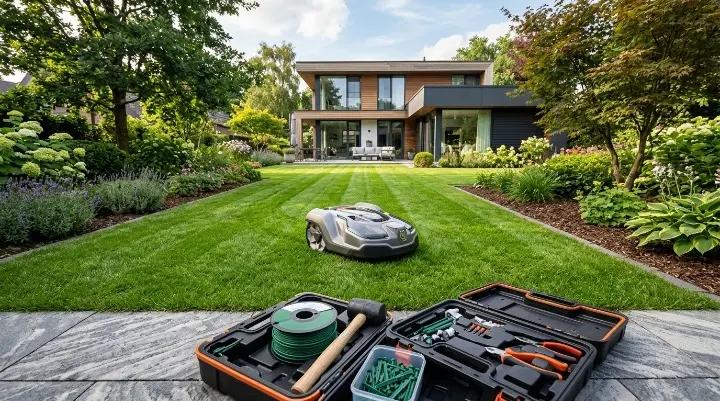
The good news is that many of these challenges can be reduced through proper installation. Charging station placement, boundary wire layout, and RTK setup can all have a significant impact on how well a robot mower handles a sloped lawn.
In the next section, we'll look at how to install a robot mower on hills to maximize traction, reliability, and overall performance.
How to Install a Robot Mower on a Sloped Lawn
Choosing the right robot mower is only part of the equation.
Even a high-end model can struggle on hills if it is installed poorly. On the other hand, a properly planned installation can improve traction, reduce wear on the lawn, and help the mower navigate difficult areas more reliably.
If your yard includes slopes, spending extra time on setup is often worth the effort.
Choose a Safe Charging Station Location
The charging station should always be placed on stable, level ground whenever possible.
Many homeowners make the mistake of placing the charging station at the top or bottom of a steep slope simply because it seems convenient. This can make docking more difficult and increase the chances of navigation errors.
A better approach is to place the charging station on a flat section of the lawn with a clear approach path.
When selecting a location, look for:
- Level ground
- Good drainage
- A clear path in front of the station
- Strong satellite visibility for RTK models
The easier it is for the mower to enter and leave the charging station, the more reliable the entire system will be.
Plan Boundary Wires Carefully
For boundary wire models, wire placement becomes more important on hills.
A wire installed too close to the edge of a steep slope can create unnecessary risks. If the mower loses traction while turning, it may repeatedly approach the boundary or struggle to stay within the intended mowing area.
As a general rule, steep drop-offs, retaining walls, ponds, and other hazards should have additional clearance between the boundary wire and the obstacle.
Pay special attention to:
- Hills near driveways
- Slopes leading toward roads
- Pond edges
- Drainage ditches
- Retaining walls
A few extra inches of clearance can make a significant difference in long-term reliability.
Optimize RTK Signal Placement
RTK robot mowers eliminate boundary wires, but they still require a strong satellite signal.
This becomes especially important on hilly properties.
Large trees, dense vegetation, buildings, and steep terrain can partially block satellite visibility, reducing positioning accuracy in certain areas of the lawn.
To improve RTK performance:
- ✔Install the RTK antenna in an open location
- ✔Avoid placing the antenna near large structures
- ✔Minimize overhead tree coverage when possible
- ✔Test signal quality before final installation
Many RTK mowing issues that appear to be traction problems are actually positioning problems. A mower that loses location accuracy may stop, reroute unnecessarily, or behave unpredictably near difficult terrain.
Create Recovery Paths for Difficult Areas
Every sloped lawn has areas that are more challenging than others.
Instead of expecting the mower to perform perfectly everywhere, it's often better to identify these areas during installation and plan accordingly.
Look for locations where the mower may need extra space to maneuver, such as:
- The bottom of steep hills
- Tight corners
- Narrow side yards
- Areas with exposed roots
- Sections where slopes change direction
Giving the mower more room in these locations can reduce wheel spin, improve navigation, and minimize turf damage.
It is also a good idea to observe the mower closely during its first few mowing cycles. Most installation problems become obvious within the first week, and small adjustments are usually much easier than redesigning the entire setup later.
A properly installed robot mower won't magically overcome every challenge on a steep property. However, good installation can often make the difference between a mower that constantly gets stuck and one that quietly maintains the lawn with very little attention.
Once the installation is optimized, the next step is choosing a mower that is actually designed for hilly terrain. Let's look at some of the best robot mowers for slopes and challenging landscapes.
Best Robot Lawn Mowers for Hills
Not every hilly yard needs the most powerful robot mower on the market.
The best choice depends on your slope severity, lawn size, and overall terrain. A yard with a few gentle inclines has very different requirements than a property with steep banks, uneven ground, and multiple mowing zones.
For most homeowners, the goal is not simply finding a mower that can climb the steepest hill. It's finding one that can handle the terrain consistently without getting stuck, damaging the lawn, or requiring constant supervision.
The following two models stand out for different reasons.
Lymow One
The Lymow One was designed with challenging terrain in mind.
Unlike many traditional robot mowers that rely on standard wheels, the Lymow One uses a tracked drive system. This design increases ground contact and helps improve traction on slopes, uneven ground, and loose surfaces.
For homeowners with larger properties or demanding terrain, this approach offers several advantages.
The tracked design can help the mower maintain grip in areas where conventional wheel-based mowers may struggle. It can also provide better stability when crossing rough sections of lawn or climbing uneven slopes.
Another advantage is capacity. The Lymow One is designed for larger mowing areas, making it a practical option for rural properties, estates, and large residential lots where terrain is often more challenging.
That said, the Lymow One is still a relatively new platform compared to some long-established competitors. While early feedback has been promising, it does not yet have the decades-long track record of brands such as Husqvarna.
Best for:
- ✔Steep terrain
- ✔Large properties
- ✔Rough ground
- ✔Homeowners who want maximum traction
Husqvarna Automower 435X AWD
When discussing robot mowers for hills, the Husqvarna Automower 435X AWD is almost always part of the conversation.
Husqvarna has spent years building a reputation in the robotic mowing industry, and the 435X AWD remains one of the most respected options for sloped lawns.
Its all-wheel-drive system allows all four wheels to actively contribute to climbing and maneuvering. This helps improve stability on hills while maintaining the navigation quality that Husqvarna is known for.
One reason the 435X AWD is frequently recommended by experienced owners is reliability. In online discussions, many users report that it handles steep sections successfully when installed correctly and used within its intended limits.
The mower is also backed by a large dealer network and an established support ecosystem, which can be valuable for homeowners who prefer a mature product with a long service history.
While newer models may advertise higher slope ratings, the 435X AWD remains one of the safest choices for homeowners who prioritize proven performance over headline specifications.
Best for:
- ✔Complex lawns
- ✔Steep residential yards
- ✔Homeowners who value reliability
- ✔Long-term ownership
Which One Is Right for Your Yard?
The answer depends on your priorities.
If your property includes particularly steep terrain, rough ground, or large open areas, the Lymow One's tracked design may provide the extra traction needed to tackle difficult conditions.
If your lawn is complex but you prefer a platform with a long track record, extensive support, and years of real-world use, the Husqvarna Automower 435X AWD is hard to overlook.
For many homeowners, both models offer more hill-climbing capability than they will ever need. The better question is not which mower can handle the steepest slope on paper, but which mower best matches the specific conditions of your yard.
Before making a decision, take time to evaluate your lawn's actual challenges. A smooth 35% slope may be easier to manage than a rough 25% slope filled with roots, bumps, and tight turns.
Choosing the mower that matches your terrain—not just the highest advertised slope rating—will usually lead to better results and fewer headaches over the long term.
Are Robot Mowers Worth It for Hilly Yards?
For many homeowners, hilly lawns are one of the strongest arguments for buying a robot mower.
Mowing steep slopes with a traditional mower can be physically demanding, time-consuming, and in some cases, uncomfortable or even unsafe. The steeper the terrain becomes, the more attractive automation starts to look.
However, whether a robot mower is worth the investment depends on your expectations and the conditions of your yard.
If your lawn consists of moderate slopes that fall within the mower's capabilities, a robot mower can save dozens of hours of work every year. Instead of spending weekends pushing a mower uphill, the machine can maintain the grass automatically while you focus on other things.
The benefits often go beyond convenience.
Because robot mowers cut frequently, they typically remove only a small amount of grass at a time. This helps maintain a more consistent lawn appearance and reduces the need for major mowing sessions after periods of rapid growth.
For larger properties, the savings can be significant. Many homeowners with challenging terrain choose robot mowers after realizing how much time and money they spend on lawn care each season.
At the same time, robot mowers are not a perfect solution for every hill.
If your property contains extremely steep banks, severe erosion, large exposed roots, or terrain that exceeds the mower's design limits, some areas may still require occasional manual maintenance.
You should also expect a small amount of ongoing upkeep. Blades need to be replaced periodically, the mower should be cleaned when necessary, and navigation settings may need occasional adjustments as the landscape changes.
The key is understanding that a robot mower is a maintenance tool, not a miracle machine.
Most robot mowers perform best when they maintain an already manageable lawn. They are excellent at keeping grass under control week after week, but they are less effective when asked to tackle overgrown areas or terrain that would challenge even a traditional mower.
For homeowners with steep but mowable lawns, the value proposition is often straightforward:
- Less physical effort
- More consistent lawn care
- Reduced mowing time
- Lower long-term maintenance workload
The return on investment becomes even more compelling if you currently pay for lawn care services. Professional mowing costs can add up quickly over several years, especially for properties with difficult terrain that require extra labor.
In those situations, a quality robot mower can often pay for itself over time while providing the convenience of automatic lawn maintenance.
Ultimately, most hilly yards do not need a robot mower. But many homeowners who own one would not want to go back to mowing slopes manually.
If your lawn falls within the capabilities of a well-chosen robot mower and you are willing to invest in proper installation, the answer is often yes—a robot mower can be well worth it for a hilly yard.
Final Verdict
So, do robot lawn mowers work on hills?
Yes, they do—but the answer depends on the mower, the slope, and the overall condition of your yard.
Modern robot mowers are far more capable than many people realize. Quality models can handle moderate slopes with ease, while premium AWD and tracked models can tackle terrain that would have been challenging for robotic mowing just a few years ago.
That said, maximum slope ratings don't tell the whole story.
Traction, drive system, grass conditions, lawn layout, and installation quality all play major roles in real-world performance. A mower that is perfectly suited for one hilly property may struggle on another with the same advertised slope.
For homeowners with challenging terrain, models such as the Lymow One and Husqvarna Automower 435X AWD demonstrate how far robot mower technology has come. When matched to the right lawn and installed correctly, they can dramatically reduce the time and effort required to maintain a sloped yard.
Before buying, take the time to evaluate your lawn's actual conditions rather than focusing only on the steepest section. The best robot mower is not necessarily the one with the highest slope rating—it's the one that fits your property and can operate reliably day after day.
For many homeowners, that means a robot mower isn't just capable of handling hills. It's one of the easiest ways to stop mowing them yourself.