
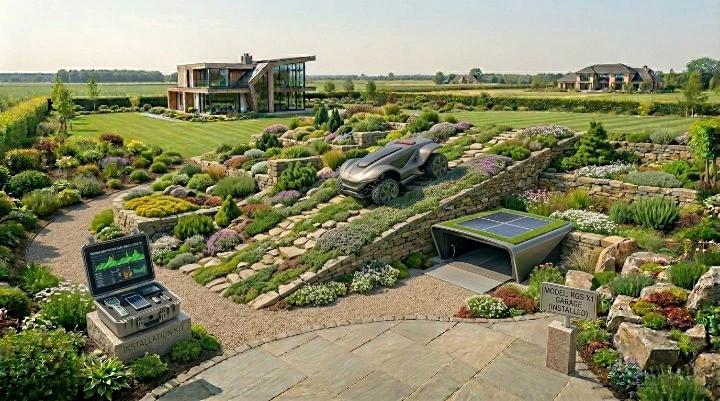
Robot mowers are built to live outdoors. They can handle rain, changing temperatures, and daily exposure to the elements. Because of that, many homeowners wonder whether a robot mower garage is actually necessary or just an expensive accessory.
The short answer is that most robot mowers do not require a garage to function properly. However, a garage can provide extra protection for both the mower and its charging station, especially in areas with intense sunlight, heavy rain, hail, or falling debris.
A well-designed garage may also help reduce long-term wear on plastic components, keep the charging station cleaner, and make the mower less visible when parked. On the other hand, if your charging station is already located in a shaded and protected area, the benefits may be much smaller.
In this guide, you'll learn when a robot mower garage is worth buying, what it actually protects, how to choose the right design, and whether building your own shelter makes sense.
Do Robot Mowers Really Need a Garage?
If you're looking for a simple yes-or-no answer, the answer is usually no.
Manufacturers design robot mowers to stay outside throughout the mowing season. Models from brands like Husqvarna, Lymow, Segway Navimow, and many others are built to operate in rain and spend long hours outdoors.
That said, "not required" does not necessarily mean "no benefit."
A robot mower garage is similar to a carport for a vehicle. Your car can sit in a driveway without one, but some protection from sun, weather, and debris can help reduce wear over time.
When a Garage Is Worth It
A robot mower garage makes the most sense when the charging station is fully exposed to the weather.
Common situations where a garage can be beneficial include:
- The charging station sits in direct sunlight for most of the day
- Your area experiences frequent heavy rain or hail
- Tree sap, leaves, or bird droppings regularly fall onto the mower
- You own an expensive robotic mower and want additional protection
- The mower remains outdoors for many months each year
Sun exposure is often the biggest reason homeowners add a garage.
In discussions among robot mower owners, many users from hot regions such as Florida report that their primary goal is not protecting the mower itself, but protecting the charging station from constant heat and UV exposure. Long periods of direct sunlight can gradually age plastic surfaces and increase temperatures around the dock while the mower is charging.
A garage can also help keep the charging area cleaner. Less debris around the charging contacts often means less maintenance throughout the season.
When You Probably Don't Need One
There are also many situations where buying a garage offers little practical value.
If your charging station is already located under a deck, beside a building, under a large tree, or in another naturally shaded location, you may already have most of the protection a garage provides.
Many experienced robot mower owners choose not to purchase a garage for this reason. In community discussions, a common opinion is that once the charging station is protected from direct sunlight, the benefits become much smaller.
You may not need a garage if:
- ✕The charging station is already shaded most of the day
- ✕The mower is stored indoors during winter
- ✕Your climate is relatively mild
- ✕The mower is naturally protected by a patio, deck, or overhang
Are robot mower shelters worth the money?
View PostFor some homeowners, a garage is mainly an aesthetic upgrade rather than a necessity. It can make the charging station look neater and help the mower blend into the landscape, but it may not significantly improve performance.
The key question is not whether robot mowers need a garage. The better question is whether your specific charging station is exposed enough to benefit from one.
If the dock spends all day in direct sun and weather, a garage can be a worthwhile investment. If the dock is already sheltered, you may be better off spending that money elsewhere.
What Does a Robot Mower Garage Actually Protect?
One of the biggest misconceptions about robot mower garages is that they dramatically increase the lifespan of the mower itself.
In reality, modern robotic mowers are already designed for outdoor use. They are built to handle rain, temperature changes, and daily exposure to the elements.
The bigger benefit of a garage is reducing long-term exposure to conditions that can slowly wear down both the mower and its charging station over time.
Protection From Sun and UV Exposure
For many homeowners, protection from sunlight is the main reason to install a robot mower garage.
Continuous UV exposure can gradually fade plastic surfaces, age rubber components, and increase temperatures around the charging station. While manufacturers design these products for outdoor use, years of direct sunlight can still contribute to cosmetic wear.
Heat can also become a factor during charging. A mower sitting under direct afternoon sun may become significantly warmer than one parked in a shaded area.
This is especially important in regions with long, hot summers where the charging station receives sunlight for most of the day.
A garage does not eliminate heat completely, but it can reduce direct solar exposure and help create a cooler environment around the dock.
Protection for the Charging Station
Many people focus on protecting the mower, but the charging station is often the component that benefits most from a garage.
Unlike the mower, which spends much of its time moving around the lawn, the charging station remains in the same location every day of the season.
Over time, the dock is exposed to:
- Sunlight
- Rain
- Dust
- Leaves
- Tree sap
- Bird droppings
A garage acts as a roof over the charging area, helping keep these materials away from sensitive charging contacts and electrical components.
This does not make the station waterproof, but it can reduce the amount of cleaning and maintenance required throughout the year.
Protection From Rain, Hail, and Debris
Most robot mowers can operate in rain, and many models are rated to withstand wet conditions.
However, weather resistance is not the same as weather immunity.
Heavy rain, hail, falling branches, pine needles, and other debris can still create unnecessary wear over time. A garage provides an extra layer of protection when the mower is parked and charging.
This benefit becomes more noticeable in areas where storms are frequent or where trees regularly drop leaves, seeds, or sap onto the mower.
Even a simple shelter can help keep the docking area cleaner and reduce the amount of debris that accumulates around the charging station.
Visibility, Pets, and Curious Children
A garage can also offer practical benefits that are not related to weather.
Some homeowners prefer to keep their mower less visible when it is parked. A covered charging area can help the mower blend into the landscape and attract less attention from visitors or passersby.
For families with young children, a garage may provide an additional layer of separation between the mower and curious hands. While robotic mowers include multiple safety features, the cutting blades are still sharp and should not be treated as toys.
In online discussions, some robot mower owners have mentioned building shelters partly because young children were constantly interested in touching or inspecting the mower whenever it returned to the charging station.
A garage is not a safety device, but it can make the mower less accessible when it is not in use.
*Must Have for Robotic Lawnmowers* DIY Locked Storage/Home Base!
View DiscussionWhat a Garage Cannot Protect Against
A robot mower garage is useful, but it is important to understand its limits.
A garage cannot fully protect against:
- ✕Theft
- ✕Flooding
- ✕Lightning strikes
- ✕Power surges
- ✕Extreme storm damage
It is also not a replacement for proper winter storage. In regions with freezing temperatures, many manufacturers still recommend storing the mower indoors during the off-season.
The most realistic way to view a robot mower garage is as a protective shelter rather than a protective vault.
It helps reduce everyday exposure to sun, rain, debris, and dirt, but it does not eliminate every risk associated with keeping a mower outdoors.
Types of Robot Mower Garages
Robot mower garages come in many shapes and styles, but most fall into four main categories: wooden, plastic, metal, and DIY shelters.
The best choice depends on your budget, local weather, and how important appearance is in your garden.
Before buying a garage, it helps to understand the strengths and weaknesses of each option.
Wooden Garages
Wooden garages are among the most popular choices because they look natural in a garden setting.
Many homeowners prefer wood because it blends well with flower beds, fences, and landscaping features. Some designs even resemble miniature houses, making the charging station less noticeable.
Wood can also be easy to customize. You can paint it, stain it, or modify the size to fit a particular mower.
The downside is maintenance.
Unlike plastic or metal, wood is affected by moisture and sunlight over time. Depending on your climate, you may need to apply a sealant or protective finish every few years to prevent cracking, warping, or fading.
For homeowners who value appearance and don't mind occasional maintenance, a wooden garage is often the most attractive option.
Plastic Garages
Plastic garages are usually the most affordable ready-made solution.
They are lightweight, weather-resistant, and require very little maintenance. Most can simply be placed over the charging station without much assembly.
Another advantage is that plastic does not rot, rust, or require painting.
However, not all plastic garages are created equal. Lower-quality models may become brittle after years of UV exposure, especially in hot climates with intense sunlight.
Appearance can also be a drawback. Some plastic shelters look more functional than decorative, which may not appeal to homeowners who care about garden aesthetics.
For most people, though, plastic offers a practical balance between price, protection, and convenience.
Metal Garages
Metal garages are typically chosen for durability.
Aluminum and galvanized steel designs can withstand years of outdoor exposure with minimal maintenance. They are often stronger than wood or plastic and can handle harsh weather conditions well.
This makes them a good choice for areas that experience strong winds, heavy rain, or occasional hail.
The main concern with metal is heat.
A poorly ventilated metal shelter can become quite warm when exposed to direct summer sunlight. While this is rarely a major issue, it is one reason ventilation should never be overlooked when choosing any robot mower garage.
Metal garages also tend to have a more modern appearance, which may fit some gardens better than others.
DIY Shelters
Not every robot mower garage needs to be purchased.
Many robot mower owners build simple shelters using leftover materials they already have at home. In online communities, it is common to see garages made from scrap wood, roofing panels, storage bins, or other inexpensive materials.
The biggest advantage of DIY is cost.
A homemade shelter can often provide basic protection for a fraction of the price of a commercial garage. It also allows you to customize the size, roof design, and appearance.
The trade-off is that results depend entirely on the quality of the build. Poor ventilation, inadequate drainage, or incorrect placement can sometimes create new problems rather than solve existing ones.
For homeowners who enjoy DIY projects, building a simple shelter can be a practical and budget-friendly alternative.
At the end of the day, there is no universally best garage material. A wooden garage may look great in one garden, while a simple plastic shelter may be perfectly adequate in another.
The most important factors are weather protection, ventilation, and compatibility with your mower's charging station.
How to Choose the Right Robot Mower Garage
Many robot mower garages look similar at first glance. Most have a roof, open sides, and enough space for the mower to reach the charging station.
However, appearance alone doesn't tell you whether a garage will work well with your mower and yard.
A good garage should protect the charging station without interfering with docking, airflow, or navigation. Before buying one, pay attention to the following factors.
Size and Clearance
The first thing to check is whether the garage is actually large enough for your mower and charging station.
Many homeowners focus only on the mower's dimensions, but the docking process requires additional space around the station. A mower needs room to approach, align itself, and park correctly.
A garage that is too narrow or too low can make docking less reliable, especially on uneven ground.
Before purchasing, check:
- ✔Garage width and height
- ✔Charging station dimensions
- ✔Recommended clearance around the dock
- ✔Future mower upgrades you may make
If you're between two sizes, choosing the slightly larger option is usually the safer choice.
Ventilation Matters More Than Most People Think
A common mistake is assuming that more enclosure automatically means better protection.
Robot mower garages should provide shelter, but they should not trap heat.
During summer, a fully enclosed structure can become surprisingly warm, particularly if it has a dark roof and receives direct sunlight throughout the day.
Good garages typically include open sides, raised roofs, or other features that allow air to circulate naturally.
This is especially important in hot climates where the mower may spend several hours charging each day.
When comparing garages, ventilation is often more important than having solid walls on every side.
Weather Resistance
Not all garages provide the same level of weather protection.
If you live in an area with frequent rain, storms, or strong sunlight, pay close attention to the roof design and materials.
Look for features such as:
- ✔A sloped roof for water runoff
- ✔UV-resistant materials
- ✔Durable outdoor construction
- ✔Corrosion-resistant hardware
A garage does not need to be completely enclosed to be effective. In most cases, a well-designed roof provides the majority of the protection homeowners are looking for.
Easy Access to the Charging Station
Sooner or later, you'll need access to the charging station.
You may need to clean charging contacts, inspect cables, reset the dock, or make adjustments during installation.
Some garages look attractive but make routine maintenance unnecessarily difficult.
Before buying, consider how easily you can reach:
- Charging contacts
- Power cables
- Boundary wire connections
- Docking indicators and controls
A design that allows quick access can save frustration later.
Appearance and Garden Integration
Function should come first, but appearance still matters.
A robot mower garage becomes a permanent feature in your yard for most of the mowing season. Choosing a design that fits your landscape can make the charging area look more intentional and less like a piece of outdoor equipment.
Wooden garages often blend naturally into traditional gardens, while metal and modern composite designs may suit contemporary landscapes better.
That said, don't sacrifice functionality for appearance alone. A beautiful garage that causes docking problems or traps heat is ultimately a poor investment.
The best robot mower garage is usually the one you barely notice. It protects the mower, allows reliable docking, and fits naturally into the garden without drawing attention to itself.
Will a Garage Affect GPS, RTK, or Navigation?
This is one of the most common concerns among robot mower owners, especially as RTK and camera-based navigation systems become more popular.
The good news is that most robot mower garages do not cause navigation problems when installed correctly.
However, certain garage designs can interfere with signals, visibility, or docking performance if they are too enclosed or placed in the wrong location.
The impact depends largely on the navigation technology your mower uses.
RTK Robot Mowers
RTK robot mowers rely on satellite signals to determine their position with high accuracy.
Because of this, some homeowners worry that adding a garage will block GPS reception and affect mowing performance.
In most cases, the mower only spends a short time inside the garage while charging. Once it leaves the shelter and returns to an open area, it can receive satellite signals normally.
The bigger concern is usually the RTK reference station rather than the mower itself.
If your RTK antenna is mounted separately in a location with a clear view of the sky, a garage over the charging station is unlikely to create problems.
Issues are more likely to occur when a garage is unusually large, heavily enclosed, or placed under dense tree cover where satellite reception is already weak.
For RTK models, it is generally best to choose an open-sided garage with plenty of overhead clearance.
Boundary Wire Models
Boundary wire robot mowers are usually the least affected by garages.
These mowers navigate using perimeter wires and guide wires installed around the lawn rather than relying heavily on satellite positioning.
As long as the mower can enter and leave the charging station without obstruction, a garage rarely impacts navigation performance.
Most manufacturers design charging stations to work under simple shelters, which is why many aftermarket garages are specifically marketed toward boundary wire models.
When installation problems do occur, they are typically caused by limited docking space rather than signal interference.
Vision-Based Models
Some newer robot mowers use cameras, sensors, and AI-assisted navigation to understand their surroundings.
For these models, visibility matters more than signal reception.
A garage that creates deep shadows, narrow entrances, or unusual visual obstacles may occasionally make docking less consistent, particularly if the mower relies heavily on cameras near the charging area.
This does not mean camera-based mowers cannot use garages. Thousands of owners do so successfully.
The key is avoiding overly enclosed structures that force the mower to navigate through a dark tunnel-like entrance.
An open-front design usually works much better than a fully enclosed shelter.
The Most Common Garage-Related Navigation Mistake
The navigation system itself is often not the real problem.
The most common mistake is simply placing the garage too close to other obstacles.
Walls, fences, garden beds, decorative stones, and storage boxes can reduce the amount of space available for docking. Even a mower with excellent navigation may struggle if the approach path is too narrow.
Before installing a garage, make sure the charging station still has enough open space around it for smooth entry and exit.
In most situations, a well-designed garage will not affect GPS, RTK, or navigation at all. Problems are usually caused by poor placement or an overly restrictive design rather than the garage itself.
Will a Garage Affect GPS, RTK, or Navigation?
This is one of the most common concerns among robot mower owners, especially as RTK and camera-based navigation systems become more popular.
The good news is that most robot mower garages do not cause navigation problems when installed correctly.
However, certain garage designs can interfere with signals, visibility, or docking performance if they are too enclosed or placed in the wrong location.
The impact depends largely on the navigation technology your mower uses.
RTK Robot Mowers
RTK robot mowers rely on satellite signals to determine their position with high accuracy.
Because of this, some homeowners worry that adding a garage will block GPS reception and affect mowing performance.
In most cases, the mower only spends a short time inside the garage while charging. Once it leaves the shelter and returns to an open area, it can receive satellite signals normally.
The bigger concern is usually the RTK reference station rather than the mower itself.
If your RTK antenna is mounted separately in a location with a clear view of the sky, a garage over the charging station is unlikely to create problems.
Issues are more likely to occur when a garage is unusually large, heavily enclosed, or placed under dense tree cover where satellite reception is already weak.
For RTK models, it is generally best to choose an open-sided garage with plenty of overhead clearance.
Boundary Wire Models
Boundary wire robot mowers are usually the least affected by garages.
These mowers navigate using perimeter wires and guide wires installed around the lawn rather than relying heavily on satellite positioning.
As long as the mower can enter and leave the charging station without obstruction, a garage rarely impacts navigation performance.
Most manufacturers design charging stations to work under simple shelters, which is why many aftermarket garages are specifically marketed toward boundary wire models.
When installation problems do occur, they are typically caused by limited docking space rather than signal interference.
Vision-Based Models
Some newer robot mowers use cameras, sensors, and AI-assisted navigation to understand their surroundings.
For these models, visibility matters more than signal reception.
A garage that creates deep shadows, narrow entrances, or unusual visual obstacles may occasionally make docking less consistent, particularly if the mower relies heavily on cameras near the charging area.
This does not mean camera-based mowers cannot use garages. Thousands of owners do so successfully.
The key is avoiding overly enclosed structures that force the mower to navigate through a dark tunnel-like entrance.
An open-front design usually works much better than a fully enclosed shelter.
The Most Common Garage-Related Navigation Mistake
The navigation system itself is often not the real problem.
The most common mistake is simply placing the garage too close to other obstacles.
Walls, fences, garden beds, decorative stones, and storage boxes can reduce the amount of space available for docking. Even a mower with excellent navigation may struggle if the approach path is too narrow.
Before installing a garage, make sure the charging station still has enough open space around it for smooth entry and exit.
In most situations, a well-designed garage will not affect GPS, RTK, or navigation at all. Problems are usually caused by poor placement or an overly restrictive design rather than the garage itself.
How to Install a Robot Mower Garage Correctly
Installing a robot mower garage is usually straightforward, but small mistakes during setup can affect docking performance, drainage, and long-term stability.
Most issues are not caused by the garage itself, but by poor placement or insufficient space around the charging station.
A good installation focuses on three things: location, stability, and clear access for the mower.
Choosing the Best Location
The location of your garage has a bigger impact than the garage design in many cases.
Even a high-quality garage can perform poorly if it is placed in a difficult area for the mower to reach.
The ideal location is usually a flat, open space with minimal obstacles around the docking path.
Before final installation, check:
- ✔The ground is level and stable
- ✔The mower has a clear approach path
- ✔The charging station is not blocked by walls or tight corners
- ✔The area is not prone to flooding or standing water
It is also important to consider sunlight. While garages are often used for shade, placing them in extremely dark or enclosed corners can sometimes make docking less reliable for vision-based models.
Leaving Enough Docking Space
One of the most common installation mistakes is placing the garage too close to the charging station.
Robot mowers need space to align themselves properly before docking. If the entrance is too narrow or the approach path is too short, the mower may struggle to park consistently.
A simple way to think about it is to imagine the mower needs a “runway” before entering the garage.
Make sure there is enough open space in front of the entrance so the mower can:
- Detect the charging station early
- Adjust its angle gradually
- Enter the garage smoothly without sudden turns
If the space is too tight, even a well-designed garage may cause repeated docking errors.
Avoiding Common Installation Mistakes
Many performance issues come from small but avoidable setup errors.
One common mistake is installing the garage on uneven ground. Even a slight tilt can affect water drainage and may cause the structure to shift over time.
Another issue is ignoring cable placement. Charging cables should be positioned so they are not pinched, stretched, or exposed at the entrance area.
It is also important not to block sensors or navigation paths. Decorative items, stones, or garden borders placed too close to the garage can interfere with the mower’s approach route.
A simple checklist during installation can prevent most problems:
- The garage sits flat on stable ground
- The charging station is centered under the roof
- Cables are safely routed and protected
- The entrance is completely unobstructed
- The mower can enter and exit in a straight or gently curved path
When installed correctly, a robot mower garage should feel almost invisible in daily use. The mower should enter and leave it naturally, without hesitation or repeated corrections.
DIY Robot Mower Garage: Is It Worth Building One?
DIY robot mower garages are very common among homeowners who want basic protection without paying for a pre-built shelter.
In many cases, you don’t actually need advanced tools or construction skills. A simple roof structure or improvised cover can already provide enough protection for the charging station.
But whether DIY is a good idea depends on what you expect from the garage in the first place.
Why Many Owners Choose DIY
The main reason people build their own garage is cost.
A basic DIY shelter can often be made using leftover wood, plastic panels, or simple outdoor materials. In online communities, it is common to see setups built from repurposed storage boxes, small sheds, or even modified garden materials.
For many users, the goal is not aesthetics, but function.
A simple DIY garage can still provide:
- Basic protection from direct sunlight
- Reduced exposure to rain and debris
- A simple cover for the charging station
- A low-cost alternative to commercial models
Another advantage is flexibility. You can adjust the size and shape based on your exact mower and charging setup, which is not always possible with pre-made products.
Are robot mower shelters worth the money?
View PostThe Main Drawbacks of DIY Shelters
While DIY solutions are attractive from a cost perspective, they also come with trade-offs.
The biggest issue is consistency. Unlike commercial garages, DIY structures are not tested for wind resistance, drainage, or long-term durability.
This can lead to problems such as:
- ✕Water pooling on flat or poorly angled roofs
- ✕Weak structural stability in strong wind conditions
- ✕Insufficient ventilation during hot weather
- ✕Misalignment with the charging station over time
Another common issue is usability. A garage that looks fine at first may become inconvenient if it blocks access to the charging station or makes maintenance more difficult.
DIY shelters also tend to age faster, especially if materials are not weather-treated.
Simple DIY Designs That Actually Work
Not all DIY garages need to be complex to be effective.
Some of the most practical designs are also the simplest. The key is to focus on covering the charging station while keeping the structure open and well-ventilated.
A few commonly used approaches include:
- A simple slanted roof attached to fence posts or wooden frames
- A repurposed plastic storage box with a cut-out entrance
- A lightweight wooden cover placed over the docking station
These designs work because they follow the same basic principle as commercial garages: they block direct sun and rain while keeping the front open for easy docking.
In most cases, a successful DIY garage is less about construction quality and more about correct placement and proper clearance around the mower’s docking path.
For homeowners who enjoy small garden projects, DIY can be a practical solution. But for those who want long-term stability with minimal maintenance, a pre-built garage is usually the more reliable option.
Best Robot Mower Garages for Different Needs
There is no single robot mower garage that works best for everyone.
The right choice depends on your budget, climate, mower type, and how much importance you place on appearance versus pure function.
Instead of focusing on one “best overall” option, it is more useful to match the garage type to your specific situation.
Best Budget Option
If your main goal is basic protection at the lowest possible cost, a simple plastic or lightweight shelter is usually the most practical choice.
These garages focus on function rather than design. They are easy to install and typically require little to no maintenance over time.
They work well for homeowners who mainly want to protect the charging station from direct rain and sunlight without investing in a premium structure.
In most cases, budget garages are best suited for:
- ✔Small to medium lawns
- ✔Mild to moderate weather conditions
- ✔Users who prioritize function over appearance
While they may not be visually impressive, they usually get the job done for everyday protection.
Best Wooden Garage
Wooden garages are often chosen by homeowners who care about how their garden looks as much as how it functions.
They blend naturally into outdoor environments and can be matched with fences, sheds, or garden furniture. This makes them a popular option for landscaped yards.
Compared to plastic or metal, wooden garages tend to feel more like a garden feature rather than an add-on product.
They are a strong choice if:
- Garden aesthetics are important
- You want a more natural or traditional look
- You are comfortable with occasional maintenance
The main trade-off is long-term upkeep, since wood is more sensitive to moisture and sunlight over time.
Best Garage for Sunny Climates
In regions with strong sunlight and long summers, UV exposure becomes the main concern.
A good garage in this environment should prioritize shade coverage and heat reduction around the charging station.
Light-colored roofs and well-ventilated designs tend to perform better because they reduce heat buildup underneath the structure.
This type of garage is especially relevant for users who notice their charging station is exposed to direct sun for most of the day.
The key goal here is not full enclosure, but consistent shade throughout the hottest hours.
Best Garage for Rainy Areas
In wetter climates, protection from continuous rain and moisture is more important than aesthetics.
A well-designed roof with proper water runoff becomes the most critical feature.
Sloped roofing designs help prevent water from pooling, while durable materials reduce the risk of long-term weather damage.
This category is most suitable for:
- ✔Regions with frequent rainfall
- ✔Gardens with poor natural drainage
- ✔Users who want to reduce dirt and mud around the docking area
In these conditions, even a simple but well-angled shelter can significantly improve cleanliness around the charging station.
Best DIY Alternative
For homeowners who prefer flexibility and low cost, DIY solutions remain a strong alternative.
A good DIY garage does not need to be complex. The most important factor is whether it effectively covers the charging station while leaving enough space for smooth docking.
Simple structures often work surprisingly well when they are placed correctly and designed with airflow and clearance in mind.
DIY options are best for users who:
- ✔Enjoy small outdoor projects
- ✔Want a customized size or design
- ✔Are trying to minimize cost
While they may not match the durability of commercial products, they can offer solid performance when built with the right priorities.
Across all categories, the most important takeaway is that the “best” robot mower garage is not defined by materials alone, but by how well it matches your environment and usage pattern.
Are Robot Mower Garages Worth the Money?
Whether a robot mower garage is worth buying depends less on the product itself and more on your yard conditions and how exposed your charging station is.
For some homeowners, it is a useful long-term upgrade. For others, it is an optional accessory that does not change much in daily use.
The key is understanding what you are actually paying for.
When a Garage Is Worth It
A robot mower garage tends to make sense when the charging station is exposed to constant environmental stress.
This includes situations where the dock is regularly hit by direct sunlight, rain, or falling debris from trees.
In these cases, the garage mainly helps reduce gradual wear and keeps the charging area cleaner with less maintenance over time.
Based on common owner feedback in real-world discussions, garages are most often considered worthwhile when:
- The charging station is in full sun for most of the day
- The area experiences frequent rain or seasonal storms
- Trees cause leaves, sap, or debris to fall on the dock
- The mower is a long-term investment and will stay outdoors year-round
In these situations, the garage is less about performance improvement and more about reducing long-term exposure.
When a Garage Is Probably Not Worth It
There are also many cases where a garage adds limited practical value.
If your charging station is already placed under a roof, beside a wall, or in a naturally shaded area, most of the protective benefits are already covered.
In these setups, adding a garage may improve appearance, but it does not significantly change how the mower or charging station performs.
In general, a garage is less necessary when:
- The dock is already shaded most of the day
- The mower is stored indoors during winter
- The climate is mild with limited extreme weather
- The charging station is naturally protected by landscaping or structures
In these conditions, many users choose to skip the garage entirely and rely on the existing environment for protection.
Simple Cost vs Benefit View
A useful way to think about robot mower garages is to compare the cost of the garage with the potential value of protection over time.
A garage does not usually improve mowing performance, battery life in a dramatic way, or navigation accuracy. Instead, it mainly reduces exposure-related wear and maintenance needs.
In practical terms, the decision often comes down to whether you value convenience and extra protection enough to justify a moderate one-time cost.
| Situation | Worth Buying a Garage? |
|---|---|
| Full sun exposure all day | Usually yes |
| Frequent rain or harsh weather | Yes in most cases |
| Partial shade or covered dock | Sometimes not necessary |
| Fully sheltered charging station | Usually not needed |
This is why there is no universal answer. The same garage can be very useful in one garden and almost unnecessary in another.
For most buyers, the decision is less about whether garages are “good or bad,” and more about whether their specific charging setup actually needs additional protection.
Final Verdict
A robot mower garage is not a required part of owning a robotic lawn mower, but it can be a useful upgrade in the right conditions.
Most modern robot mowers are designed to handle outdoor environments without protection. They can operate in rain, sun, and changing temperatures without major issues.
However, a garage becomes more valuable when your charging station is exposed to constant sun, heavy rain, or falling debris over long periods of time.
In simple terms, the decision comes down to how exposed your setup is.
If your charging station sits in an open area with little natural protection, a garage can help reduce wear, keep the dock cleaner, and improve long-term maintenance convenience.
If your charging station is already in a shaded or sheltered location, a garage is often optional and mainly serves an aesthetic purpose.
The best choice is not about finding the “best garage,” but about matching the level of protection to your specific yard conditions.