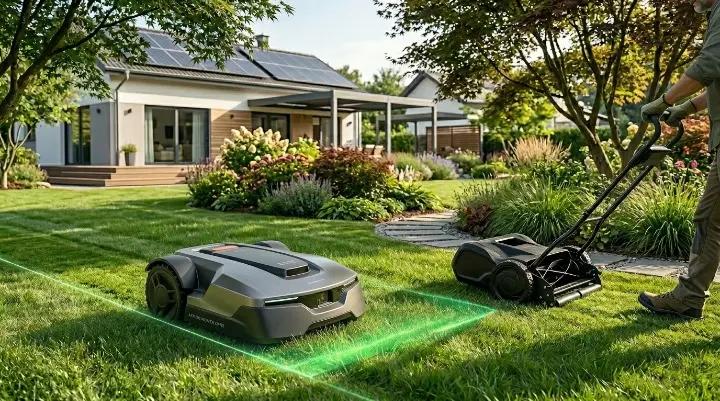

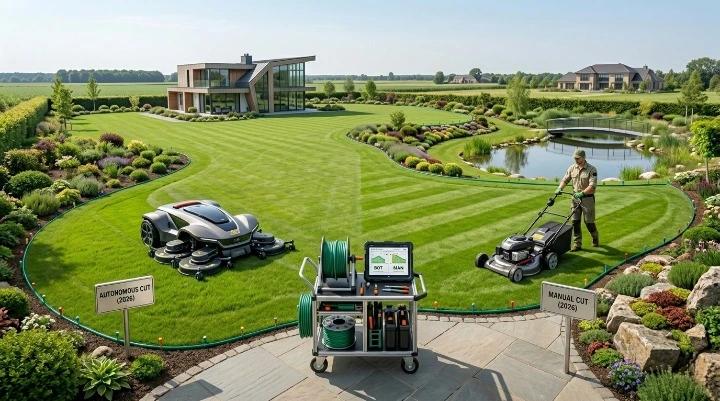
For decades, traditional lawn mowers were the only real option for homeowners. If your grass needed cutting, you either pushed a mower yourself, hired a lawn service, or invested in a riding mower.
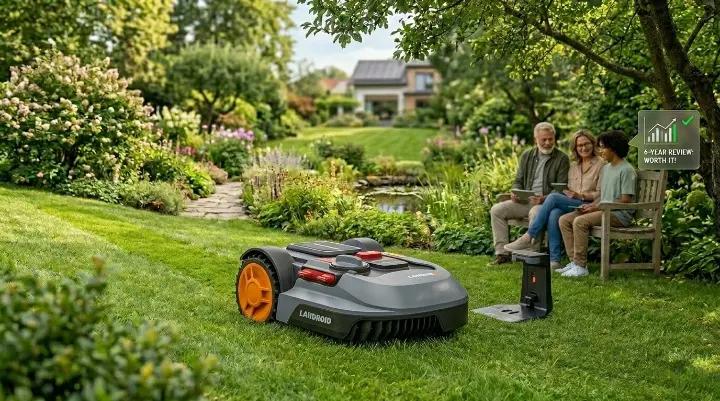
Today, robot mowers offer a different approach. Instead of mowing once a week, they work automatically throughout the week, keeping the lawn at a consistent height with little effort from the owner.
That sounds appealing, but robot mowers are also much more expensive upfront. Many homeowners wonder whether the convenience is really worth the cost.
The answer depends on more than just your budget.
The size of your lawn, the amount of free time you have, your tolerance for maintenance, and even how much you enjoy mowing can all affect which option makes more sense.
In this guide, we'll compare robot mowers and traditional mowers in the areas that matter most, including cost, time savings, lawn quality, maintenance, and long-term value. By the end, you should have a clear idea of which type of mower is the better fit for your yard.
Robot Mower vs Traditional Mower: The Quick Verdict
If you want the shortest possible answer, neither option is better for everyone.
A robot mower is usually the better choice for homeowners who want to spend less time mowing and are willing to pay more upfront for convenience.
A traditional mower is usually the better choice for homeowners who have a smaller budget, don't mind mowing, or only need to cut grass occasionally.
Here's a quick comparison.
| Situation | Better Choice |
|---|---|
| You want to spend as little money as possible upfront | Traditional Mower |
| You want to save time every week | Robot Mower |
| You enjoy mowing and yard work | Traditional Mower |
| You travel often or have a busy schedule | Robot Mower |
| You want a quieter mowing solution | Robot Mower |
| Your lawn is small and simple | Either Option |
| Your lawn is large and requires frequent mowing | Robot Mower |
| You prefer simple equipment with fewer electronics | Traditional Mower |
For many homeowners, the decision comes down to one simple question:
Would you rather save money or save time?
A traditional mower typically costs less to buy, but it requires your time every week. A robot mower costs more upfront, but it can handle most of the mowing automatically.
That's why more homeowners are starting to view robot mowers less like lawn equipment and more like a time-saving appliance. The real value isn't just cutting grass. It's getting your weekends back.
Of course, cost is only one part of the story. Lawn quality, maintenance, noise levels, and long-term ownership costs can also make a big difference.
Let's look at the five factors that matter most.
The 5 Differences That Matter Most
Both robot mowers and traditional mowers can keep a lawn looking neat. The real difference is how they do it and what you have to give up in return.
For most homeowners, the decision comes down to five key factors.
Cost
Traditional mowers win when it comes to upfront cost.
A basic push mower can cost a few hundred dollars, while even a quality self-propelled mower is often much cheaper than a robot mower. Riding mowers cost more, but many homeowners with small and medium-sized lawns never need one.
Robot mowers require a larger initial investment. Depending on the model and lawn size, prices can range from around $700 to several thousand dollars.
However, purchase price is only part of the story.
Traditional mowers require fuel, oil, air filters, spark plugs, or battery replacements over time. If you hire a lawn service, costs can add up even faster.
Robot mowers use very little electricity and typically have fewer routine maintenance tasks. For homeowners who currently pay for weekly mowing, a robot mower may eventually pay for itself.
The important question isn't which option is cheaper today. It's which option costs less over the years. We'll look at that in more detail later.
Time and Effort
This is where robot mowers have their biggest advantage.
With a traditional mower, someone has to do the work. Even a small lawn may take 30 to 60 minutes every week during the growing season. Larger properties can require several hours.
That time adds up quickly.
Many robot mower owners say the biggest benefit isn't money—it's getting their weekends back. Instead of setting aside time to mow, the mower works automatically while they focus on other things.
That doesn't mean robot mowers are completely hands-off.
You may still need to trim lawn edges, clean the mower occasionally, replace blades, or solve the occasional navigation issue. But compared to mowing manually every week, the time commitment is usually much lower.
Lawn Quality and Grass Health
Many people assume a traditional mower provides a better cut because it's larger and more powerful.
In reality, robot mowers often produce a healthier-looking lawn.
The reason is simple: they mow more frequently.
A traditional mower typically cuts a large amount of grass once every week or two. Robot mowers remove a very small amount almost every day. This creates a more consistent lawn height and reduces stress on the grass.
The tiny clippings also fall back into the lawn and break down naturally. This process, often called mulching, can help return nutrients to the soil.
Many long-term robot mower owners report that their lawns look thicker, greener, and more uniform after switching from traditional mowing.
That said, traditional mowers still have an advantage when dealing with extremely tall or overgrown grass. If your lawn regularly gets out of control, a robot mower may struggle until the grass is brought back to a manageable height.
Maintenance Requirements
Neither option is maintenance-free.
Traditional mowers require regular upkeep. Depending on the type of mower, that may include changing oil, replacing spark plugs, sharpening blades, cleaning air filters, or preparing the machine for winter storage.
Robot mowers have a different set of maintenance needs.
Most owners only need to clean the mower periodically and replace blades several times per season. However, robot mowers can occasionally require troubleshooting, especially older boundary-wire models or lawns with difficult terrain.
For some homeowners, replacing a few small blades every few months feels easier than maintaining a gas engine.
Others prefer the simplicity of a machine they can easily repair themselves.
The better choice often comes down to which type of maintenance you dislike less.
Noise and Environmental Impact
Traditional gas mowers are loud.
Anyone who has spent a summer morning listening to multiple lawn crews in the neighborhood already knows this.
Robot mowers are much quieter. Most can operate without disturbing neighbors, family members, or outdoor conversations. Some homeowners even run them early in the morning or later in the evening without issue.
Electric robot mowers also produce no direct emissions while operating.
That doesn't mean traditional mowers are automatically bad for the environment. Battery-powered push mowers have become increasingly popular and are much cleaner than older gas models.
Still, if low noise and low energy consumption are priorities, robot mowers generally have the advantage.
As you can see, neither option wins every category. Traditional mowers usually cost less upfront and handle neglected lawns better. Robot mowers save time, reduce noise, and can help maintain a consistently healthy lawn.
The next question is whether those benefits are worth the higher purchase price.
What Does Each Option Really Cost Over 5 Years?
One of the biggest mistakes homeowners make is comparing only the purchase price.
A robot mower might cost several times more than a traditional mower on day one, which makes it seem like an easy decision. But lawn equipment is something you use for years, not months.
To understand the real value, it's helpful to look at long-term ownership costs instead of upfront costs alone.
The example below represents a typical homeowner with a medium-sized lawn.
| Cost Category | Robot Mower | Traditional Mower |
|---|---|---|
| Initial Purchase | $1,500 | $500 |
| Electricity or Fuel (5 Years) | $50–$100 | $300–$600 |
| Blade Replacements & Maintenance | $150–$300 | $200–$500 |
| Estimated 5-Year Cost | $1,700–$1,900 | $1,000–$1,600 |
Based on costs alone, a traditional mower is often still the cheaper option over five years.
That's why robot mowers are not usually purchased to save money.
They're purchased to save time.
Think about a homeowner who spends two hours mowing every weekend during the growing season. Over a year, that can easily add up to 50 to 100 hours of lawn work.
Over five years, that's hundreds of hours.
For some people, mowing is enjoyable and those hours aren't considered a cost at all. For others, especially busy homeowners, those hours have real value.
This is also why homeowners who currently pay for lawn service often reach a different conclusion.
In one Reddit discussion, a homeowner estimated spending about $1,820 per year on mowing service for a one-third-acre lawn. At that rate, a robot mower could potentially pay for itself much faster than many people expect.
Of course, every situation is different.
A homeowner who already owns a working push mower may see very little financial benefit from upgrading. On the other hand, someone choosing between a new riding mower, ongoing lawn service, or a robot mower may find the price difference much smaller than it first appears.
There is another factor that rarely shows up in cost comparisons.
A robot mower cuts frequently enough that the lawn is usually maintained at the same height all season. That means there is no need to wait until Saturday morning to mow before guests arrive or before a backyard gathering.
The lawn is simply maintained in the background.
For many owners, that convenience becomes the biggest benefit of all.
When you look beyond the purchase price, the choice becomes less about dollars and more about lifestyle. The question isn't just "Which mower costs less?" It's "How much is your time worth?"
The answer will be different for every homeowner.
Why More Homeowners Are Switching to Robot Mowers
A few years ago, robot mowers were still considered a niche product.
Today, they're becoming much more common in suburban neighborhoods, and the technology has improved rapidly. Modern models can handle larger lawns, navigate more accurately, and require far less setup than many early robot mowers.
But technology alone isn't the reason more homeowners are making the switch.
The biggest reason is simple: people value their time.
For many homeowners, mowing is no longer viewed as a weekend activity they enjoy. It's just another task competing for time alongside work, family, errands, and home maintenance.
A robot mower doesn't eliminate every lawn care job, but it can remove one of the most repetitive ones.
This is especially appealing in regions where grass grows quickly during spring and summer. Instead of setting aside time every week to mow, homeowners can let the mower maintain the lawn automatically throughout the season.
Another reason is consistency.
With a traditional mower, lawns are often cut only when the owner has time. During busy weeks, grass may grow taller than intended before finally being mowed.
Robot mowers work differently.
Because they mow frequently, the lawn tends to stay at a more uniform height. Many owners prefer the appearance of a lawn that always looks maintained instead of one that alternates between overgrown and freshly cut.
The improvement in technology has also helped remove some of the barriers that kept people away in the past.
Early robot mowers often required extensive boundary-wire installation. Newer RTK, camera-based, and AI-assisted navigation systems have made setup easier for many homeowners and reduced concerns about damaged wires or complicated yard layouts.
Of course, robot mowers still aren't perfect.
Owners sometimes report navigation issues, occasional troubleshooting, or situations where the mower gets stuck on difficult terrain. Most long-term users will eventually encounter a problem that requires attention.
What has changed is that many homeowners now view those occasional issues as a worthwhile tradeoff.
One robot mower owner on Reddit summed it up well after dealing with a few springtime stuck situations on a wet lawn. Even with occasional rescues, they said the mower remained a major time saver and they would never go back to regular mowing.
That opinion appears frequently among long-term robot mower owners.
The initial setup can take time. Learning how the mower handles your yard can take time. But once everything is dialed in, many homeowners feel the convenience outweighs the extra effort required at the beginning.
Why don't more people have robot mowers, and should I get one?
View DiscussionThere is also a growing awareness factor.
Many homeowners simply didn't know robot mowers existed a few years ago. Today, social media videos, YouTube reviews, and word-of-mouth recommendations have made the technology much more visible.
In some neighborhoods, robot mowers are following a path similar to robot vacuums. At first they seemed unusual. Then people saw them working in real homes and began considering them for themselves.
That doesn't mean every homeowner should rush out and buy one.
But it does help explain why robot mowers are moving from a niche product into a mainstream lawn care option for many households.
Why Some Homeowners Still Prefer Traditional Mowers
Despite the growing popularity of robot mowers, traditional mowers aren't going away anytime soon.
In fact, for many homeowners, they are still the better choice.
The first reason is cost.
A traditional mower remains one of the most affordable ways to maintain a lawn. Many homeowners already own a mower that works perfectly well, making it difficult to justify spending thousands of dollars on a robot mower.
For someone with a small yard, the time savings may simply not be large enough to justify the investment.
Another reason is simplicity.
Traditional mowers are familiar. Most homeowners know how they work, how to maintain them, and how to troubleshoot basic problems.
There is no mapping process, no app setup, no software updates, and no GPS signal to worry about.
You start the mower, cut the grass, and you're done.
Some homeowners also prefer having complete control over the mowing process.
With a traditional mower, you decide exactly when to mow, how fast to mow, and which areas need extra attention. If part of the lawn grows faster than the rest, you can address it immediately.
A robot mower follows a schedule. While modern models are becoming increasingly intelligent, they still require homeowners to trust the machine to make many decisions on its own.
Not everyone is comfortable with that.
Lawn conditions can also influence the decision.
If your grass frequently becomes overgrown, a traditional mower may handle the situation better. Most robot mowers are designed to maintain grass regularly rather than cut down tall, neglected growth.
Homeowners with heavily wooded properties may face challenges as well.
Dense tree cover can interfere with some navigation technologies, while highly complex yards may require more setup and adjustment than a simple push mower.
There is also the enjoyment factor.
Not everyone sees mowing as a chore.
Some homeowners genuinely enjoy being outside, listening to music, getting exercise, and seeing immediate results from their work. For them, mowing can be relaxing rather than frustrating.
One Reddit user put it simply: they enjoy mowing and the satisfaction that comes from seeing a freshly cut lawn when the job is finished. A robot mower might save time, but it wouldn't provide the same sense of accomplishment.
That's an important point that cost comparisons often overlook.
Time saved only has value if mowing is something you would rather not be doing.
If you already enjoy lawn care, the equation changes.
This is why traditional mowers continue to make sense for many homeowners. They're affordable, familiar, easy to understand, and highly effective for a wide range of lawns.
The rise of robot mowers doesn't mean traditional mowers are becoming obsolete.
It simply means homeowners now have another option.
Which Type of Lawn Is Best for a Robot Mower?
Not every lawn is equally suited to a robot mower.
Modern models are far more capable than they were a few years ago, but yard size, terrain, obstacles, and layout can still affect performance.
If you're considering a robot mower, here's what tends to work best.
Small Lawns
Small lawns are often the easiest environment for a robot mower.
The mower can usually cover the entire area without needing long operating hours, and charging interruptions are less noticeable. Homeowners with smaller yards also benefit from spending less time on mowing in the first place, making the convenience factor even more appealing.
The challenge is usually cost.
For a very small lawn, a traditional mower may still be the more economical choice. The time savings exist, but they may not be significant enough for every homeowner.
Medium-Sized Lawns
This is where robot mowers often provide the best balance of cost and convenience.
A medium-sized lawn can take an hour or more to mow with a traditional mower, especially during periods of rapid growth. Over an entire season, that adds up to a considerable amount of time.
Many homeowners in this category find that a robot mower removes one of their most repetitive weekly chores while keeping the lawn consistently maintained.
If your yard is relatively open and free of major obstacles, most modern robot mowers can handle it with little difficulty.
Large Lawns
Large lawns are where time savings become most noticeable.
What might take several hours on a push mower or require an expensive riding mower can often be managed automatically by a properly sized robot mower.
That doesn't mean every robot mower is suitable for large properties.
Coverage capacity varies significantly between models. Before buying, it's important to choose a mower designed for your lawn size rather than selecting based on price alone.
Many of today's higher-end RTK and wire-free models are specifically designed for larger properties and can manage multiple zones efficiently.
Complex Lawns
A complex lawn isn't necessarily a problem, but it does require more planning.
Examples include:
- ✔Multiple mowing zones
- ✔Narrow passages
- ✔Trees and landscaping features
- ✔Garden beds
- ✔Separate lawn sections connected by paths
Most modern robot mowers can handle these situations, but setup becomes more important.
A poorly configured robot mower may struggle with navigation, miss certain areas, or spend too much time traveling between zones.
The good news is that navigation technology has improved rapidly. RTK systems, onboard cameras, and AI-assisted obstacle avoidance have made many complex lawns much easier to manage than they were in the past.
Sloped Lawns
Not all robot mowers are designed for hills.
Some entry-level models work best on relatively flat ground, while others are built specifically for steep terrain and can handle slopes that would challenge many traditional mowers.
If your property includes significant elevation changes, traction becomes one of the most important specifications to check.
In some cases, a robot mower may actually be safer and more comfortable than mowing steep sections manually.
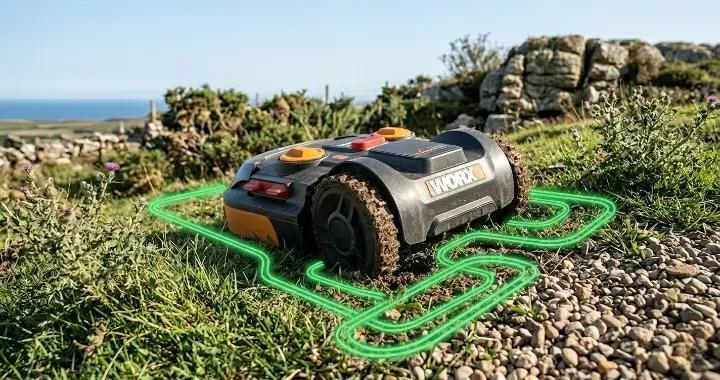
However, extremely rough ground, deep ruts, exposed roots, or frequently muddy areas can still create challenges for any autonomous mower.
The best approach is to evaluate your lawn honestly before choosing a model.
A robot mower is usually a great fit if your lawn:
- Requires regular mowing throughout the growing season
- Takes a noticeable amount of time to maintain manually
- Has a layout that modern navigation systems can reasonably manage
- Doesn't regularly become severely overgrown
The more time you currently spend mowing, the more value a robot mower tends to provide.
That's why many homeowners with medium and large lawns often see the biggest benefits after making the switch.
When a Robot Mower Is Worth the Investment
A robot mower is not the right choice for everyone, but for the right type of homeowner, it can be a very practical upgrade.
The key is not just whether you can afford one, but whether it fits how you actually live and maintain your yard.
Here are the situations where a robot mower usually makes the most sense.
You Spend Too Much Time Mowing Each Week
If mowing regularly takes a noticeable part of your weekend, a robot mower can change your routine.
This is especially true for medium and large lawns where mowing can take an hour or more each time. Over a full growing season, that becomes a significant time commitment.
For many homeowners, the main benefit is not just convenience. It is consistency. The lawn stays maintained without needing to schedule time for it.
You Want a Low-Noise Lawn Care Option
Traditional gas mowers are loud enough to affect conversations, relaxation, and even neighborhood quiet hours.
Robot mowers operate at a much lower noise level. In many cases, they can run during the day without disturbing anyone nearby.
This makes them especially useful in suburban areas where people value quiet outdoor environments.
You Prefer a Always-Maintained Lawn Look
Some homeowners care less about mowing itself and more about how the lawn looks day to day.
Because robot mowers cut small amounts of grass frequently, the lawn rarely looks overgrown. Instead of a weekly “before and after” cycle, the grass stays at a steady height throughout the season.
This creates a more uniform and consistently maintained appearance.
You Already Pay for Lawn Care Services
For homeowners who currently pay a lawn service, the comparison often changes completely.
Instead of replacing a low-cost DIY task, the robot mower is competing with an ongoing monthly or weekly expense.
In many cases, the cost of a robot mower can become more reasonable when compared to several years of professional lawn care.
This is one reason why some homeowners start calculating payback periods in months or a few seasons rather than many years.
You Want Less Physical Effort in Lawn Care
Traditional mowing requires pushing, lifting, refueling or recharging, and regular physical effort during peak growing seasons.
A robot mower reduces that workload significantly.
You still need to handle basic tasks like edge trimming and occasional maintenance, but the main mowing work is automated.
This can be especially appealing for busy homeowners or those who prefer to reduce physical yard work over time.
In general, a robot mower is worth considering if you value time savings, consistent lawn appearance, and reduced manual effort more than the lowest possible upfront cost.
It becomes less about replacing a tool and more about changing how lawn care fits into your weekly routine.
For homeowners who still enjoy mowing or only spend a small amount of time on their lawn each week, a traditional mower may still be the better fit.
The next question is the opposite side of that decision: when a traditional mower still makes more sense.
When a Traditional Mower Makes More Sense
Even though robot mowers are becoming more advanced, there are still many situations where a traditional mower is the more practical choice.
For some homeowners, it comes down to cost. For others, it is about yard conditions, simplicity, or personal preference.
Here are the most common cases where a traditional mower still makes more sense.
You Want the Lowest Upfront Cost
The most obvious reason is price.
A traditional push mower is still one of the cheapest ways to maintain a lawn. Even higher-quality self-propelled or battery-powered models are usually far less expensive than a robot mower.
If you are not looking to spend a large amount upfront, a traditional mower is the clear choice.
This is especially true if your lawn is small and does not require frequent mowing.
Your Lawn Is Small or Simple
For small, straightforward lawns, the time savings from a robot mower may not be significant enough to justify the investment.
If it only takes you 15 to 30 minutes to mow your yard, the convenience benefit becomes much smaller.
In these cases, a traditional mower is often the more efficient and cost-effective option.
You Prefer Full Control Over Lawn Care
Some homeowners simply prefer doing things themselves.
With a traditional mower, you decide exactly when to mow, how short to cut, and how to handle different areas of your lawn. There is no scheduling system or automation involved.
You are fully in control of the process from start to finish.
For people who enjoy yard work or take pride in hands-on lawn care, this control can be a meaningful advantage.
Your Yard Has Challenging Conditions
Not every lawn is ideal for automation.
Very uneven terrain, frequently muddy areas, dense obstacles, or heavily overgrown grass can still be difficult for many robot mowers.
While high-end models are improving quickly, traditional mowers are still more flexible when dealing with unpredictable conditions or occasional neglect.
If your lawn often gets overgrown or changes dramatically between mowing sessions, a traditional mower may handle those situations more reliably.
You Want a Simple, Low-Tech Solution
Traditional mowers are straightforward.
There is no app setup, no mapping, no software updates, and no connectivity issues to troubleshoot. You simply start the mower and begin cutting.
For homeowners who prefer tools that are easy to understand and maintain without learning new systems, this simplicity is a major advantage.
It also means fewer points of failure over time.
In the end, traditional mowers remain a strong choice for homeowners who value low cost, simplicity, and direct control over their lawn care.
They are not outdated. They are just optimized for a different type of user.
For many people, especially those with smaller yards or limited budgets, they still represent the most practical solution.
The final decision depends on what you value more: convenience and automation, or simplicity and cost efficiency.
Recommended Robot Mowers for Different Needs
Once you understand whether a robot mower fits your lawn, the next step is choosing the right type of model.
Not all robot mowers are built for the same job. Some are designed for small, simple lawns, while others are built for larger or more complex properties.
Below are the main categories to consider based on real-world use cases.
Best for Large Lawns: RTK or High-Capacity Models
Large lawns need more than just basic automation. They need strong navigation, longer runtime, and reliable coverage across wide areas.
RTK-based robot mowers and high-capacity models are usually the best fit here. These systems are designed to handle larger properties with more precise positioning and fewer missed sections.
They are also better suited for lawns with multiple zones or longer distances between mowing areas.
While these models are more expensive, they are often the only practical option for homeowners with large open yards who want full automation.
Best for Slopes and Tough Terrain: AWD Models
If your lawn includes hills, uneven ground, or rough patches, traction becomes a key factor.
All-wheel-drive (AWD) robot mowers are designed to handle steeper slopes and more demanding terrain than standard models.
They reduce the risk of getting stuck and can maintain more stable cutting performance on challenging ground.
These models are especially useful for properties where traditional push mowing feels physically demanding or unsafe in certain areas.
Best Budget-Friendly Option: Entry-Level Robot Mowers
For smaller or simpler lawns, entry-level robot mowers can offer a good balance between price and automation.
These models usually have lower coverage limits and simpler navigation systems, but they still provide the core benefit of automated mowing.
They are best suited for flat, open yards without too many obstacles.
While they may not include advanced features like RTK positioning or AI obstacle detection, they can still significantly reduce manual mowing time.
Across all categories, the most important factor is matching the mower to your lawn, not just choosing the most expensive or most advanced model.
A well-matched robot mower can run quietly in the background and keep your lawn consistently maintained with minimal input.
A poorly matched one, however, can lead to frustration and frequent manual intervention.
That is why understanding your lawn type first is more important than choosing a brand.
The final step is bringing everything together and deciding which option truly fits your situation.
Final Verdict: Robot Mower vs Traditional Mower
There is no universal winner in this comparison.
Robot mowers and traditional mowers are built for different types of homeowners and different lifestyles.
A robot mower is the better choice if you value time savings, consistent lawn appearance, and low-effort maintenance. It works especially well for medium to large lawns where mowing takes a noticeable amount of time each week. Over a full season, the biggest benefit is not just convenience, but removing a recurring chore from your routine.
A traditional mower is the better choice if you want the lowest upfront cost, prefer simple tools, or enjoy hands-on lawn care. It is also more flexible for lawns that are small, frequently overgrown, or difficult to automate.
The real decision is not about which mower is objectively better. It is about which tradeoff you are more comfortable with.
One option saves money upfront. The other saves time over the long term.
For many homeowners, that single difference is what determines the final choice.